
WITH HYBRID AND ELECTRIC CARS sparking a revolution on land, cruise lines around the world are riding a green wave at sea. From diesel engines to single-use plastic straws, the industry is adopting measures to reduce pollution and combat climate change.
As ships adopt cleaner technologies, passengers are becoming more directly involved in sustainability efforts. Most major cruise lines now employ environmental officers to ensure greener practices are embraced from bow to stern. One obvious target is single-use plastics: straws, stirrers and disposable drink containers are rapidly being phased out. Crystal Cruises has replaced plastic straws and stirrers with bamboo and metal alternatives, while Holland America Line and Carnival Cruises now provide plastic straws only upon request. Norwegian Cruise Line and Regent Seven Seas Cruises have pledged to eliminate non-reusable plastic water bottles entirely, and Disney Cruise Line plans to cut plastics in staterooms by 80 percent by switching to refillable in-room amenities.
Alongside reducing plastic waste, cruise lines are working to curb emissions. Shore-power connections are increasingly standard on new builds and retrofits; these allow ships to turn off their engines while in port and plug into cleaner land-based electricity. Many modern vessels also use exhaust gas cleaning systems—commonly called scrubbers—to remove sulfur compounds and particulates from engine exhaust. Royal Caribbean, Azamara and Celebrity Cruises report emissions reductions of about 20 percent on some of their newest ships after installing such systems.
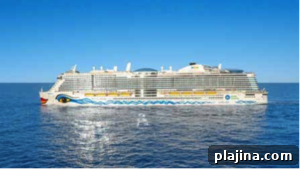
PHOTO © AIDA CRUISES
Fuel innovation is another major focus. The cruise industry is investing roughly $8 billion in alternative propellants, with liquefied natural gas (LNG) emerging as the most widely adopted cleaner fossil fuel. AIDA Cruises introduced AIDAnova, the world’s first passenger ship powered exclusively by low-emission LNG. Many other lines are commissioning or planning LNG-powered ships to lower greenhouse-gas output.
Some companies are also offsetting emissions. Beginning in 2020, MSC Cruises committed to becoming the first large cruise line to operate carbon-neutrally across its 17-ship fleet by purchasing carbon offsets. Those investments support projects such as tree planting, wetland restoration, and kelp and algae farms that absorb carbon dioxide.
Longer-term change may come from hybrid propulsion and battery systems that reduce dependence on fossil fuels. Ponant’s Le Commandant Charcot, described as the world’s first luxury polar vessel powered by LNG and electric batteries, exemplifies this trend. Paul Gauguin Cruises, now part of Ponant, will add two 230-passenger ships to its French Polynesia fleet with extensive battery packages to enable smokeless operation at anchor, in ports and in environmentally sensitive areas. AIDA Cruises plans to trial fuel cells on passenger ships, a technology that could further lower emissions and noise.
Where older passenger liners once emitted visibly and audibly, the future points toward quieter, cleaner vessels. Holland America Line even prints many onboard materials with soy-based ink. With commitments to phase out single-use plastics and reduce carbon output, the cruise industry appears set on a course toward more sustainable operations and, eventually, a generation of hybrid or all-electric ships.
WHO’S THE GREENEST OF THEM ALL?
Competition is fierce among cruise lines striving to claim the greenest credentials, making it difficult to name a single leader. Hurtigruten, an expedition operator expanding into the North American market, makes a persuasive case. CEO Daniel Skjeldam has stated the company’s aim to be “the greenest cruise line in the world.”
Hurtigruten was among the first to ban single-use plastics—removing items such as straws, cups, bags, cutlery and single-portion butter. Its most significant shift came with the launch of MS Roald Amundsen, the first hybrid electric-powered passenger ship, which began sailing in Alaska. This 530-passenger vessel can operate silently for nearly an hour at full cruising speed and for extended periods at low speed on battery power alone, cutting harmful emissions by up to 20 percent.
Hurtigruten’s second hybrid, MS Fridtjof Nansen, entered service with Antarctic itineraries, and a larger third hybrid was scheduled to follow. The company is also retrofitting older expedition ships to use a mix of large batteries, LNG and biogas—a renewable fuel produced from organic waste, including fish processing byproducts—further reducing reliance on diesel.
As technology and policy continue to drive change, cruise lines are increasingly integrating cleaner fuels, shore power, advanced emissions controls and battery systems. Together these steps are steering the industry toward a more sustainable future without sacrificing the onboard experience passengers expect.