
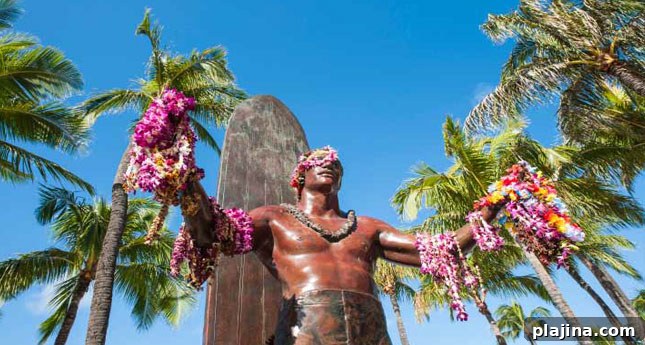
Often called “The Gathering Place,” Honolulu, the capital of Oahu, truly lives up to its nickname. Visitors are welcomed on Waikīkī Beach by the bronze, lei-covered statue of Duke Paoa Kahanamoku, widely celebrated as the “Father of International Surfing.” With roughly 5 million visitors a year, Honolulu houses nearly a third of Hawaii’s population and blends Eastern and Western influences rooted in Native Hawaiian traditions and values.
Honolulu has been the political and cultural center of the Hawaiian Islands since King Kamehameha I united the islands in 1810. Queen Liliuokalani, Hawaii’s last reigning monarch, ruled until 1893, and the islands later became the 50th U.S. state in 1959. Today the Hawaiian State Capitol stands just behind Iolani Palace in downtown Honolulu, symbolizing the continuity of the islands’ history.
Waikīkī is the city’s focal point. Its sweeping arc of white sand, more than 30,000 hotel rooms and the 1.1 million-square-foot Hawai’i Convention Center welcome both business and leisure travelers. To accommodate and sustain growing visitor demand, Honolulu and state planners launched a series of major infrastructure projects.
“The upcoming hotel renovations and improvements in Waikīkī are an investment in the long-term sustainability and growth of Hawai’i’s tourism economy. It’s important that we continually refresh, improve and upgrade our product to remain a competitive destination,” says Mike McCartney, president and CEO of the Hawai’i Tourism Authority. He notes that these upgrades will enhance Waikīkī, provide construction jobs and stimulate the state economy.
One of the city’s earliest large-scale efforts was the 2012 beach restoration, when contractors pumped 24,000 cubic yards of offshore sand to widen Waikīkī’s shoreline by more than 37 feet. In early 2013, work began on a 12-year, $2.3 billion modernization of Honolulu International Airport, aimed at upgrading terminals, runways, security and supporting infrastructure to handle projected future growth.
Waikīkī Beach © Chrishowey | Dreamstime.com
Following these improvements, air service expanded: Allegiant Airlines launched twice-weekly flights between Los Angeles and Honolulu, and Hawaiian Airlines began three weekly non-stop flights from Beijing to Honolulu—its first Mainland China route—while increasing service from Brisbane. These additions were expected to add more than 25,000 seats to Honolulu routes in 2014.
With visitor numbers rising and an average stay of about seven days, hotel renovations and new properties have been underway. In December 2013 Hilton opened the 143-room Hokulani Waikiki, aimed at sophisticated travelers who want to be at the center of Waikīkī’s energy, according to Bryan Klum, executive vice president of Hilton Grand Vacations–Asia Pacific. David Carey, president and CEO of Outrigger Enterprises Group, described the Hokulani as a fitting complement to the Outrigger-led Waikīkī Beach Walk development, a stylish gathering place for residents and visitors.
The Hokulani joined other recent openings such as the 125-room Vive Hotel Waikiki and the 135-room Shoreline Hotel Waikiki. In August 2013, developer PACREP LLC broke ground on the 309-unit Ritz-Carlton Residences, Waikiki Beach, a luxury hotel-condominium project scheduled for completion in early 2016.
These investments have spurred culinary and nightlife growth across Waikīkī. New venues include the 3,600-square-foot Park Restaurant and a major redevelopment of the iconic International Market Place. Reimagined as a three-level, more upscale destination in the heart of Waikīkī, the new Market Place will feature about 390,000 square feet of retail, dining and entertainment space with seven restaurants and roughly 60 shops; the $300 million project was slated to open in 2015. City planners also predicted that Honolulu’s signature street festival, the Waikīkī Spam Jam, would attract a roughly 15 percent increase in visitors in 2014.
Longtime Honolulu resident and actor James MacArthur, known for his role as Danno in the original Hawaii Five-0 series, captured the city’s appeal when he said, “Beating the drums for Hawai’i is not hard to do … the place just grows on you.” As Honolulu continues to develop its reputation as a gathering place, it is likely to win over even more visitors.
SCENIC DRIVES
One of Oahu’s signature landmarks is Diamond Head. According to legend, Hi’iaka, sister of the fire goddess Pele, named the mountain Le’ahi because its summit resembles the forehead of an ahi fish. Western explorers later called it Diamond Head in the late 1700s after mistaking calcite crystals in the crater rock for diamonds. The nearly one-mile hike to the summit is a popular activity for spectacular sunrise views over Waikīkī. From Waikīkī, it is about a one-hour drive east along Kalākaua Avenue to Park and Kapahulu avenues, which lead to the crater park.
For a scenic day trip, take the Pali Highway from Honolulu and continue on the Kahekili Highway to the Byodo-In Temple at the Valley of the Temples near Haiku Village. Built in 1968 to commemorate the 100th anniversary of the first Japanese immigrants to Hawaii, the temple is a smaller replica of the historic Byōdō-in Temple in Uji, Japan. The serene temple and its surrounding valley have appeared in episodes of both the original and the modern Hawaii Five-0 television series. Return to Honolulu via the Kalanianaole Highway and stop for a refreshing swim at Kaupo Beach Park, which offers striking views of the Makapu’u Point lighthouse.