
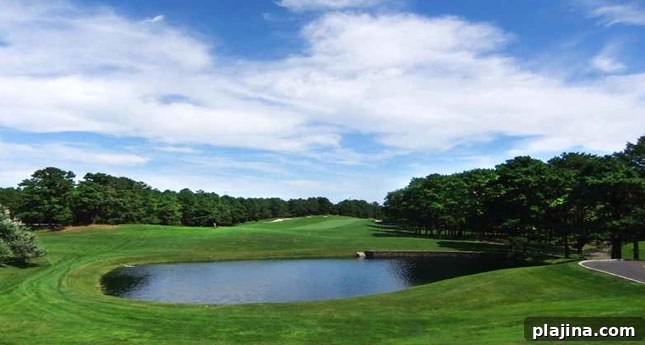
Built in 1965, Hampton Hills Country Club is a quiet hideaway in the Hamptons. Playing the course feels remote; the stillness across the fairways is remarkable and creates a peaceful golf experience.
Stanley Pine, the general manager and financial architect behind the club’s modern era, helped acquire the property after it was auctioned in 1986. Originally owned by the New York Teamsters and designed by Francis J. Duane, the course was purchased by Pine and his partner Barry Beil “as is.” Their bid of $8.5 million required no zoning changes and set the stage for a different vision for the land. Ultimately their plan included selling 1,200 acres to The Nature Conservancy and Suffolk County for $17.7 million, a transaction that preserved open space and stabilized the club’s future.
Renovation work by Fry/Straka Global Golf Course Design respected Duane’s original routing while improving playability and aesthetics. Bunkers were repaired and added, and brush beneath the trees was cleared so errant shots could be played out rather than lost. The result is a course that retains its classic bones while offering renewed strategic interest.
Spread across 209 acres with notable elevation changes, Hampton Hills provides varied and scenic golf. Pine describes it as a “resort-friendly beach course,” an apt label that emphasizes a welcoming atmosphere over elitism. The staff, management and dining team reinforce that approachable, friendly vibe—members and visitors alike tend to find the service warm and inviting.
I visited for a long weekend as a guest of a friend who recently bought a home on Shelter Island. With good company—Jimmy Spratt, John Ecklund and Bobby Hancock—we enjoyed fine dinners and a bright summer day on the course. Below are highlights from several holes that stood out during our round.
Hole 1 | 385 yards, par 4
The first hole starts with a helpful starter who points out trouble to the right where drives often bounce into the woods. The tee shot rewards a controlled fade; a slice or a hook can leave you searching. The green is relatively flat but guarded by three bunkers, so an accurate approach is essential. After a conservative recovery from the trees, I reached the green but the group made no stellar start to the round.
Hole 7 | 408 yards, par 4
One of the course’s prettier holes, No. 7 features a pond along the right side of the fairway that catches long tee shots. My tee ball flirted with the water before settling just short of the hazard, leaving an inviting angle to attack the green. The flag sat high on the left and, after a delicate lag, I tapped in for par along with two playing partners.
Hole 8 | 175 yards, par 3
An elevated green and bunkers left and right make this par 3 play longer than the yardage suggests. My tee shot looked ideal but came up half a foot short of the front edge. The rest of the group missed as well, prompting a lighthearted “fun ball” and a re-tee. Playing the original shot, I saved par and moved on.
Hole 9 | 423 yards, par 4
No. 9 is rated the toughest hole on the card. Dense trees flank the fairway, leaving little room for error; accuracy off the tee is rewarded while stray drives are punished. One player kept it down the left and advanced to a wedge into the green, then executed a smart sand shot and a single putt for par. Those who wandered into the woods on either side faced tricky recoveries.
Hole 11 © Francis X. Gallagher
Hole 11 | 524 yards, par 5
Long and strategic, No. 11 plays as a slight dogleg right with fairway bunkers left to catch over-aggressive tee shots. A left-sloping fairway brings the green back into play, and length is required to get home in two. Our group struggled here, carding higher scores that reflect the hole’s challenge. After a modest drive I hit a solid 3-wood to reach 100 yards, but a poor chip and two-putt left me with a bogey.
Hole 16 | 177 yards, par 3
Another elevated par 3, No. 16 demands club selection and respect for the contours. The green is protected by three bunkers—one on each side and one in the back—so it’s wise to take more club than distance alone indicates and allow for the elevation.
Hole 18 | 517 yards, par 5
The finishing hole is a satisfying test. A dogleg right that climbs toward the green, it requires a thoughtful tee shot and a strong second to set up an approach. The green complex is well defended by four frontal bunkers and another to the left, so missing the short grass can make par hard to reach. One player drove boldly over the right tree line and routed the ball back to the fairway, showcasing the reward for creative, confident shots.
Hampton Hills Country Club
County Road 31
(Exit 63N, off Rt. 27)
Westhampton Beach, NY 11978
tel 631 727 6862
hamptonhills.com