
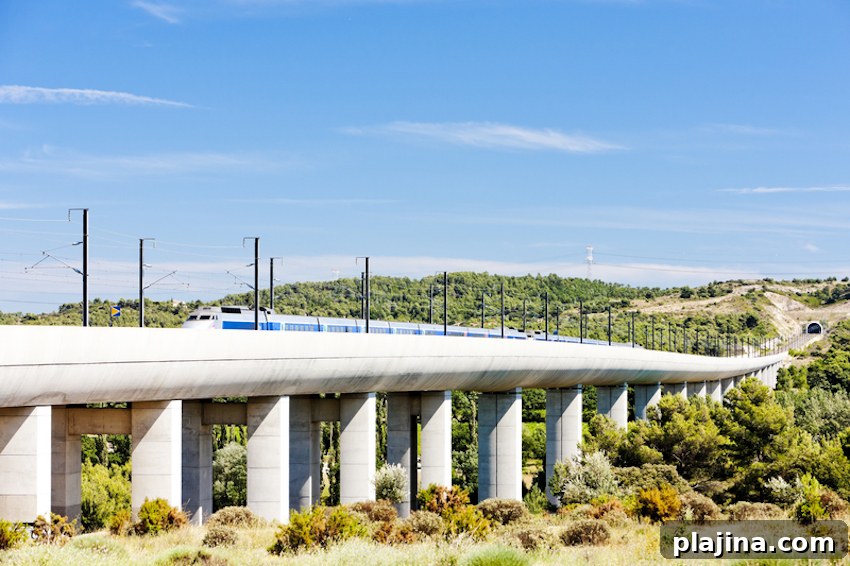
By 2023, France will introduce five upgraded high-speed rail corridors as part of a major government investment in transport infrastructure. These routes are not entirely new lines but rather existing connections that will be modernized with faster trains, improved signaling, and refurbished stations to shorten journey times and enhance passenger comfort.
One of the upgraded links connects Bordeaux and Toulouse. Where the trip once could exceed four hours, the high-speed upgrades will reduce travel time to about three hours. Both Bordeaux and Toulouse stations will receive renovations to handle increased traffic and offer better services to travelers.
Along the Mediterranean coast, the Côte d’Azur corridor between Marseille and Nice will see faster service, cutting journey times to roughly three hours. In addition, a revitalized line between Montpellier and Perpignan—close to the Spanish border—will strengthen regional connections along the southern coastline and support cross-border travel and economic ties.
Further north, improvements will shorten travel between Paris and the port city of Le Havre in Normandy, delivering a quicker alternative to the current 2.5-hour trip. These upgrades aim to make rail travel more competitive with road and air options for regional journeys.
Passengers arriving at Paris Charles de Gaulle Airport will also benefit from enhanced high-speed links to the Picardy region, improving access to towns such as Chantilly, Clermont, and Compiègne. Faster connections between the airport and nearby regions will simplify transfers and expand the airport’s effective catchment area for both visitors and commuters.
Overall, the modernization program focuses on higher speeds, greater frequency, and better station facilities, while prioritizing reliability and passenger experience. By upgrading signaling systems, rolling stock, and station infrastructure, these projects are designed to reduce travel times, encourage rail use over short-haul flights and car journeys, and support regional economic development.
While the routes themselves build on existing corridors, the coordinated improvements in equipment and infrastructure represent a significant step toward a faster, more efficient national rail network. Travelers can expect smoother journeys, upgraded onboard amenities, and more convenient connections at key hubs, making rail an increasingly attractive option for both regional and intercity trips across France.