
WHIRLING WOMEN IN LONG, FLARED skirts in an absolute riot of colors, patterns and jewelry, and men clad in pajama-style pants and short tunics dance ever faster, whipped into an ecstatic frenzy by rhythmic drums and songs: the Navratri dance festival in Gujarat is a flamboyant spectacle you’ll never forget.
Sandwiched between Rajasthan and Maharashtra, India’s westernmost state is rich in cultural heritage, ancient crafts and independence movement history, yet it is often overlooked on tourist itineraries. Gujarat is one of India’s most ethnically diverse states, home to Hindus, Muslims, Jains and Parsis. It includes the Kutch region, an off-the-beaten-track area known for its craft villages, high-quality handicrafts made by ethnic minorities and a surreal-looking white plain that becomes marshland in the monsoon. Kutch also contains the birthplace of Mohandas Gandhi and the headquarters from which he led India’s struggle for freedom, as well as Ahmedabad, India’s first UNESCO World Heritage City. Ahmedabad’s old town features 15th- to 17th-century buildings that blend Hindu and Muslim architectural styles. Elsewhere in the state are two former Portuguese colonies and Asia’s last surviving Asiatic lions.
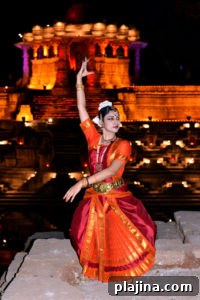
Modhera Dance Festival PHOTO: © PRASHANT VAIDYA – DREAMSTIME.COM
Gujarat is unique in celebrating Navratri, a major Hindu festival honoring the goddess Shakti, for nine consecutive nights in cities and villages across the state. People of many faiths join the festivities, which honor different manifestations of the goddess each night—Lakshmi, the goddess of prosperity; Saraswati, the goddess of wisdom and the arts; and Durga, the warrior goddess who defeated a demon. The garba dance features circular arm and foot movements as participants circle a shrine to Shakti or a lamp. Dandiya raas, another popular dance, pairs men and women who rhythmically strike painted bamboo sticks together.
The Rann Utsav festival offers a chance to experience Kutch’s culture and traditions and to admire its crafts, especially textiles in a dazzling range of patterns, styles and techniques. Held from late October through late February, the festival begins and ends in Bhuj, Kutch’s capital, and includes music, dance and guided tours of highlights around northwest Gujarat organized by the state tourism board. Accommodation ranges from colorful, decorated tents with attached bathrooms and porches to mud huts near the White Rann salt plain. Many camps add modern comforts such as heating and air conditioning.
“Tourists can join the festival at any time, but the best time is during the full moon, when the moonlight makes the white plains shimmer,” says Sanjay Choudhary of Services International Ltd., a Delhi-based tour operator that arranges multiday cultural and festival itineraries to Gujarat. Tented camps and thatch-roofed mud huts, known locally as bhungas, offer an immersive local experience and span a wide range of comfort levels—from luxury two-bedroom units to modest one-bedroom options. Resorts like Rann Riders in Dasada provide authentic bhunga stays furnished with local crafts and furniture.
Textiles are a defining strength of Kutch. “India is rich in textiles, and Kutch has historically been one of the richest regions for handmade textiles in the country. Artisans practice styles as distinctive as fingerprints, passed down through ancient traditions,” says Judy Frater, founding director of Somaiya Kala Vidya, a school that preserves traditional crafts and runs open-studio tours to meet artisan graduates in Bhujodi and Ajrakhpur. Frater, who has lived in Kutch for decades, authored Threads of Identity, a study of local textile traditions.
Ajrakh block printing uses wooden blocks to stamp intricate geometric and floral motifs onto fabric treated with resist paste and then repeatedly dyed in natural colors such as indigo, pomegranate rind and madder. The term ajrakh traces to an Arabic word for blue, reflecting indigo’s prominence in the palette. Bandhani is a tie-dye technique used for saris and turbans: fabric is finely pinched and tied into thousands of tiny knots before dyeing to produce distinctive dotted patterns.
Nirona village is renowned for rogan printing, a rare technique in which artisans draw ornate, glossy motifs—often trees of life, flowers or peacocks—on silk or cotton using a viscous pigment made from natural dyes and oil. After freehand painting, they sometimes enhance the fabric with metal block stamping. Historically practiced by one Muslim family, rogan was virtually unknown elsewhere until recent efforts expanded training to local women. Its craftsmanship gained national attention when a rogan textile was presented as a diplomatic gift in 2014.
Other local crafts include detailed embroidery embellished with beads and tiny mirrors, appliqué work with Persian and Mughal influences, weaving in wool, silk and cotton, and lacquerwork applied to wooden jewelry boxes and household utensils. Each craft tradition contributes to Gujarat’s vibrant material culture and supports village economies.
The Tarnetar Fair is a lively marriage market for ethnic communities, featuring folk dances, music, magic shows and a dazzling array of costumes. Men display heavily embroidered, beaded and patchworked umbrellas—sometimes topped with ornamental peacocks—to attract potential brides, while eligible women often wear red skirts. Held in August or September on the grounds of the Trineteshwar Temple, about 35 miles from Rajkot, the multiday fair is noted for high matchmaking success.
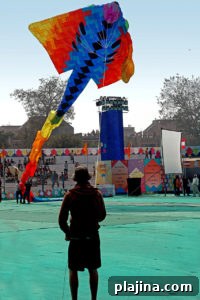
International
Kite Festival PHOTO: © PRASHANT VAIDYA
– DREAMSTIME.COM
In January, the International Kite Festival, known locally as Uttarayan, fills the skies with thousands of kites flown from dawn into the night. Participants compete to bring down rival kites using glass-coated string, while families gather on rooftops to enjoy the spectacle. Ahmedabad’s kite bazaars, which spring up each November in the old walled city, supply makers and fliers year-round. Since 1989 the city has hosted international kite competitions featuring entries from across Asia, Europe and North America.
The Modhera Dance Festival, a three-day event each January, showcases classical dance at the Sun Temple in Modhera. This partly ruined 11th-century temple is famed for its elaborate carvings depicting scenes from Hindu epics and for its architectural alignment that lets the dawn sun illuminate the sun god’s image during equinoxes. Modhera lies about 60 miles northwest of Ahmedabad and offers a striking setting for performances of India’s classical dance forms.
Experience Gujarat with gusto—attend a festival, meet artisans, and witness the state’s colorful traditions and crafts firsthand.
INFO TO GO
The Ahmedabad airport, Sardar Vallabhbhai Patel International Airport, is located about five miles north in Hansol. Major international carriers operate flights to Ahmedabad with one-stop connections via Mumbai or Delhi from cities such as New York, Chicago and Washington, D.C. Ahmedabad is a short domestic flight from Mumbai or Delhi and offers rail connections to Bhuj, including an overnight train. A luxury tourist train, the Royal Orient, links Gujarat and Rajasthan and operates to and from Delhi.