
“Do you think there’s actually a landing strip down there?” my seatmate asked as the small plane began its descent. It was a fair question: all we could see from the window was ocean meeting dense jungle. Still, the pilot found it. We bounced down a rough runway and pulled up in front of a weathered building that served as Bahía Solano’s tiny airport terminal.
There was no hurry in this remote outpost on Colombia’s Pacific coast. We waited at the terminal for about an hour before a few basic four-wheel-drive Toyotas rolled up. The vehicles had clearly endured worse roads and were about to face more. For roughly nine miles we jostled over deep ruts and splashed through rain-filled potholes, balancing precariously on narrow wooden bench seats. Eventually we reached the beach and drove across the sand to our base for the next four days: El Almejal, an ecolodge squeezed between the sea and the rainforest.
“The adventure of arriving,” our host César Vásquez called it. After settling in, we gathered in the main communal building — a large, open-sided wooden structure that combined living area, dining room and kitchen. Vásquez, who has run El Almejal with his mother for more than 25 years, explained the lodge’s philosophy and programs. He is deeply committed to ecology and sustainable tourism and focuses on teaching guests about local flora and fauna. From the lodge you can join guided whale-watching trips, rainforest hikes, nature walks and visits to waterfalls.
The staff carried our bags to simple wooden cottages set among the greenery. These were comfortable but unpretentious accommodations — true ecolodge-style rooms rather than luxury suites. Each cottage had a proper bathroom, a cozy bed, a porch hammock and mosquito nets — a helpful reminder that paradise often includes small inconveniences like insects.
Security is discreet but present. Given Colombia’s history, there is a military presence: young soldiers in camouflage carrying large rifles patrolled the property and accompanied our rainforest hikes. They remained unobtrusive, but their presence was reassuring.
After a long day of travel and a bit of jet lag, I relaxed with a local Poker beer in the communal area before dinner. Meals at El Almejal are straightforward and flavorful, typically featuring fish from local fishermen and produce, some grown in the lodge’s own garden. At night, the sound of waves and the rainforest’s chorus becomes a memorable soundtrack, more soothing than any lullaby.
Between June and October, humpback whales migrate to warm Pacific waters to give birth and nurse calves, and this coastline is one of their seasonal haunts. Eager to witness them, we boarded the lodge’s outboard boats the next morning. We skimmed across deep-blue water while our guide scanned the horizon. Just when it seemed the whales might remain elusive, he spotted activity and directed the driver. Soon we were watching fins, backs and tails break the surface. Being in small boats allowed us to get surprisingly close and experience these enormous mammals at sea level.
That evening I participated in a turtle release. To protect eggs from dogs and other threats, Vásquez created a protected nesting area on the property. When hatchlings emerge, staff place them in tubs of water and carry them down to the beach for release. Watching tiny turtles orient toward the sea and disappear into the Pacific was a touching, hopeful sight.
The following days offered a mix of hiking, kayaking, swimming, more whale watching and a visit to the nearby town. I ate fresh fish, napped in a hammock and slowly unwound. When it was time to continue down the coast to El Cantil ecolodge, I chose to make the entire trip by boat rather than flying into Nuquí and taking a short ride.
At first the boat plan seemed appealing, but a morning of driving rain and dark skies turned it into a test of endurance. Clad in rain gear, I climbed into an outboard for what was scheduled as a two-hour ride. Rough seas and hard bench seats stretched the trip to three and a half hours. I was relieved when we finally arrived.
Nana and Guillermo Gómez, owners of El Cantil, greeted me with steaming hot chocolate. Even in the gray weather their red-roofed wooden cottages tucked into the hillside looked inviting. Each porch had a hammock and direct ocean views, framed by rainforest behind the lodge.
By afternoon the skies cleared enough for a hike to a nearby waterfall. The following morning we visited a natural thermal pool. The cement basin that met the river emitted a sulfurous scent before we saw the steam rising from the warm water. We soaked in the toasty bath, then cooled off with a brisk dip in the river. Local guides even used sulfur-infused mud for facial treatments. Refreshed, we spent the afternoon whale watching from the coast.
The Gomezes proved gracious hosts, and their strong English was welcome for those of us with limited Spanish. Activities at El Cantil ranged from scuba diving and surfing to easy hammock-time with a book. On my final day I joined an “extreme” five-hour hike in search of poisonous tree frogs — a challenging but rewarding outing.
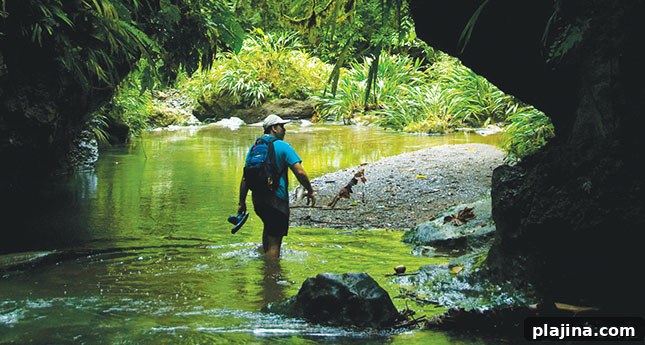
Armed with stout walking sticks, we plunged into thick rainforest bordering the cottages. The trail was wet, muddy, slippery and steep. Within minutes the humidity and exertion had soaked us. After more than two hours of hard trekking we reached the frogs’ habitat. Guillermo proved adept at spotting the tiny red-and-black tree frogs perched in the foliage. They were far smaller than I expected, delicate and vividly colored. With the sighting accomplished, we faced the long, exhausting return to the lodge. My knees protested the descent, and I joked that a sedan chair would have been worth any price. Though grueling, the hike was a fitting finale to an unforgettable trip.
INFO TO GO
El Almejal Rainforest Beach Lodge and El Cantil Ecolodge operate year-round and offer basic packages that include transfers, lodging and three meals daily, along with specialty packages featuring additional activities.
Medellín is the closest major city to Colombia’s Pacific coast. Travelers generally fly into José María Córdova International Airport (MDE) and transfer to Olaya Herrera Domestic Airport (EOH) for flights to the coast. El Almejal is served via Bahía Solano Airport (BSC), while El Cantil is reached through Nuquí Airport (NQU).