
The golden edge of light peeking through a groggy layer of fog was a clear sign I needed to secure a sunrise spot quickly. I joined a steady stream of early-rising visitors making the steep climb up the five-tiered Shwesandaw Pagoda to catch the first view over Bagan.
Bagan is Myanmar’s cultural heart, an expansive plain on the eastern bank of the Irrawaddy River dotted with thousands of Buddhist monuments. The Bagan Archaeological Zone, inscribed as a UNESCO World Heritage site in 2019, records 3,595 monuments, including stupas, temples, murals, sculptures and other structures central to Buddhist practice.
As the mist lifted, the silhouettes of countless pagodas emerged across the plain, punctuated by the slow drift of hot-air balloons. Most of Bagan’s temples and ruins date from the 11th to 13th centuries, the peak of the Kingdom of Bagan. Today, balloons remain the safest and most popular way to experience the area’s mystical sunrises and sunsets, particularly since safety rules now restrict climbing many temples.
Shwesandaw Pagoda, rising prominently to about 328 feet, was constructed in 1057 by King Anawratha in the Mon architectural style. Its bell-shaped stupa crowns a white-painted, symmetrical structure of five receding terraces. The pagoda is traditionally believed to enshrine sacred hairs of the Buddha.
Like many structures in Bagan, Shwesandaw sustained heavy damage in the 1975 earthquake, and later quakes—including a 6.8-magnitude tremor in 2016—affected nearly 200 temples. Despite this, Bagan remains an extraordinary destination. Some sites stand in ruin, while others were repaired during restoration efforts in the 1990s, making even a short visit a challenge if you want to absorb a fraction of the area’s heritage.
The Bagan Archaeological Zone includes the temple clusters and four main settlements: Nyaung-U, Old Bagan, Myinkaba and New Bagan. The Bagan Archaeological Museum in Old Bagan is an excellent starting point for orientation, showcasing original relics and artworks that illustrate the city’s religious and architectural history.
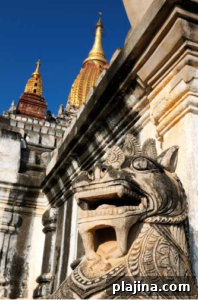
PHOTO: © RAFAÅł CICHAWA | DREAMSTIME
Old Bagan contains many of the most important and visually striking monuments. Ananda Pagoda, built in 1090 and among the best-preserved of Bagan’s pagodas, is considered one of the holiest. Its four large Buddha statues face the cardinal directions, and the interior displays frescoes that trace the Buddha’s life from birth to death, embodying teachings and spiritual wisdom.
I timed my visit to coincide with the Ananda Pagoda Festival, a week-long celebration held in the month of Pyahto (roughly December–January). Devotees gather to worship and support the local community; many arrive by traditional bullock cart and some camp for the entire week. During the festival, around 1,000 monks chant scriptures continuously for 72 hours. On the day I visited, the temple grounds brimmed with monks in burgundy robes and vendors selling food and local crafts, from sand paintings to small statues.
While Ananda bustled with worshippers and tourists, the nearby Thatbyinnyu Temple—the tallest structure in Bagan at about 201 feet—felt hushed and almost empty. Its grand facade and spacious interior corridors give it the atmosphere of a medieval citadel.
Dhammayangyi Temple, the largest in Bagan, was built between 1167 and 1170 by King Narathu. Its history carries darker legends: accounts say the king murdered close relatives and imposed brutal standards on the masons who built the temple. The temple’s dense brickwork and somber presence reflect that troubled past.
Shwezigon Pagoda, near Nyaung-U, is another key site revered for its sacred relics. Legend says a white elephant selected the site while carrying a tooth relic of the Buddha, and the pagoda is held in high esteem for housing important remains.
Sulamani Temple, whose name means “small ruby,” sits in the Minnanthu area southeast of Old Bagan. The temple’s base and terraces display more than 500 plaques depicting the Buddha’s life and path to enlightenment. Its corridors are lined with frescoes and murals from various periods that illustrate scenes from the Buddha’s life.
Htilominlo Temple, built later and similarly grand, features colorful frescoes and murals as well, although time has faded many of the details. Both Sulamani and Htilominlo highlight the artistic dedication that flourished in Bagan across centuries.
For my final sunset, I slipped away from the main tourist trails to Gubyaukgyi Temple in Myinkaba Village. Built in 1113, this cave temple offered a quieter, more contemplative setting—a peaceful close to a visit in this majestic historic landscape.
INFO TO GO
Regional airlines such as Yangon Airways and Golden Myanmar Airlines operate flights from Yangon or Mandalay to Nyaung U Airport. Flight time from Yangon is about 1 hour 20 minutes, and from Mandalay around 25 minutes. A taxi from the airport to Nyaung-U town center takes roughly 10 minutes and about 20 minutes to Old or New Bagan. Alternatives include bus services from Yangon or Mandalay and riverboat trips from Mandalay.
Getting around the expansive archaeological zone can be done by private car, taxi, horse cart or bicycle. In the hot, dusty climate, regular bicycles often prove more reliable than e-bikes, which can be affected by dust. Hot-air balloon rides are a highlight—especially at sunrise—and sunset cruises on the Irrawaddy River provide another memorable perspective on the area.
EDITOR’S NOTE:
Before planning travel to Myanmar, check current travel advisories from your government or relevant authorities to ensure you have the latest safety and entry information.