
Photo: Michael DeFreitas
After tying up to the mooring at Ribbon Reef 10, commonly known as Cod Hole, we geared up and entered the water for our first dive. We followed the mooring line down to about 80 feet and swam northeast along a series of long, narrow coral ridges locals call the “Supermarket Aisles.” A curious five-foot Napoleon wrasse glided by and shadowed us for much of the dive.
We enjoyed searching the gorgonian fans for pygmy seahorses and watching clownfish dart in and out of giant anemones. Beneath coral overhangs, sweetlips and resting green sea turtles swayed gently in the current.
We ascended gradually along one of the aisles until it opened into a shallow, sandy lagoon around 40 feet deep known as Cod Hole. Historically a favored stop for fishermen working the outer reef, the lagoon’s calm water was reportedly used to clean their catch. Fish scraps that drifted into the lagoon attracted large groupers—potato cod—that learned to feed on the scraps and eventually became accustomed to humans.
Over time divers began hand-feeding the cod. To manage this interaction, the Australian government designated the Cormorant Pass section of the reef a protected area and implemented rules about feeding the fish. Today the site is part of the Cairns Section of the Great Barrier Reef Marine Park, and the potato cod remain a major draw.
Within seconds of arriving at Cod Hole, a dozen six-foot potato cod surrounded us. One massive fish, close to 300 pounds, calmly nudged my side to check the outside pocket of my buoyancy compensator for food. Finding nothing, it moved on to another diver.
When our guide opened a small plastic box of fish scraps, the scene changed dramatically. Hungry cod darted in and around us, jostling for position with gaping mouths scooping up anything that looked like food. Their speed and enthusiasm were surprising—more like eager Labrador dogs than slow groupers. In the excitement, a cod’s tail dislodged one diver’s mask and another diver’s regulator was briefly knocked loose. The feeding frenzy lasted only a few minutes. When the guide showed the empty container and signaled it was finished, the fish relaxed and lumbered around again, offering excellent photo opportunities.
The Great Barrier Reef is the largest reef system on Earth, made up of about 2,900 individual reefs and 900 islands stretching more than 1,600 miles along Australia’s northeast coast. It is the largest single structure created by living organisms and can be seen from space. Designated a UNESCO World Heritage site in 1981, the reef contains countless dive locations with more than 400 species of coral and around 1,500 species of tropical fish. It also supports six species of marine turtles and dozens of marine mammals, including whales, dolphins and dugongs.
The reef first captured global attention in 1770 when Captain Cook’s ship, the Endeavour, struck coral and sustained hull damage. After making repairs, Cook spent weeks searching for a safe passage through the reef—a dramatic early encounter between sailors and the coral kingdom.
Today, modern dive and snorkel boats shuttle visitors from northeastern ports such as Cairns, Port Douglas and Cooktown. Because the reef lies relatively close to shore—often 10 to 60 miles offshore—day trips are common for snorkelers, while divers frequently choose liveaboard trips lasting four to nine days to reach more remote sites.
On our seven-night Coral Sea safari we visited roughly 30 dive sites. After the Cod Hole encounter, we steamed well beyond the main reef to Osprey Reef in the Coral Sea. Located about 200 miles north of Cairns, this isolated, 30-square-mile atoll is world-renowned for its oceanic pelagic diving—big animal encounters with species such as manta rays, sharks, marlin and tuna.
Sheer underwater walls on the outer edge of the atoll drop 3,000 feet and are draped in diver-sized soft corals and massive golden gorgonian fans. These walls attract hammerhead, whitetip and grey reef sharks hunting among large schools of trevally, mackerel and tuna. Inside the lagoon, colorful coral gardens teem with small reef fish, while mantas, eagle rays, green turtles and schools of barracuda patrol deep cuts through the fringing reef.
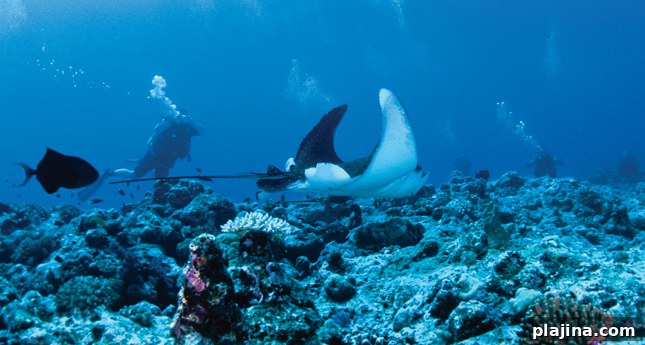
After an overnight sail we reached Osprey Reef at dawn and anchored in the calm of a 100-foot-deep lagoon. We began our two-day exploration with an orientation dive at False Entrance, a deep gully on the lagoon’s western side. A dense school of barracuda parted as we swam through, and moments later a giant manta filtered plankton from the mild current. Below it, an eight-foot whitetip rested on the sandy bottom—a memorable start.
The trip’s highlight came on our final day at North Horn, a well-known shark site on the atoll’s northern rim. The site features a large coral amphitheater where the Pacific current bends. We settled in a tight semicircle on the bottom with our backs to the wall. Dozens of silvertip, whitetip and grey reef sharks circled slowly above us.
From the boat a crew member lowered a sealed drum containing fish heads and scraps about 20 feet from our group. Within seconds 40 to 50 sharks began circling and bumping the drum, attempting to dislodge food through small holes. When the guide released the lid, the scene exploded into controlled chaos—fish heads flew, fins flashed, and sharks tore into the scraps. The noise of crunching was audible even underwater. Large moray eels, jacks and a massive potato cod joined the feeding frenzy.
It was one of the most electrifying dives of my 25 years underwater—big sharks and jacks moving within touching distance. In roughly five minutes the last scrap vanished and the crew hauled the battered drum back to the boat. The sharks followed briefly, then eased off and resumed slow patrols around us, perhaps hoping for an encore.
Two days later we returned to the main reef to explore calmer sites, the shark encounter still vivid in our memories.
The Great Barrier Reef offers remarkable diving year-round, with seasonal highlights. From May to July, hundreds of dwarf minke whales migrate here to mate and calve, offering extraordinary close encounters. Coral spawning occurs from October to December, when night-time releases of eggs and sperm draw baitfish and larger pelagic predators. February through May brings cooler temperatures, excellent visibility and active reef life—prime conditions for many divers.
Info To GoMajor airlines offer daily flights into Cairns International Airport (CNS). Port Douglas is about an hour’s drive north of Cairns. Numerous operators run multiday dive trips on the Great Barrier Reef, including liveaboard safaris that visit remote sites such as Osprey Reef and the Coral Sea. Plan trips according to seasonal highlights like minke whale season (May–July), coral spawning (October–December) and the clear, active months of February–May. |