
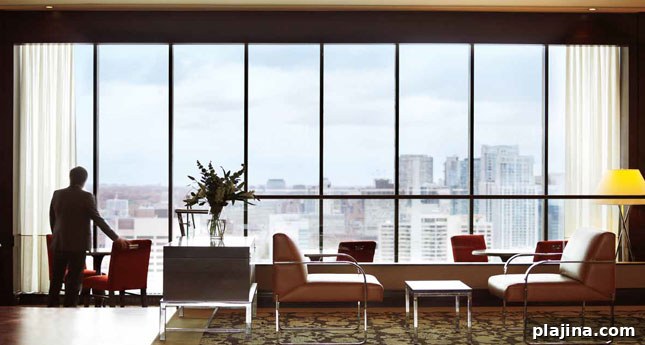
Executive floors in hotels are often promoted as a “hotel within a hotel.” Guests on these floors receive elevated service from staff, separate check-in and check-out areas, and a measure of privacy away from the crowds on regular guest floors. Club lounges typically provide a substantial breakfast, a place to work and relax, and evening refreshments. Rooms on these floors are frequently larger and furnished with upgraded amenities.
Those are the typical expectations. Whether an executive floor is worth the extra cost depends on the traveler, how much time they will spend in the hotel, and the quality of the club lounge and services offered.
Ken D’arcy, former president of Crosman Corp., always chooses executive-floor rooms. “Because they are executive-level, they are usually full of executives or frequent travelers. They are in town to work, not for pleasure; thus, peace and quiet usually prevails. Most of these floors offer club lounges where one can either work or simply relax and enjoy a drink or light snack.” He also cites an added safety benefit: restricted elevator access to these floors often requires a special key card.
Donald Jacobs, president of Inteck, values the concierge lounge. “I like these floors because of the concierge room that is set aside. There I can get some hors d’oeuvres and relax instead of just staying in my room. It feels like a comfortable family room,” he says.
Other frequent travelers prioritize price over extras. Many prefer booking discounted rooms through online travel sites and do not maintain strict brand loyalty. Dan Herman, managing principal at Aspen Advisors, explains, “I don’t have loyalty to any hotel brand, and I use last-minute booking tools to secure a hotel when I arrive in a new city.” Still, he’s sometimes upgraded by chains like Marriott and Hilton, which grants him access to the executive floor for breakfast — a convenient place to meet colleagues and enjoy a complimentary meal.
Executive Lounge at The JW Marriott Marquis in Dubai © JW Marriott Marquis
Some travelers, such as hospital consultant Jamie Bernstein, have access to executive floors but spend most of their time in standard rooms. “I traveled 80 percent of the time and typically didn’t ‘bond’ with my room. I just wanted things to work, such as short lines to check in, a key that worked and a wake-up call that happened,” she says.
Loyalty programs are another pathway to executive floors. Top-tier members of hotel loyalty programs or reciprocal airline-program elites are often upgraded to club-level access even when they book a standard room. Takao Nagai, a repeat traveler with elite airline status who received Gold status at a major hotel brand, recalls being upgraded to club level at a mountain resort: “I don’t know how to describe all that good food in the lounge. It is so much better than going out for dinners. In the evenings, maybe it is meant to be just for an appetizer before going out for dinner, but we always ended up just staying in the lounge, enjoying the food and relaxation and, needless to say, the value we got.”
From an industry perspective, many hotels invest in executive floors because they can raise rates and appeal to guests willing to pay for exclusivity. Bjorn Hanson, clinical professor at the Preston Robert Tisch Center for Hospitality, Tourism, and Sports Management, notes that upgraded furnishings, elevated floors and enhanced services provide a straightforward way to increase revenue while offering options for targeted guests. If these premium rooms are not sold at the higher rate, they remain in inventory and can be offered at regular prices or used for complimentary upgrades to build loyalty.
One example is Sheraton’s decision to upgrade its club floors. The chain invested heavily in improving lounges worldwide, positioning the club product as a clear upgrade option similar to paying for extra legroom or an airport lounge pass. That investment led to a significant uptick in guests purchasing club-level access, with club guests tending to be younger professionals and a mix of leisure and business travelers.
Club-floor staff and managers often compete to make their lounges stand out through personal attention, attractive food offerings and comfortable spaces. At the Hyatt Regency San Francisco, the Regency Club occupies the top two floors of the waterfront hotel and is promoted as a private space for socializing or working. “Our guests like a private space, either to socialize or work, and they see the club lounge as an extension of their guestroom. They get food and the beverages, but they are really purchasing an experience beyond the guestroom,” says the hotel’s director of sales and marketing.
Fairmont Pacific Rim Hotel, Vancouver Gold Lounge © Fairmont Hotels & Resorts
Some brands design executive floors to feel like boutique hotels inside larger properties. The Fairmont Gold product focuses on destination-inspired touches, from in-room curiosities to locally themed lounge design. These floors emphasize personalized service, including private check-in in the lounge, bespoke welcome amenities, and tailored food and beverage offerings. At one mountain property, guests receive a warm hand towel on arrival, a personal tour of amenities, a welcome letter with cookies, and wake-up calls delivered with coffee. The lounge offers an ample breakfast, snacks throughout the day, and evening appetizers with an honor bar — plus family-friendly features like gaming consoles in rooms.
Hyatt Regency San Francisco Club dining © Hyatt
Quality and offerings vary widely between hotels. If club amenities matter to you, ask what is included before paying the premium. Upgrades can cost roughly $75 extra per night at some properties to $160 or more at others. Some hotels provide only a basic breakfast and coffee, while others offer extensive perks: a 24/7 lounge with workstations and bookable meeting rooms, high tea service, or access to award-winning spa and thermal experiences.
When executive floors capture the feel and personalized service of a small boutique — even inside a large hotel — they give frequent travelers a reliable place to decompress after a busy workday or a satisfying spot to relax on vacation. For many guests, that combination of ambience, convenience and consistent quality keeps executive floors and club lounges in demand.