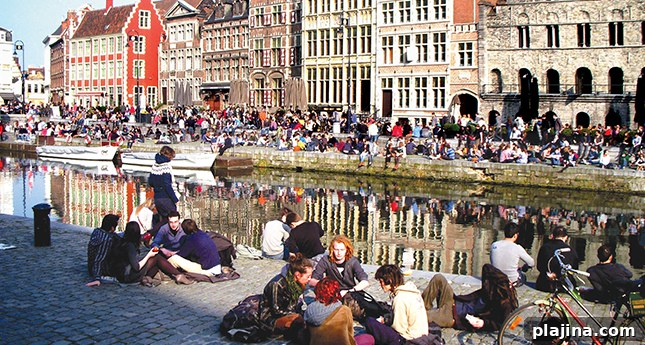
With its scenic canals, excellent local cheeses and beers, and thousands of bicycles clattering over cobblestone streets, Ghent resembles Amsterdam in many respects. The language — Dutch — is the same, but Ghent, located about 20 minutes northwest of Brussels in Flanders, offers a quieter, more compact experience with far fewer tourists. Its small size makes it possible to explore the entire medieval center in a day.
Historically significant, Ghent was Europe’s second-largest city until the 13th century, surpassed only by Paris. Today the city retains one of the continent’s best-preserved medieval cores. Often overshadowed by the crowds that flock to nearby Bruges, Ghent is equally beautiful and makes an excellent choice for a one- or two-day visit.
I boarded a morning train from Brussels to Gent-Sint-Pieters station and took a narrow yellow tram from the post-war commercial district into Sint-Baafsplein (St. Bavo Square), Ghent’s historic heart since the eighth century. The compact layout and dense concentration of sights make walking and cycling ideal ways to explore.
Although I normally avoid organized tours, I joined a two-hour guided bike trek offered by VIZIT called “Nibbling through Ghent.” The ride — also available as a walking tour — combined cycling around the old town with stops at several of Ghent’s long-established food purveyors.
We rode rented bikes along flat, cobbled streets and through spacious historic squares. Our first stop was Fevery Bakery, a neighborhood institution for decades, where coffee and a mastel — a small, doughnut-shaped brioche roll flavored with cinnamon — got the morning started. A short ride later we visited Daskalidès, a family-run chocolate maker with roots going back to 1931, and sampled rich chocolates, including their renowned merveilleux, a chocolate confection built on a hazelnut paste base.
At the tiny cheese shop Petite Normandie (Donkersteeg 21), owner Gino Carels served crusty French bread alongside generous tastings of Belgian cheeses: nutty gouda, the pungent Herve, and the velvety Passendale, named for the Flemish village. The tour continued toward the Groentenmarkt, a vegetable market since the 18th century, where we stopped at Vve Tierenteyn-Verlent. This small shop has produced and sold its distinctive, thick mustard in the same building since 1790, and a spoonful made clear why locals have prized it for generations.
Our final stop was Het Groot Vleeshuis, Ghent’s restored 15th-century Great Butchers’ Hall, where rows of Ganda hams hang from wooden beams. In the modern pub attached to the Vleeshuis, we tasted slices of this East Flanders specialty paired with tall glasses of Belgian beer — a fitting end to the “nibbling” portion of the tour.
After the tasting I needed exercise to work off the snacks. My guide, Leentje, suggested cycling along rivers and canals a few miles west of the city. The Flemish countryside there is peaceful and picturesque: flat, well-marked paths wind through canal-side villages and farmland, crossing quaint drawbridges. Along the route I occasionally used small pontoons to ferry the bike across narrow waterways, adding a charming, adventurous note to the ride.
For dinner, two restaurants stand out: Belga Queen and Brasserie Pakhuis, each offering strong menus in memorable settings. If you plan to stay overnight in Ghent or return to Brussels later, make time for a nightcap at Brasserie Aba-Jour (Oudburg 20). This tiny riverside bar in the historic Patershol neighborhood is perfect for ending an evening at a candlelit table by the River Leie.