
Want to be enchanted? If you find yourself in Austria, Italy or Germany on business, take a side trip to the Dolomites — a spectacular mountain range in northern Italy that French architect Le Corbusier praised as “the most beautiful natural architecture worldwide.” Composed of dramatic pinnacles, spires and towers that rise nearly two miles above sea level, the Dolomites were designated a UNESCO World Heritage site in 2009 and attract increasing numbers of visitors each year to their snowy slopes, lush hiking trails and picturesque villages.
Mareccio Castle among vineyards in Bolzano © Louise Roach | Dreamstime.com
Eager to experience the region firsthand, I based myself in Bolzano, the capital of South Tyrol. This charming northern Italian city — which often feels more like a town — is nicknamed the Gateway to the Dolomites. Bolzano combines cobbled streets and a medieval city square with Gothic and Romanesque churches, stylish shops, excellent restaurants and a large park ideal for jogging, strolling or relaxing on a blanket. The city reflects a rich blend of European cultures and traditions.
“People from South Tyrol do not consider themselves strictly Austrian, German or Italian,” explained my guide Hannes Tauber, who grew up locally and works with Export Organization South Tyrol. “We are a culture unto ourselves, shaped by elements from each of those countries.” Language illustrates that mixture: among the region’s more than 500,000 residents, roughly 70 percent speak German, 25 percent speak Italian and about 5 percent speak Ladin, a language with roots in the Roman and Rhaetian communities that lived here in antiquity.
Because the mountains define much of South Tyrol’s cuisine, sports and identity, my first morning was at the Messner Mountain Museum, founded by legendary mountaineer Reinhold Messner, who was born in the region. Housed in Sigmundskron Castle, the museum documents the history and art of mountaineering with photography, sculpture and memorabilia from Messner’s expeditions. Messner’s achievements include climbing Mount Everest without supplemental oxygen. Several satellite Messner Mountain Museums are dotted along scenic routes in South Tyrol, each with a different focus — for example, the museum dedicated to the Dolomites explores how the range was opened up to climbers and visitors.
Continuing the alpine theme, lunch was a hearty meal at Bierkeller Latsch, a wooden lodge in the small town of Laces. Seated at a long wooden table, we enjoyed chilled local Chardonnay, crusty bread with farm butter and cabbage salad with crispy Speck Alto Adige PGI — a cured and lightly smoked pork similar to prosciutto, flavored with malt and mountain herbs. We then dug into spit-roasted chickens, pork ribs and succulent pork shanks with blistered, salty skin.
South Tyrol’s culinary reputation is well earned: twenty restaurants in the region hold a total of 23 Michelin stars. Exceptional ingredients are part of the reason. In addition to Speck, South Tyrol produces outstanding mountain cheeses, hearty breads, honey and fruit, especially apples. The region enjoys more than 300 days of sunshine annually and spans landscapes from snowy alpine peaks to valleys where Mediterranean plants thrive.
Skilled chefs are another reason for the accolades. Franz Mulser, a 35-year-old chef at Gostner Schwaige, has received praise for his floral, alpine-centered cuisine. Gostner Schwaige began as his family’s mountain lodge in Castelrotto, reached via the Alpe di Siusi, Europe’s largest alpine pasture. The pasture spreads across meadows dotted with farms and chalets and is framed by the Dolomites. After parking, we took a tram and then a short carriage ride through slopes turned a vivid early-June green, hikers in traditional dress scattered across the meadows and snow-capped peaks on the horizon — an almost storybook scene.
Chef Mulser welcomed us with Prosecco infused with homemade rose and elderflower syrups. He served a small bite of minhas, a rich, polenta-like preparation made with alpine butter, milk, eggs, buckwheat and wheat flours. Our appetizer was a delicate hay soup, prepared by steeping hay with local herbs and finishing with cream. The main course featured local veal loin with wild thyme jus, and dessert was an alpine cheese omelet cooked in an iron skillet, dotted with raisins and topped with fresh raspberries and rose petals from Mulser’s farm.
A snack in South Tyrol isn’t complete without local wine and smoked Speck. © Kabvisio | Dreamstime.com
Wine is central to the culinary experience. South Tyrol cultivates more than 20 grape varieties across roughly 13,000 acres tended by about 5,000 growers, with climate variations that allow many styles to flourish. White wines commonly include Pinot Grigio, Gewürztraminer and Chardonnay as well as lesser-known Sylvaner and Kerner. Indigenous red varieties include Schiava and Lagrein, alongside Pinot Noir, Merlot and Cabernet Franc.
The Dolomites also offer outdoor adventure year-round. South Tyrol is home to Dolomiti Superski, one of the world’s largest ski networks, with 12 ski areas, nearly 750 miles of slopes, 450 lifts and the famed Sella Ronda, a 16-mile circuit around the peaks. In summer, walkers and hikers can choose among about 13,000 trails that crisscross the region’s valleys and high plateaus.
To unwind after exertion, the Therme Meran/Terme Merano spa provides a modern retreat with 25 indoor pools fed by local thermal springs, hot and cold saunas and a variety of treatments. Two treatments unique to the region are the wool bath — where the body is immersed in local sheep’s wool to produce gentle warmth and stimulate microcirculation — and the hay bath, where guests lie on fragrant mountain hay to relax muscles and ease pain.
In Bolzano, the South Tyrol Museum of Archaeology is a must-see for the famous Ötzi the Iceman exhibit. Ötzi is a 5,300-year-old glacier mummy found in 1991 in the Ötztal Alps. The museum presents the story of the discovery, forensic evidence about his death and insights into his clothing, tools and diet. The museum sits in a lively shopping district near cafés and the local favorite Loacker Moccaria, the café of a family confectionery renowned for bite-sized wafer cookies and chocolates, including a hazelnut-filled alpine rose-shaped chocolate.
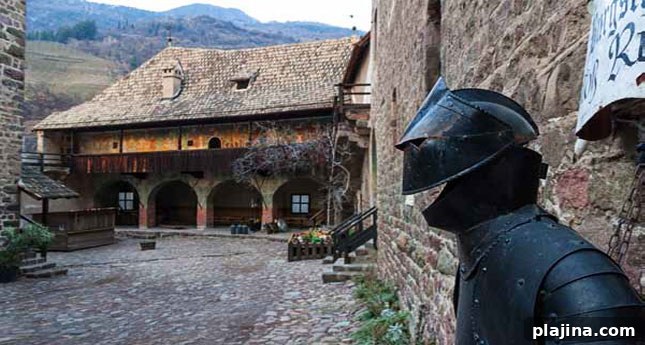
South Tyrol also boasts more than 400 castles, such as Runkelstein Castle north of Bolzano. Built originally in 1237 and extended over centuries, it is noted for an extensive collection of secular frescoes depicting medieval court life, family scenes and regional legends.
Music and festivals enrich cultural life. Bolzano is home to the Haydn Orchestra, which performs Baroque and modern repertoire, and each summer the South Tyrol Jazz Festival brings a wide range of artists to venues around the region.
For a memorable final evening, I dined in the Art Nouveau dining room at Park Hotel Holzner on the Renon plateau above Bolzano. Accessible by cable car, the hotel’s panorama terrace offers sweeping views of the Dolomites. Dinner showcased the region’s abundance: white asparagus with local ham, spinach ravioli finished with mountain butter and Tyrolean gray cheese, veal with vegetable polenta and classic apple strudel accompanied by a regional bitter liqueur. It was a fitting farewell to a luminous, lesser-known corner of Italy.
Dolomites Info to Go
Bolzano is accessible by air, car or train from most major European cities. South Tyrol’s local airport, Bozen Dolomiten/Bolzano Dolomiti, lies on the southern edge of the city. Nearby international airports include Innsbruck to the north and Verona to the south.