
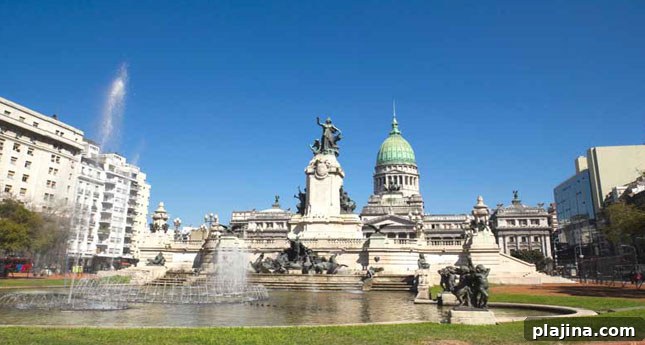
Buenos Aires, often called the most European of Latin American cities, earned the nickname “Paris of South America” thanks to its wide boulevards and architecture reminiscent of Madrid, Paris and Milan.
At the turn of the 20th century the city was South America’s wealthiest, and Argentina ranked among the world’s richest countries. Although the 16th-century Spanish founders did not find the silver they had hoped for when naming the Río de la Plata (River of Silver), later generations of Porteños prospered as the city became a major distribution port for beef from Argentina’s vast pampas.
Agriculture remains a major part of the economy, accounting for roughly 60 percent of exports. Argentina is a leading global producer of soy-based oil used in biodiesel and a top biodiesel exporter. The economy relies heavily on dollars and has been shaped by sovereign debt challenges and restricted access to international capital. After a robust rebound from the 2009 recession that spurred strong construction growth, 2012 showed signs of slowing and rising inflation. Official inflation figures are often disputed by international organizations.
Ezeiza International Airport sits about 45 minutes from downtown. Taxis from the official blue-and-white booth in the arrivals hall are a convenient option (expect to pay around $25) and attendants will escort you to the car; a tip for the escort is customary. Remis private car services, such as Manuel Tienda León, typically cost slightly more and can be reserved in advance or at kiosks in the arrivals area. At the airport, use authorized exchange services such as Banco de la Nación located near baggage claim.
The city has an extensive subway system (El Subte) and many bus routes, but taxis—especially radio taxi services called in advance—are often the fastest and safest way to get around.
Buenos Aires’ largely grid layout makes navigation straightforward, and locations are commonly identified by barrio, or neighborhood. Avenida de Mayo connects Plaza de Mayo with Congressional Square in a tree-lined stretch of Art Nouveau and Neoclassical architecture designated a National Historic Site. Cutting across it is Avenida 9 de Julio, famous for its broad width and multiple lanes.
Plaza de Mayo is anchored by the Casa Rosada, the presidential offices and a focal point for civic life, from protests to public celebrations. North of the plaza, the San Nicolás barrio functions as the commercial and financial center, with Calle San Martín as a principal street.
To the north, Recoleta represents the city’s most elegant district, filled with Beaux-Arts buildings and upscale hotels suited to international business travelers. Opened in 2012, Buenos Aires Grand drew business clientele with Club 31 and a lively lobby bar, and offers modern meeting spaces for corporate events.
For a taste of Recoleta’s grandeur, the five-star Alvear Palace Hotel, originally built in 1932 and updated in 2010, remains a classic choice. Its formal dining room and elegant settings are well suited to business lunches and breakfasts, and the hotel’s tea service is a refined late-afternoon option.
The Palacio Duhau – Park Hyatt Buenos Aires, combining a 1934 mansion with a contemporary tower, offers understated luxury, private spaces for conversation and a restaurant focused on seasonal Argentine ingredients. Several hotels and private venues in the area provide meeting rooms and business amenities.
For relaxed, intimate business gatherings, cigar bars and historic mansions in Recoleta arrange private tastings and cocktail receptions paired with Argentine wines. Milión, housed in a Belle Époque mansion with marble staircases and garden, is a striking venue for cocktails or dinner.
Retiro, adjacent to the financial district, hosts international hotels with Art Deco and contemporary design. Sofitel Buenos Aires features Le Sud for French interpretations of Argentine cuisine and several casual dining options suitable for breakfast meetings and informal gatherings, all offering complimentary WiFi.
Between the city center and the Río de la Plata, Puerto Madero is a revitalized dockland of modern high-rises and upscale restaurants. The area includes notable public spaces and pedestrian bridges and remains a popular setting for dining and business entertaining. Faena Hotel + Universe brought a distinctive, design-forward approach to hotel dining and nightlife, while other venues in Puerto Madero focus on high-quality Argentine steaks and seafood.
For classic Argentine beef, Cabaña Las Lilas in Puerto Madero is widely regarded as one of the city’s best steakhouses, known for prime Angus cuts and traditional preparations such as tenderloin with Madeira reduction or confit suckling pig.
The colorful Barrio of La Boca © Stillman Rogers Photography
South of the center, San Telmo offers atmospheric, cobblestone streets lined with antiques shops, galleries and classic restaurants. La Boca, once an Italian neighborhood, is brightly painted and lively, famed for its cafés, eateries and the Boca Juniors stadium. Dining at traditional venues like El Obrero delivers authentic local flavor, good steaks and straightforward service—take a taxi to and from the neighborhood for safety and convenience.
For a scenic escape from the city, Tigre lies about a 45-minute train and boat ride north into the Paraná Delta. The waterways and islands host restaurants with dock access, allowing for relaxed lunches where staff will flag down a return boat. Gato Blanco, set in a pleasant park-like area, is known for rib eye and seafood dishes such as hake with leek sauce.
If time allows between meetings, a walk through Recoleta Cemetery is highly recommended. The marble mausoleums and ornate vaults commemorate Argentina’s notable figures; the tomb of Eva Perón remains a frequent site of fresh floral tributes.