
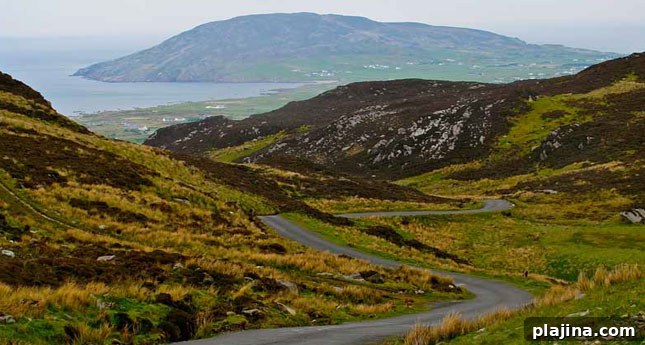
As a longtime off-the-beaten-path traveler, I admit I was a little annoyed when Ireland officially mapped the Wild Atlantic Way, a 1,500-mile route that traces the rugged western coastline from Derry to Kinsale. Revealing so many hidden detours means fewer secrets for solo explorers, yet there’s a catch: the Wild Atlantic Way isn’t for the faint-hearted. To enjoy it fully you must be prepared to navigate twisting, cliffside roads while seated on the right and driving on the left.
The Wild Atlantic Way favors byways over motorways. It skirts sheep-dotted headlands, traces beaches, peat bogs and patchwork fields, threads through Irish-speaking villages and passes ancient archaeological sites. The route rewards travelers who embrace spontaneity: take a single-track lane, linger in a village that seems to pass in a blink, or follow the invitation of local folklore. You’ll find opportunities to hike, paddle, surf, play golf, stroll gardens, watch birds or simply watch a sunset painted by wind and spray. There are, of course, must-see highlights marked in guidebooks, but the salt-sprayed, peat-scented memories are often born in the moments between those famous stops.
I first fell under County Donegal’s spell while exploring the Inishowen 100, a scenic loop around the Inishowen Peninsula. My husband and I visited the ancient Grianan of Aileach ring fort, believed to date back some 4,000 years; wandered the soaring dunes of Five Fingers Beach; breathed in Atlantic air at Bamba’s Crown, Ireland’s northernmost point; and held our breath as we wound our way over Mamore Gap.
Cozy harbors and fishing villages salt County Donegal’s coastline. © Hilary Nangle
Inishowen was only a taste of what Donegal offers. We used detailed Ordnance Survey maps to track quiet country roads through rolling farmland and heath, seeking out remote beaches and dramatic cliffs on the way to Fanad Head Lighthouse, which perches on a rocky point. We walked the sands of Ballystocker, often named among the world’s most beautiful beaches, and explored the ivy-clad ruins of the early-16th-century Carmelite Friary in Rathmullan.
We drove Rossguill’s Atlantic Drive multiple times, taking a different lane each visit. Hairpin turns and panoramic beaches never grew old. We browsed McNutt’s Woollen Mill in Downings, stopped for a pint at The Singing Pub and, on a whim, followed a local recommendation to Tramore Beach after buying the Dunfanaghy Walk Guide in a town bakery.
Donegal’s northwest is a scalloped fringe of harbors and pocket fishing villages with irresistible names such as Bunbeg and Derrybeg. In Burtonport we ducked into Kelly’s Lobster Pot for lunch. The dramatic Bloody Foreland gets its name not from battle but from the red granite cliffs glowing at sunset. Tory Island, visible on the horizon, hinted at more stories, though time didn’t allow a visit on that trip.
The route then eases into County Sligo, sweeping out to Mullaghmore Head—known for its beaches and big-wave surfing—and enticing literature lovers with the Yeats Trail. I detoured instead to ancient sites like Carrowmore, one of Europe’s largest megalithic cemeteries, and later visited Ceide Fields in County Mayo, the world’s most extensive Stone Age field system, set amid vast blanket bogs with walls, dwellings and tombs some 6,000 years old. The exposed landscape and windswept views are unforgettable.
Oscar Wilde called Connemara’s landscape “savage beauty,” and it’s easy to see why. Between the Twelve Bens mountains and the sea, scenery alternates between intimate and immense. We followed Killary Fjord’s shoreline from Leenane to Killary Harbor, looped the Renvyle Peninsula and visited Connemara National Park. In Clifden we took the Sky Road, clinging to a cliff-hugging drive, then explored Derrigimlagh Bog, where early trans-Atlantic wireless and aviation history unfolded.
County Clare boasts famous sites like the Cliffs of Moher, Doolin’s music pubs and the white sands of Lahinch, but The Burren’s stone-strewn landscape kept calling us back. We traced its single-track lanes, hunting for mapped castles and ruins among the limestone hills. On a narrow lane, two drivers met face-to-face and, after a brief, courteous exchange and a mutual mirror-folding maneuver, continued on with a friendly wave—a small moment that sums up the region’s unhurried spirit.
The Wild Atlantic Way continues along the peninsulas of Kerry and Cork. The Dingle Peninsula is an archaeological treasure trove, with thousands of preserved sites from the Mesolithic onward. We linked past to present at the Blasket Centre, learning about the islands’ literary heritage, and left with local pottery, blankets and a hand-knit sweater as tangible memories.
Killarney and the Ring of Kerry on the Iveragh Peninsula draw crowds for good reason, yet steering off the beaten path reveals quieter rewards: the ruins of Ballycarbery and Dunkerron castles, the ancient stone ring fort at Staigue, and the Skellig Ring’s dramatic approach to views of Skellig Michael, a remote monastic island and UNESCO World Heritage site.
Irish cheeses in Kenmare Market © Hilary Nangle
Kenmare, known for its lace and stone circle, sits at the head of a bay that separates the Iveragh and the less-visited Beara Peninsula. I’ve long been protective of Beara’s wild character—tour buses largely avoid it, and the lanes feel intimate and rugged. Over three days a friend and I barely scratched the surface: we visited fishing villages, explored megalithic sites, walked segments of the Beara Way and poked around old copper mines. Weather thwarted our plan to take the Dursey Island cable car, but we still enjoyed Garinish Island’s formal Italianate and woodland gardens.
Healy Pass is Beara’s dramatic backbone. We crossed it several times, each climb offering breathtaking views over Kenmare Bay and Bantry Bay. On one visit gale-force winds tested our balance; on another, sunset light and brooding clouds transformed the landscape into a vivid, shifting painting. On our last pass the clouds parted just long enough to catch a rainbow—an apt goodbye.
Wild Atlantic Way Info to Go
International flights serve Dublin, Shannon and Belfast International airports, with rental cars available at each. For detailed navigation, pick up regional maps from Ordnance Survey Ireland.
Where to Stay in Ireland
Gregans Castle Hotel An elegant Georgian manor in the Burren with welcoming hospitality, notable cuisine and views to Galway Bay. Ballyvaughan, County Clare $$$
Park Kenmare A five-star Relais & Châteaux property near Kenmare, overlooking the bay with spa facilities and refined service. Kenmare, County Kerry $$$
Rosapenna Hotel & Golf Resort A four-star resort tucked between dunes on Sheephaven Bay, popular with golfers. Downings, County Donegal $$
Restaurants in Ireland
Aniar Restaurant A Michelin-starred restaurant in Galway offering a daily-changing menu built on local, seasonal and foraged ingredients. 53 Lower Dominick St., Galway, County Galway $$$
Gregans Castle Hotel The dining room offers contemporary Irish menus showcasing locally sourced ingredients, with views over gardens to Galway Bay. Ballyvaughan, County Clare $$$
Manning’s Emporium A gourmet shop, deli and café offering farmhouse cheeses, charcuterie and baked goods. Ballylickey, Bantry, County Cork $–$$
Read about Ireland’s Inishowen Peninsula.