
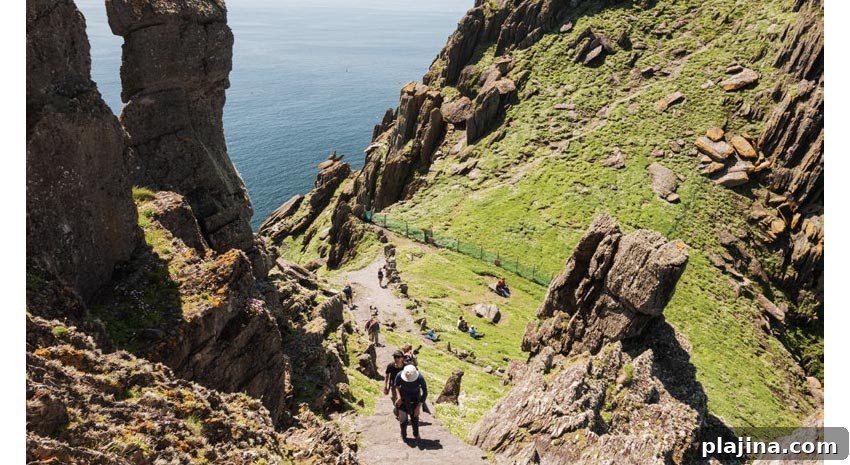
A critical scene from Star Wars: The Force Awakens transports viewers to a mystical mountaintop rising from a deep blue sea. The dramatic setting, however, was not filmed in a galaxy far, far away but on Skellig Michael, an island about eight miles off the southwest coast of Ireland in County Kerry. Director J. J. Abrams told the Irish Film Board he wanted a location that felt authentic and “out of this world.”
County Kerry, together with neighboring County Cork, is renowned for otherworldly landscapes: steep cliffs and pounding surf, lakes and craggy mountains, bright green pastures dotted with ancient stone forts and old castles. Small villages display signs in Irish Gaelic, life runs at a gentler pace, and locals are welcoming. Whether traveling with a partner or family, this part of Ireland offers memorable scenery and experiences that reward a few days of exploration.
Fans of Luke Skywalker can take a private boat from Portmagee, a seaside village on the Iveragh Peninsula, for the roughly 40-minute trip to Skellig Michael. There are no large ferries; several small independent operators run tours weather permitting. Landing tours let visitors step ashore, climb the 640 stone steps to the summit, and explore the sixth-century monastic site where the film was shot. Alternately, circle tours stay aboard and provide dramatic views from the water. Whatever option you choose, book well in advance.
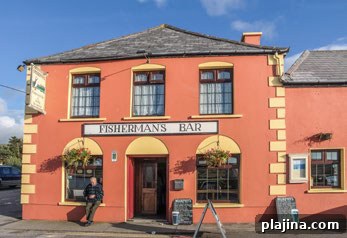
A colorful pub in Portmagee © CHRISTIAN MUERINGER | DREAMSTIME
Portmagee sits just off the Ring of Kerry, one of Europe’s most scenic drives. Even if weather keeps you from reaching Skellig Michael, the Iveragh Peninsula provides striking views and plentiful sights. The 112-mile loop has numerous lookout points offering seascapes over the Atlantic and rugged overlooks toward Dingle Bay—perfect for photographers or anyone enjoying panoramic vistas.
There are beautiful beaches such as the Blue Flag Beach near Glenbeigh, popular with families, and a nature trail at Derrynane National Park that leads to another outstanding shore. Derrynane is also a birdwatcher’s gem and the site of Derrynane House, the ancestral home of Daniel O’Connell, a prominent Irish statesman. The house is an Irish National Monument, and nearby tearooms serve traditional cakes, tea and coffee in a sheltered courtyard.
The Ring of Kerry also appeals to history enthusiasts. The area contains prehistoric stone forts built without mortar, with Staigue Fort among the largest and best-preserved. Remains from the Stone Age and early Christian settlements dot the region, particularly on the Dingle Peninsula where the Gallarus Oratory—an early Christian church shaped like an upturned boat—still remains waterproof after more than a thousand years.
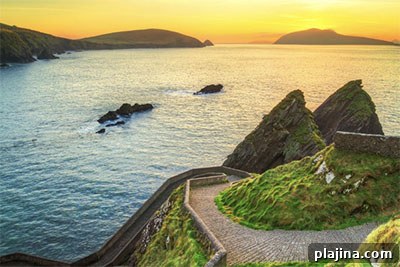
Dingle Peninsula © PATRYK KOSMIDER | DREAMSTIME
The Slea Head Drive around the tip of the Dingle Peninsula spans less than 30 miles but moves slowly. Dramatic shoreline views, sandy coves and narrow lanes with hairpin turns encourage frequent stops. Be prepared to pull over for oncoming cars on single-track stretches, and expect the occasional traffic delay when livestock crosses the road.
The lively fishing town of Dingle, east of the peninsula’s tip, is an excellent base for a stopover or overnight stay. Dingle offers a mix of shops, traditional music, cozy pubs and acclaimed restaurants serving fresh seafood alongside local cheeses, honey and other regional specialties. Southwest Ireland has earned a reputation among food lovers for its high-quality produce and culinary offerings.
Further east, Kinsale is a charming harbor town renowned for gourmet dining, while nearby Cork is often a starting point for travelers exploring the region. Cork is home to celebrated culinary destinations and the historic covered English Market. The area also includes iconic attractions such as Blarney Castle, visited by thousands annually for its famous stone.
Less crowded but rich in legend, Ross Castle in County Kerry was built in the 15th century by O’Donoghue Mór and sits amid the lakes of Killarney. Those lakes cover roughly one-third of Killarney National Park, whose highlights include Muckross House and Gardens and the pretty Torc Waterfall. Visitors can explore woodland paths, take horse-drawn jaunting car rides, enjoy boat trips on the lakes, and discover local folklore—like the tale of O’Donoghue rising from the waters on his white horse every seven years, a sight said to bring good luck.
Ireland Info to Go
Most travelers arrive via Ireland’s international airports in Dublin (DUB), Cork (ORK) or Shannon (SNN). Public transport is more limited in Southwest Ireland, so renting a car or joining a guided group tour is the best way to explore at your own pace.
Where to Stay in Ireland
CASTLEWOOD HOUSE A boutique property blending antiques and art, overlooking Dingle Bay. Romantic and well appointed. The Wood, Dingle, Co. Kerry.
HAYFIELD MANOR HOTEL A five-star hotel and spa set in a private walled garden, offering elegant rooms and afternoon tea. Perrott Avenue, College Road, Cork, Co. Cork.
KILLARNEY PARK HOTEL Luxury accommodations near Killarney National Park with attentive service and classic charm. East Avenue, Town Centre, Killarney, Co. Kerry.
Restaurants in Ireland
THE CHART HOUSE A former boathouse with stained glass and exposed stone, serving seasonal dishes and desserts. The Mall, Dingle, Co. Kerry.
FISHY FISHY An award-winning seafood restaurant known for fresh catch and a relaxed atmosphere. Crowleys Quay, Kinsale, Co. Cork.
LES GOURMANDISES A chef-owned restaurant offering French-inspired cuisine using local ingredients. 17 Cook St., Cork, Co. Cork.