
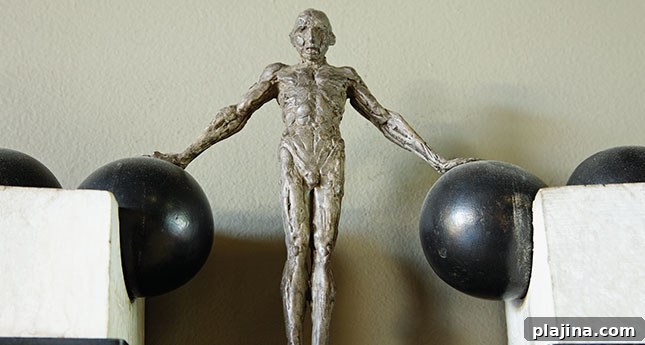
Artist Jeff de Boer first met Calgary mayor Dave Bronconnier at the unveiling of his kaleidoscopic metallic sculpture Light, the Universe and Everything, installed outside Calgary’s Hotel Arts. The piece brought wider recognition to De Boer, whose work had already appeared at Alberta Children’s Hospital and Calgary International Airport.
“I told [the mayor] that hotels are like cities,” De Boer recalled. “They all have the same basic services, so why stay at one over another? Art is what makes it different. If you’re busy and don’t have time to take in the local art scene, it’s there waiting for you when you go back to your room. It’s not just decoration — it’s something more, something that makes a difference.”
To attract guests, hotels often promote tangible upgrades: better beds, new technology, innovative cuisine and conference facilities. But art offers something different — a contemporary, lasting investment that gives each property a distinct identity. That philosophy guided Sonesta Collection owner Roger Sonnabend as he assembled more than 7,000 paintings, sculptures, prints and tapestries across his 21 hotels and resorts over four decades.
“Roger was quoted as saying that the value of mahogany doesn’t go up, but the value of art does,” said Sonesta Collection spokeswoman Lorie Juliano. “Art enhances the guest experience, helps visitors appreciate local culture and gives a clearer sense of place. It also makes the hotel feel more like home. Guests will even request particular rooms or suites because of the art.”
Hotel art collections run the gamut from historical to cutting-edge. Madrid’s Villa Real houses Greek Apulian vases and Roman mosaics alongside a wide range of Catalan and Spanish etchings, lithographs and paintings — a collection that would interest any museum curator. By contrast, Seattle’s Hotel Alexis focuses on emerging regional talent, rotating three up-and-coming Pacific Northwest artists each quarter in its Art Walk gallery.
“As director of the Seattle Art Museum gallery, I have access to more than 200 artists, so I have a lot of opportunity to look for new and emerging talents,” said curator Barbara Shaiman. “A hotel brings people out to see the art who aren’t familiar with the local scene, and gives them a taste of what’s available.”
Conceptual and challenging contemporary art tends to resonate with guests at boutique, design-forward hotels such as the Alexis and Calgary’s Hotel Arts. “We’re Calgary’s premiere boutique hotel, and we attract a lot of creative types: design agencies, advertising firms, a lot of the fashion and entertainment industry, in addition to touring acts,” said spokesman Fraser Abbott. “We know who we are, and the art chosen by [owner] John Torode works well with that demographic. The art creates an atmosphere. We feed off it, and our clients do, too.”
But thought-provoking work can make an impression even on guests who don’t normally seek out art. “I think our art appeals to a very broad audience,” said Austin Watkins, a spokesperson for the Four Seasons Hotel San Francisco. “We have 16 pieces by Lita Albuquerque on our ground floor — brightly colored blues, reds and golds that look like beetles or turtles. Many people stop to look, and they come from all walks of life. There are also people like me, who enjoy art but may not have deep knowledge about it.”
How a hotel presents its collection also shapes the guest experience. At The Four Seasons San Francisco, visitors can use pre-programmed iPods with artist-recorded descriptions and background on each work. “By far, the coolest thing we’ve ever done,” Watkins said.
Hotels sometimes create unique local tie-ins. Barcelona’s Hotel Bagués plans to include an original Masriera jewelry piece in each room and feature a small museum dedicated to the Modernist jeweler Lluís Masriera in its lobby. The Royal Sonesta Hotel in Cambridge, Mass., effectively functions as a museum, offering self-guided tours and inviting students from nearby universities and art schools to study its collection.
“We have many masters of contemporary art, but we also take great pride in the local pieces we display,” Juliano said. “As you walk through the collection, recognizable names like Andy Warhol stand out, but you also encounter artists people may not know, such as Maggie Brown, a figurative artist who lives in Cambridge.”
Including local art — whether ancient or modern — gives a hotel a strong sense of place. San Francisco’s Yerba Buena Arts District, home to the Museum of Modern Art and several other cultural institutions, is surrounded by major hotels including the InterContinental, the St. Regis and the W. By integrating with the neighborhood’s cultural life, the Four Seasons San Francisco distinguishes itself from competitors.
“When the Contemporary Jewish Museum opened adjacent to us in 2008, we added an audio interview about the museum to our podcast tour so guests can finish the tour and look down over Yerba Buena Gardens to see it,” Watkins said. “This area offers so many cultural attractions, and we find ways to connect our hotel to them.”
Collections can also transport guests. The Four Seasons Resort Hualalai’s native Hawaiian collection, which includes hand-woven cloth, wooden artifacts and oil paintings dating to 1775, immerses visitors in historical Hawaii. In Boston, the Fairmont Battery Wharf emphasizes modern energy, featuring elegant glass sculptures by Nikolas Weinstein alongside powerful steel, stone and bronze works by Obie Simonis. Calgary’s Hotel Arts balances past and future: a giant cow statue, Rita, nods to the city’s cattle-town roots, while De Boer’s lobby sculpture points toward a technologically inspired future.
“One of the first things you notice as you walk through the front doors is this wonderful suspended-light installation of blown glass by Barry W. Fairbairn, a local glass blower,” Abbott said. “It’s interesting to see the look on people’s faces when they see it, especially locals who remember when this used to be a Holiday Inn. They’re flabbergasted.”
Art has also driven business for some hotels. “A lot of young couples have decided to host their weddings here because of the contemporary feel of the property,” Abbott added. “This is not the ballroom where their parents got married.”
Artwork that dominates a lobby or conference room can become the focal point of events. “We’ve actually had businesses choose our hotels because of the collections,” Juliano said. “An association of visual arts professionals considered our hotel in Cambridge for a design conference. When their planners did the site inspection, they knew immediately this was the right space for their event.”
Still, hotel curators must balance provocation with hospitality. Collectors look for pieces that provoke thought, make a statement or elicit emotion, while ensuring guests remain comfortable in public spaces.
“One of our pieces that is somewhat controversial is Dark Oval #4, by Marie Ofalco,” Watkins said. “It resembles a Cinderella mirror — looking at it can feel like looking into your soul. Some guests are put off by it, while others are deeply moved. It’s a powerful work.”
De Boer took a similar risk with his Hotel Arts sculpture. By day, the 18-foot sphere resembles a metallic tree, referencing Calgary’s forested past and hinting at future technological possibilities. At night, its multicolored LED display animates lines, curves and dotted rivets that suggest waves, particles and the interplay of light — an image the artist describes as representing elements of the universe.
“The ball really is all the elements of the universe described as an image,” De Boer said. “Once you have light, once you’re able to describe the universe, you have just about everything. It’s a beacon meant to inspire people, to say, ‘Look what one person can do if he cares — and has a budget.’ ”