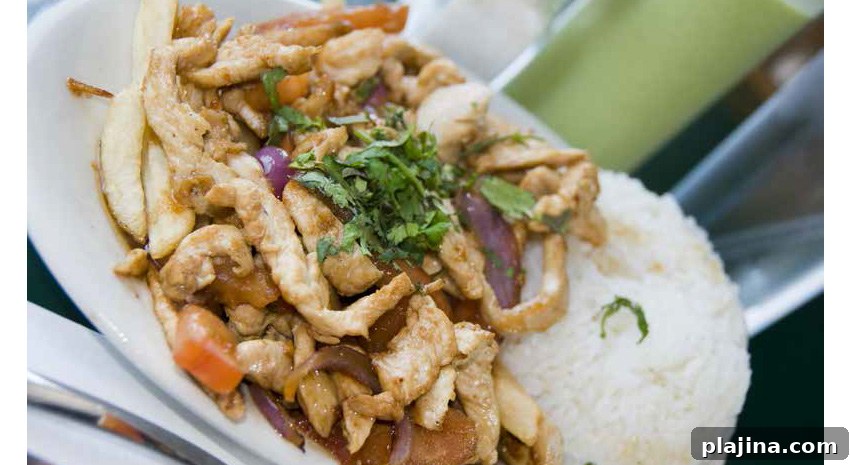
Peruvian cuisine may be the most exciting—yet underappreciated—movement in the global culinary scene. Unlike Mexican, Japanese, Thai, or Indian food, which instantly evoke specific dishes and flavors, “Peruvian” often lacks a single, defining image. That ambiguity stems from Peru’s extraordinary culinary diversity: a fusion of indigenous traditions, immigrant influences, and regionally available ingredients.
At the heart of Peruvian food are four staples: rice, potatoes, quinoa and beans. Indigenous ingredients and techniques—shaped in part by the legacy of the Incas—combined with the foods and methods introduced by Spanish colonizers and later immigrants from Italy, Germany, Asia and West Africa. These cultural interactions transformed local ingredients into a dynamic fusion cuisine praised by critics and chefs alike. U.S. food critic Eric Asimov of The New York Times called it “one of the great cuisines of the world,” a sentiment shared by Peru’s most famous chef, Gastón Acurio.
Spanish influence remains especially visible, particularly in Lima’s historic center. Centro Histórico, an urban enclave extending north from Plaza San Martín, showcases Baroque, Neoclassical and colonial architecture that recalls Spain’s long presence in the region. The plaza itself is anchored by an equestrian monument to General José de San Martín, one of the leaders of South America’s struggle for independence. When Peruvian independence was declared in 1822, San Martín briefly served as Protector of Peru following a meeting with Simón Bolívar.
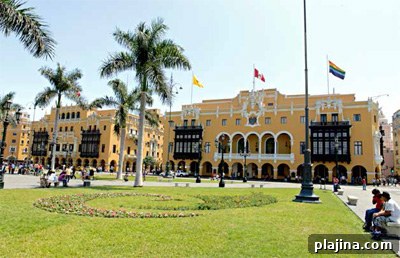
Plaza Mayor de Lima © JOE BAUR
Begin a colonial architecture walk at Plaza Mayor de Lima, where the Cathedral of Lima and the Government Palace face one another across the square. Tourists admire the ornate facades, yet for locals the plaza remains a lively, everyday public space: children play near the fountain while family members push elderly relatives in wheelchairs, and residents pass through as part of daily life. Nearby, the Basílica y Convento de San Francisco de Lima—famed for its symmetrical yellow towers and richly decorated interior—earned UNESCO World Heritage status in 1991. Its catacombs, discovered in 1943, contain thousands of skulls and bones from roughly 25,000 interments, a stark historical reminder that is still viewable today.
Shift from history to the present by strolling Jirón de la Unión, a bustling pedestrian avenue lined with shops and cafes in handsome colonial-style buildings. The street offers everything from affordable clothing to upscale fashion, and the local coffee scene is strong—skip global chains and try a neighborhood roaster such as 9Bares Coffee Roasters for a more authentic caffeine fix.
Lima’s coastline is one of the city’s great assets. Rather than ceding the waterfront to highways, Lima’s oceanfront features parks, promenades and scenic overlooks. Start at Parque Domodossola and pass the photogenic Iglesia Virgen de Fátima to enjoy sweeping views of the Pacific and Playa Redondo. Bridges and staircases lead down to the shore where surfers and spectators gather, especially when events are scheduled.
For dining with a view, the Larcomar shopping center integrates restaurants with the cliffside park setting. Continue north along the coast to Parque del Amor (Park of Love), recognized for its colorful mosaic tiles and a prominent sculpture of two embracing lovers. The park draws couples who enjoy the panoramic ocean vistas and the romantic atmosphere.
No overview of Lima is complete without mentioning the pisco sour, Peru’s signature cocktail. Pisco—the grape brandy used as the base—is produced across the country, sometimes by small, handcrafted distillers. The classic pisco sour mixes pisco with lime or key lime juice, syrup, ice, egg white and a dash of Angostura bitters. It’s a popular choice throughout the day, from business lunches to evening outings. Try a classic version at the Gran Hotel Bolívar in Centro Histórico, an early-20th-century landmark loved by locals and visitors alike.
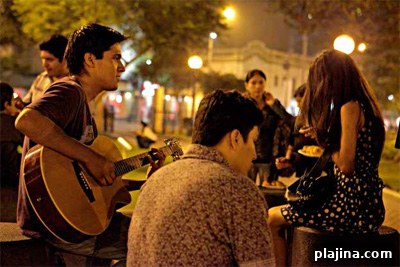
Musicians in Miraflores © JOE BAUR
If you prefer a hands-on experience, several culinary tours teach you to make your own pisco sour and ceviche, balancing instruction with creative freedom so you leave confident in your skills. These classes are a great way to connect with Peru’s food culture and learn the techniques behind its most iconic dishes.
End the evening in Miraflores at Parque Kennedy, a lively park where locals and tourists mingle. Stray cats wander the well-kept lawns while artists sell paintings on nearby sidewalks and musicians perform throughout the night. For a more traditional experience, step into Parque Central de Miraflores where older generations gather to sing and clap along in a communal celebration of Peruvian music and song.
Lima Info to Go
Jorge Chávez International Airport handles both international and domestic flights and lies roughly seven miles west of Centro Histórico. Taxi fares from the airport to central neighborhoods typically run in the $15–$17 range.
Where to Stay in Lima
FORESTA HOTEL LIMA Centrally located in San Isidro, Foresta Hotel Lima is close to a range of restaurants and sits between the Lima Golf Club and Bosque El Olivar park. Calle Los Libertadores 490, San Isidro $$
HOTEL ATTON SAN ISIDRO Modern design and welcoming staff distinguish Hotel Atton San Isidro, which offers a complimentary breakfast buffet in a comfortable setting. Av. Jorge Basadre 595, San Isidro $$$
HOTEL B Located in the trendy Barranco neighborhood, Hotel B blends historic atmosphere with contemporary comfort and serves dishes that emphasize Peruvian traditions with Mediterranean influences. Sáenz Peña 204, Barranco $$$$
Restaurants in Lima
SAQRA RESTAURANTE Named from the Quechua word meaning “little devil” or “mischief maker,” Saqra delivers contemporary Peruvian cuisine with a playful edge. Av. La Paz 646, Miraflores $$$
TANTA Created by Chef Gastón Acurio and Astrid Gutsche, Tanta models a welcoming home environment and celebrates recipes handed down through Peruvian households. Pancho Fierro 115, San Isidro $$$
LA VERDAD DE LA MILANESA A modern take on the milanesa, this restaurant riffs on a classic South American dish of breaded meat topped with ham, tomato paste and mozzarella. Av. Almirante Miguel Grau 170, Barranco $$