
As our small plane left the main Viti Levu island behind and we headed toward the Yasawa chain, the Fiji I had imagined unfolded beneath us: green tropical isles fringed by white sand, and South Pacific waters shifting through brilliant shades of blue. When the seaplane touched down near Turtle Island Resort, bare‑chested men carried guests ashore as others sang a warm, welcoming song.
Singing is central to Polynesian culture in Fiji, and the music is one of the strongest impressions visitors take home. Musicians and singers greet arriving travelers at the international airport, and song continues at resorts throughout the day and into the night, sometimes breaking out spontaneously. In Fiji, a staff member who doesn’t sing might even seem unusual.
After a long flight from most parts of the world, it often makes sense to spend the first night or two near Nadi—the main international gateway—to adjust to the time change. The Denarau Island development, with its long beach and golf course, hosts a range of international hotels including The Westin, Sofitel, Sheraton, Hilton and Radisson Blu, plus dozens of restaurants.
To experience the true spirit and beauty of Fiji, though, venture beyond the arrival hubs and find your own stretch of paradise. Much of the country remains wild and sparsely populated, attracting adventure travelers who come to hike steep peaks, explore caves, swim beneath waterfalls and raft down rivers. The rugged interiors of Fiji’s two largest islands offer weeks of adventure options. On Beqa Island, firewalkers keep an old tradition alive by walking barefoot over glowing coals—an unforgettable cultural spectacle.
A Fijian warrior greeting the arrival of the Yasawa Flyer, a comfortable, fast catamaran connecting most of the Yasawa Islands © MARCO RAMERINI – DREAMSTIME.COM
Most travelers, however, come to Fiji seeking their own South Pacific postcard: to unwind, watch picture‑perfect sunsets and snorkel among fish in hundreds of colors. With more than 300 islands, Fiji offers numerous secluded beaches, quiet coves and excellent snorkeling spots—so you can find a peaceful, scenic place to call your own.
The Mamanuca Islands, where the film Cast Away was shot, lie close enough to Nadi to reach by boat in about two hours. Accommodation options range widely and include Fiji’s only overwater bungalows at Likuliku Lagoon Resort. Many resorts around these islands are within easy reach of the international arrival point, and some even transfer guests by helicopter.
The narrow chain of Yasawa Islands to the north is a short seaplane hop (and a longer boat ride) that easily evokes the sense of island exploration. The archipelago hosts some of Fiji’s earliest private‑island resorts, including Turtle Island—where guests rotate having a private beach for the day—and Yasawa Island Resort, where bungalows come with beach cabanas, hammocks and outdoor showers. Nearly every island in the area sits close to coral reefs teeming with marine life in comfortably warm water.
High‑end resorts often provide direct air service, while tourist ferries connect islands in both the Yasawa and Mamanuca groups, allowing visitors to hop between ports. With a bit of planning you can create a beach‑hopping itinerary that changes scenery while keeping travel simple.
Fiji’s second‑largest island, Vanua Levu, also offers plenty of inland and coastal activities and tends to have more budget‑friendly accommodations alongside resorts that attract international guests. Laucala Island, off the coast of Taveuni, is one of the most exclusive options—25 villas spread across a private estate, developed with few limits on luxury.
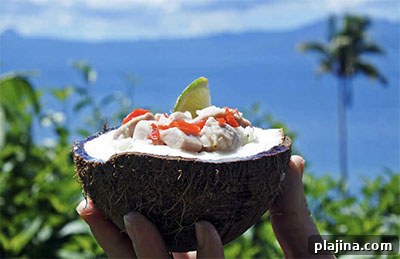
The national kokoda fish and coconut dish © MAURIE HILL – DREAMSTIME.COM
No matter where you relax, you’ll likely encounter a kava ceremony—a cornerstone of Fijian social life. This isn’t theatre for tourists: even hikers who arrive in remote mountain villages may find themselves invited to join. Along with kokoda, the national dish of fish marinated in coconut, kava is a traditional drink made from the root of the pepper plant and prepared in a communal bowl to share among guests.
During a kava ceremony, participants usually sit in a circle on the ground. When offered the drink, you clap once with your hand cupped, drink from a vessel often made from half a coconut shell, then clap three times. The flavor is earthy and distinctive, and the ritual is a friendly, welcoming way to be included in local life.
Fiji is warm year‑round and moves at an easy‑going pace, so dressing up or hurrying is rarely necessary. Because many outer island resorts are reachable only by propeller plane, traveling light is essential—small aircraft often require careful weight distribution, and luggage and passengers may be weighed together.
The best way to enjoy Fiji is to relax, adopt island time and let each day unfold. Appreciate how accommodations have evolved since the first explorers arrived, but also savor the simple pleasures: a flawless beach, a spectacular sunset and a day spent swimming in turquoise seas.
INFO TO GO
Fiji Airways operates daily direct flights from Los Angeles (LAX) and Honolulu (HNL) to Nadi (NAN), the main gateway for international travel. Other international connections commonly transit through Tokyo, Hong Kong, Singapore and several Australian cities. Airport transfers to Denarau Island hotels or seaplane departure points typically run about $20–25 by taxi or around $40 by car service. Domestic carriers, including Fiji Link, provide internal flights between islands and to the capital.
LODGING
LAUCALA ISLAND A private, all‑inclusive island resort with an exceptionally high staff‑to‑guest ratio and 25 villas. Laucala Island $$$$$
TURTLE ISLAND FIJI RESORT A classic, relaxed luxury private‑island resort on the island made famous by the film Blue Lagoon. Turtle Island $$$$$
VOMO ISLAND FIJI A family‑friendly option with a lively kids’ club accessed by a suspension bridge and dedicated children’s dining options. Vomo Island $$$$$
DINING
Many Fiji resorts are all‑inclusive or require meal plans. Dining options listed here are centered around the Nadi and Denarau area, where most international visitors arrive and depart.
INDIGO INDIAN AND ASIAN RESTAURANT Frequently praised as one of the best upscale Indian restaurants on the main island; air‑conditioned and vegetarian‑friendly. The Port at Denarau, Shop R3, Denarau Island, Nadi $$$
NADINA AUTHENTIC FIJIAN RESTAURANT A waterfront choice serving elevated local dishes with a focus on fresh seafood. The Port at Denarau, Shop R1 & R2, Denarau Island, Nadi $$$
TATA’S CURRY HOUSE A local favorite near Nadi’s prominent Indian temple, known for bold, authentic curries. Nadi Back Road, Nadi $$