
There is never a moment on Rapa Nui, commonly known as Easter Island, when you don’t feel intensely aware of where you are. This tiny island, roughly 2,200 miles from mainland Chile, ranks among the planet’s most remote inhabited places. Its enigmatic moai—those massive carved heads that have filled magazine pages and stirred curiosity for centuries—captivated me from childhood. I promised myself I would see them in person someday.
When I finally visited, I was exhilarated. No photograph, film or article can fully capture the experience. The carved stone figures average about 13 feet tall and weigh roughly 14 tons. Standing beneath them and looking up is unlike anything the media can convey: humbling, awe-inspiring and puzzling all at once. It’s hard not to marvel at the labor and ingenuity required to carve and erect these monuments, especially given the limited tools available to the island’s ancient inhabitants.
Rapa Nui hosts roughly 900 moai scattered across an island of about 64 square miles, so you can see the main sites in a few days. With only three roads, navigation is straightforward; nonetheless, booking an island tour through your hotel or a local operator is the best option for most visitors. Guided excursions remove the need to rent a car and provide valuable local context about the moai, the island’s history and cultural traditions.
The Museo Antropológico Padre Sebastián Englert offers an excellent introduction to the island. Its exhibits present the best-available archaeological and ethnographic information on Rapa Nui’s past, while also addressing present-day challenges such as overtourism and climate change. The museum also displays one of the island’s few female moai.
Current scholarly reconstructions, drawn from oral histories and external records, suggest that King Hotu Matu’a and his family arrived from Polynesia sometime around the 10th century, landing on the island’s northern shore and establishing a settlement. Because there are no contemporary written records, the precise timeline remains uncertain. Equally mysterious are the moai’s original purpose—most researchers believe they honored ancestors or chiefs—and the practical methods used to carve, transport and erect these massive figures. Most moai were likely created between the 10th and 16th centuries, an enormous undertaking for a small, resource-limited community.
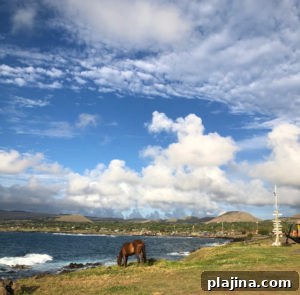
PHOTO: © CKIM FOLEY MACKINNON
Visiting the Rano Raraku quarry is unforgettable. This volcanic crater supplied the stone for most moai, and around 400 figures in all stages of completion remain scattered across the slope, as if work stopped suddenly and the sculptors walked away. In the quarry you’ll see moai still partly attached to the bedrock, including one lying prone and another depicted in a unique kneeling pose.
On Anakena Beach in Rapa Nui National Park, seven restored moai known as Ahu Nau Nau stand sentinel on the sand. Anakena is also the traditional landing site associated with King Hotu Matu’a. Across the island, Ahu Tongariki features 15 moai aligned on a 200-foot ahu, facing a large ceremonial plaza with petroglyphs of turtles and fish.
Rano Kau, a vast volcano at the island’s southern tip, contains a crater about a mile across with a lake partially choked by reeds. From the crater rim you can see where the caldera gives way to a crescent of deep blue ocean. Nearby sits Orongo, a ceremonial village built in the late 1600s and used until the mid-19th century. Orongo was the center of ceremonies devoted to the god Make-Make and the base for the island’s famed birdman competition. The national park covers roughly 40 percent of Rapa Nui, so no matter where you explore, you will encounter more moai and sacred sites.
Easter Island is one of the most singular places I have ever visited. As a writer I strive to convey a destination’s spirit, but some places—like the Grand Canyon, the Galápagos and the Taj Mahal—resist description. Rapa Nui is among those: its scale, mystery and beauty are best appreciated in person.
INFO TO GO
LATAM Airlines is the only carrier serving Mataveri International Airport (IPC), also known as Isla de Pascua Airport. Direct flights arrive a few times weekly from Santiago, Chile (SCL) and once weekly from Papeete, Tahiti (PPT); either route takes less than six hours. Many hotels provide complimentary round-trip airport shuttle service and offer a traditional welcome lei upon arrival.