
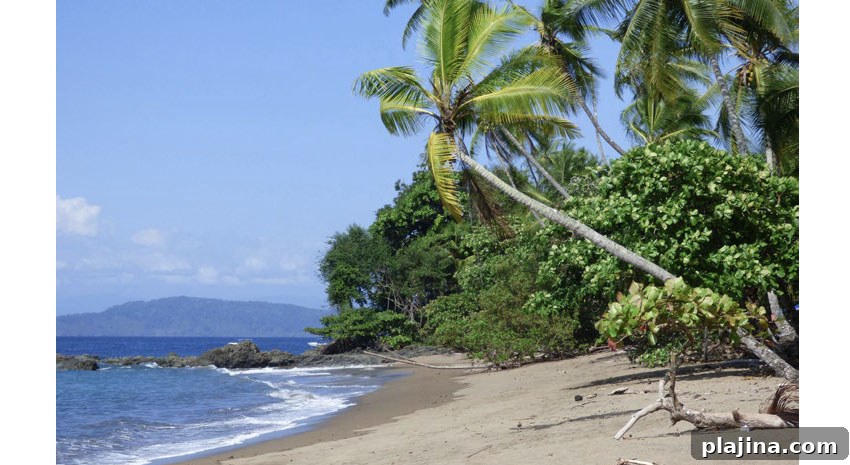
IN HOW MANY PLACES can you see wild monkeys and tropical birds on a walk from your room to the dining area? On how many hikes can you spot a sloth and a blue morpho butterfly before your first sip of water? In the wildlife-rich Osa Peninsula region of Costa Rica, the variety of animals in a single square kilometer can easily outnumber the visitors who come to see them.
Costa Rica is widely known as one of the greenest countries in the Americas. Nearly 28 percent of the country’s land is protected as national parks, reserves or conservation areas. Without a standing army and with strong environmental policies, Costa Rica ranks among the most biodiverse places on Earth. Estimates suggest about 850 bird species, roughly 400 reptiles and amphibians, and some 230 mammal species thrive here, along with an astonishing plant diversity that includes more than 1,000 orchid species.
Many international and local conservation efforts help keep large tracts of land out of development. On the Osa Peninsula, Corcovado National Park and about 20 additional protected areas — a mix of public and private reserves — combine to form the extensive Osa Conservation Area, creating the contiguous habitat wildlife needs to move, hunt and breed.
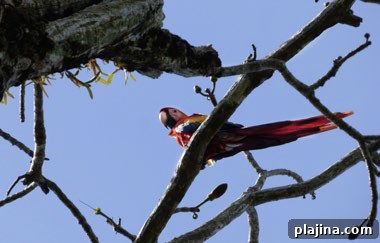
A scarlet macaw in a tree © TIM LEFFEL
One privately protected area borders Lapa Rios Lodge, where my family stayed for a nature-focused vacation. After a short prop-plane flight from San José to Puerto Jiménez and a drive in a Land Rover, our driver stopped under a tree so we could watch a dozen scarlet macaws flap, preen and call to one another. It felt like an omen: the lodge’s name comes from the Spanish lapa (scarlet macaw) and río (river) — “scarlet rivers” in the sky. Before we had even reached our bungalow, we spotted agoutis on the trail, a large toucan perched on a branch and a few howler monkeys moving through the canopy.
Lapa Rios sits on roughly 1,000 acres of intact rainforest that sweep down to the Pacific, with only a small portion dedicated to its 17 bungalows. Opened in 1993, the lodge operates as an eco-friendly destination intended to bring guests close to nature while promoting conservation. On day hikes and guided walks we encountered a wet sloth curled in a tree, playful capuchin monkeys, aracaris, toucans and even a coral snake. In certain months, humpback whales can be seen breaching offshore in the Gulf of Dulce.
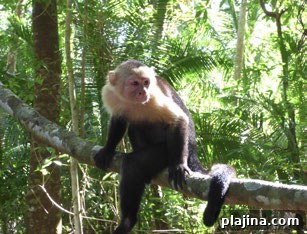
A capuchin monkey © TIM LEFFEL
On the beach, our daughter enjoyed corralling hermit crabs and building tiny obstacle courses for them, though she learned firsthand that nature can be unpredictable when she was stung by a jellyfish while swimming.
The Osa’s protected lands, which frame the deep Golfo Dulce, form wildlife corridors large enough for wide-ranging species. This region is unique in the Americas for supporting all five of the hemisphere’s small wild cat species: margay, ocelot, jaguarundi, puma and jaguar. Conservation groups use camera traps and field monitoring to better understand population sizes and animal movements across the landscape.
On a guided night hike, equipped with boots and flashlights, we hoped to find nocturnal wildlife. Instead we observed parrots sleeping upright on branches, bright tree frogs tucked into leaf litter and the occasional small snake slipping through the undergrowth.
I returned to the Osa Peninsula on subsequent trips, discovering more lodges and more unvarnished wilderness. Unlike busier tourist circuits in Costa Rica, this area still feels wild and unpredictable in the best way. At Playa Nicuesa Rainforest Lodge the manager warned that food and drinks need to be secured because monkeys and wild pigs will happily investigate any unattended provisions. The lodge’s 165 acres, backed by Piedras Blancas National Park, make a safe haven for those animals.
While hiking near Playa Nicuesa I watched squirrel monkeys chatter in the canopy and found lizards engaged in mating behavior beside the trail. Drawn by strange, distant noises, I crept toward them and discovered a group of peccaries squabbling over a food find — an unnerving sound that turned out to be harmless animal debate.
These nature lodges prioritize sustainability and a low-impact guest experience. Many eliminate plastic water bottles and televisions, rely on renewable energy from solar, wind or hydro, and use candles or low-wattage lighting. Food is often grown on-site or sourced locally; common snacks include chips made from cassava or plantain, prepared the traditional way.
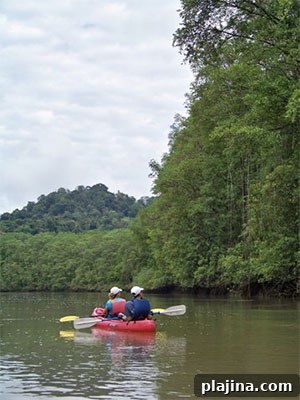
A kayaking excursion © TIM LEFFEL
Most lodges in the region are accessible only by boat or four-wheel drive and operate as largely self-contained properties. Rates commonly include all meals served at set times, and menus emphasize fresh, local ingredients served with care.
At Playa Cativo Lodge, reached by boat from Golfito, I found calm bay views, a swimming pool and one of the area’s best restaurants. There I spotted wild pigs, a golden-naped woodpecker and a long list of tropical birds. While paddleboarding along the shore, two dolphins swam past and a sea turtle surfaced to investigate.
On another visit I toured the Osa by boat on a small-ship expedition that included time in Golfo Dulce and along the peninsula’s coastline. We visited the House of Orchids garden to see scores of plants and visiting birds, paddleboarded up a mangrove-lined river to glimpse rays beneath the water, and hiked to secluded creeks and empty beaches. Those beaches remain undeveloped and play an important role as nesting sites for sea turtles.
On a final afternoon stroll along a deserted beach, I followed a commotion in a nearby tree and looked up to see a pair of scarlet macaws — the same vibrant birds that had greeted me on my first trip to the region. It was a fitting bookend to time spent in one of Costa Rica’s most wildlife-rich and carefully protected corners.
Costa Rica Info to Go
Two small airports serve domestic flights to the Osa: Puerto Jiménez (PJM) and Golfito (GLF), both connected by prop-plane service to San José (SJO). Golfito is also reachable by road from other parts of Costa Rica and from Panama.
Where to Stay in Costa Rica
LAPA RIOS LODGE The region’s original upscale jungle lodge, with a pool, beach, bar and restaurant. Cabo Matapalo, Puerto Jiménez.
PLAYA CATIVO LODGE A full-service eco-resort offering expansive gulf views, miles of trails and attentive service. Golfo Dulce.
PLAYA NICUESA RAINFOREST LODGE Reached by boat and surrounded by mountainous rainforest, this lodge is among the country’s greenest. Punta Nicuesa.
Restaurants in Costa Rica
EL GAVILÁN RESTAURANT A farm-to-table dining experience at Playa Cativo Lodge, highlighting fresh organic produce from the on-site farm. Playa Cativo Lodge, Golfo Dulce.
MARISQUERIA CORCOVADO A popular seafood spot in Puerto Jiménez with water views, convenient for arrivals and departures. Oceandrive Blvd., Puerto Jiménez.
MAR Y LUNA GOLFITO Generous portions of seafood and ceviche with cocktails on the water in Golfito’s port area. Road 14, Golfito.