
While America’s Motor City remains a cornerstone of the automotive industry—with General Motors, Ford Motor Co. and Stellantis (formerly Fiat Chrysler Automobiles) continuing the legacy of the “Big Three”—Detroit is also experiencing a notable renaissance that extends far beyond manufacturing.
Consider the Beaux-Arts Michigan Central Station. Built in 1913 by the same architects behind New York’s Grand Central Terminal, this 18-story train terminal once served more than 4,000 passengers a day and housed thousands of office workers. Located in Corktown, Detroit’s oldest neighborhood, the station closed in 1988 and narrowly escaped demolition before Ford Motor Co. invested in a dramatic restoration. Reopened in June 2024 after extensive renovations, Michigan Central Station now anchors Michigan Central, Ford’s new technology hub, which was recognized by Fast Company as one of The World’s Most Innovative Companies for 2025.
Michigan Central Station is just one example of Detroit’s wide-ranging transformations. Claude Molinari, president and CEO of Visit Detroit, says the city’s revitalization includes dozens of historic buildings from the late 1800s and early 1900s being repurposed, along with new skyscrapers rising across the skyline.
© Visit Detroit
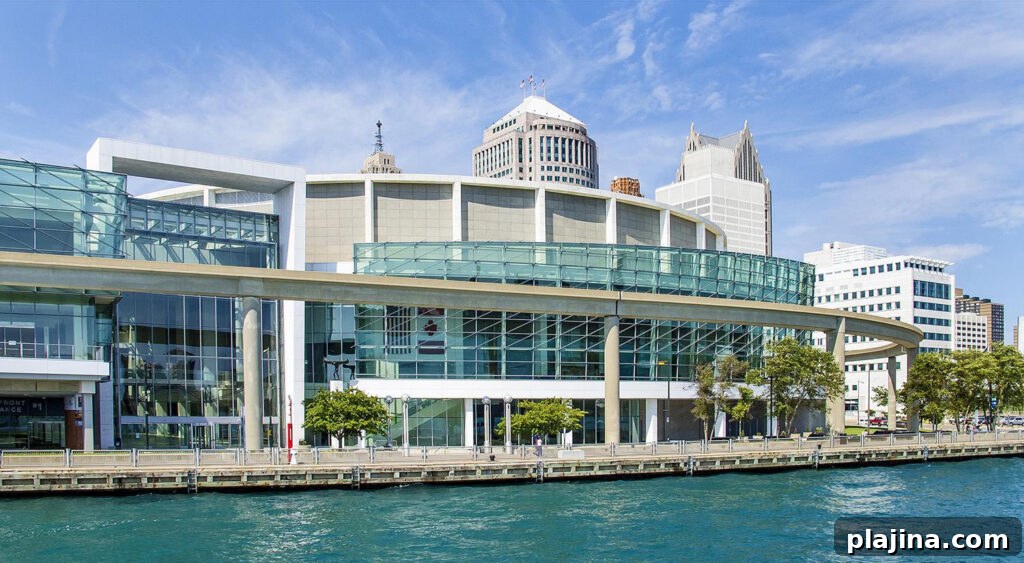
From his 10th-floor office with a 360-degree view of downtown, Molinari notes, “I cannot not see a crane. Nothing speaks to the success and the growth of the city like cranes building things.” He watches construction daily as a 600-room JW Marriott rises along the riverfront, directly connected to the convention center. This hotel project is a response to growing business travel demand, reflecting a broader push to expand downtown hotel capacity.
“When it comes to hotel development, we’re not even close to done,” Molinari explains. “We have the 16th-largest convention center in North America, yet our limited downtown hotel inventory prevents us from fulfilling some clients’ criteria. We’re continuing to invest to increase rooms so we can host major events. Developers are actively interested in supporting Detroit’s resurgence.”
Revitalization is also reshaping neighborhoods once known for crime. Capitol Park, once warned against by locals, has been transformed into a vibrant downtown destination featuring high-end restaurants, a patisserie, a bicycle shop and additional retail offerings.
© Visit Detroit / Huntington Place
Infrastructure and public spaces are expanding as well. The 27.5-mile Joe Louis Greenway, designed for pedestrians and cyclists, will connect Capitol Park with neighborhoods and riverfront green spaces like Ralph C. Wilson, Jr. Centennial Park, a 22-acre waterfront park that opened this fall. Campus Martius Park has been named the No. 1 Best Public Square in the United States by USA Today for the third year running. Cosm Detroit, a large new entertainment venue akin to Las Vegas’ Sphere, is under construction in the square, further enhancing the city’s robust lineup of venues. Only London, New York City and Las Vegas have more seats than Detroit, which offers everything from intimate clubs to major stadiums.
Molinari acknowledges that outside perceptions of Detroit can be negative, but he stresses the city’s safety and vitality. “Detroit is a safe place,” he emphasizes. “Downtown, midtown and the suburbs all offer incredible things to do.” He speaks passionately about the city’s character: “I’ve fallen in love with this place because of the people, the energy, the swag. There’s an authentic energy from Detroiters and Michiganders that’s exceptional—friendly, cool, and resilient. You don’t have to be born here to feel like a Detroiter; it’s an attitude about hustling hard and having grit.”
SCENIC DRIVES
Detroit’s location near the Great Lakes and the Canadian border makes it an ideal base for scenic day trips. Plan for at least four hours to fully enjoy a route that highlights several historic covered bridges. Start about an hour north in Bruce Township to visit the Zappella Covered Bridge, then head northeast to Hadley to see the Mill Creek Covered Bridge. Continue south to Walled Lake for the Robert H. Long Nature Park Bridge, and then to Flat Rock to visit the Huroc Park Covered Bridge. Return toward Detroit with a stop at the covered bridge in Dearborn’s Ford Field Park before heading back into the city.
For a taste of German heritage, drive about an hour and a half to Frankenmuth—Michigan’s Little Bavaria—where Bavarian-style architecture and German-inspired restaurants create a festive atmosphere. Alternatively, cross the border into Ontario for a day at Point Pelee National Park, one of Canada’s most ecologically diverse parks, ideal for hiking and birdwatching.