
“Forget China. Forget Singapore. Forget Brazil and Russia. If India becomes as prosperous as Delhi, we’ve got it made,” wrote Nidhi Nath Srinivas, a columnist for the Economic Times, last October, praising the country’s capital.
Life for the Dilliwallah, Srinivas continued, looks like a dream to many Indians: average incomes in Delhi are roughly three times the national average, rising at rates that outpace inflation. Residents spend more on leisure than on healthcare, and the city’s workforce increasingly includes more women.
Whether sari-clad or suited, the typical Delhi resident — a house-owning, car-driving, fashion-conscious urbanite — represents the expanding Indian middle class. According to the National Council for Applied Economic Research, the share of Indians classified as middle class (by developing-world measures) rose from 18 percent in 1995 to 41 percent in 2005.
By 2007 India had surpassed the United States in mobile phone users, and with the arrival of Tata’s Nano — a $2,500 car meant to bring affordable motoring to millions — the number of drivers is expected to climb further. Economists point out that education is an even stronger indicator of middle-class growth: India’s 18,000 colleges and 348 universities produce around 2.5 million graduates each year, including roughly 400,000 engineers. Many of these graduates join IT firms such as Infosys or multinational corporations with Indian operations. Each year about 80,000 Indians enroll in American universities, compared with 65,000 Chinese students.
This investment in human capital helped fuel entrepreneurship and rapid urban growth, creating powerful economic engines in India’s major cities. Since the 1991 economic liberalization, foreign direct investment has surged, drawing companies like Sony, GE, IBM and Dell to develop office parks and operations around the capital. Often touted as an emerging economic superpower, India has seen major growth, with Delhi at the forefront.
Delhi’s long history as a seat of power — from the founding of Lal Kot by the Tomars in the 11th century to the completion of the British imperial capital in 1931 — has shaped a city of contrasts. North Delhi holds Shahjahanabad, or Old Delhi, where the Red Fort and Jama Masjid rise above narrow, crowded streets. South Delhi features broad, planned boulevards and estates from the British Raj era, anchored by the commercial hub of Connaught Place.
For years Connaught Place had become run down, but it has revived as trendy restaurants, art galleries, cafés and bars filled the area. This revival reflects not only a growing middle class but also a surge in wealth: the 2008 CapGemini Merrill Lynch Asia Pacific Wealth Report found a 22 percent increase in Indians with more than $1 million in assets, reaching 167,000—more than any other country in Asia. Luxury brands have chosen New Delhi as the site for their first Indian boutiques, underscoring the city’s role as a center for high-end retail.
The global recession of the late 2000s affected economies worldwide, but India’s slowdown remained modest by comparison. Analysts noted that India still posted strong growth—around 7.1 percent—and Delhi’s economy was relatively resilient because it did not rely heavily on financial services or U.S. exports. Instead, the city’s strength lay in telecommunications, construction, media, tourism and information technology. The Massachusetts Institute of Technology’s decision to hold its EmTech conference in New Delhi marked the first time the event took place outside the United States, a nod to the city’s growing tech importance.
Manufacturing contributes nearly a quarter of Delhi’s GDP, and its retail sector has spawned Western-style megamalls in suburban areas. International retailers planned major expansions into India—Wal-Mart partnering with Bharti Enterprises and Carrefour negotiating with the Future Group—signaling potential transformation across the retail landscape.
Delhi itself has been changing rapidly. A city of about 15 million, it prepared to host the 2010 Commonwealth Games, prompting extensive infrastructure investments: massive extensions to the Delhi Metro, a new terminal at Indira Gandhi International Airport with capacity for millions more passengers, and an Intelligent Traffic System to improve road monitoring and flow. These projects aimed to modernize transport and accommodations ahead of the international event.
LODGING
THE ASHOK, NEW DELHI
India’s first five-star hotel, the 550-room Ashok sits on 25 acres within the Diplomatic Enclave and features the city’s largest convention hall.$$
THE ASHOK, NEW DELHI
50-B Chanakyapuri
tel 91 11 2611 0101
www.theashok.com
THE OBEROI, NEW DELHI
A leading business hotel, the Oberoi is known for impeccable service and a central location between the Delhi Golf Club and Humayun’s Tomb.$$$$
THE OBEROI, NEW DELHI
Dr. Zakir Hussain Marg
tel 91 11 2436 3030
www.oberoidelhi.com
THE SHANGRI-LA, NEW DELHI
A contemporary luxury property with 320 guestrooms, convenient to shopping in Connaught Place.$$$$
THE SHANGRI-LA, NEW DELHI
19 Ashoka Road
tel 91 11 4119 1919
www.shangri-la.com
DINING
BUKHARA
Frequently ranked among the world’s top restaurants, Bukhara specializes in frontier-style kebabs cooked in a traditional tandoor. $$
BUKHARA
Maurya Sheraton Hotel, Sadar Patel Marg
tel 91 11 2611 2233
THE SPICE ROUTE
Decorated with Kerala temple carvings and antique pillars, this restaurant is known for dishes such as tom kha kai—spicy lemongrass chicken in coconut milk. $$
THE SPICE ROUTE
1 Janpath
tel 91 11 2334 1234
www.theimperialindia.com
TAI PAN
Housed in the Oberoi, Tai Pan is one of Delhi’s most celebrated Chinese restaurants, offering a special dim sum menu and Peking duck steamed in lotus leaves. $$$
TAI PAN
Dr. Zakir Hussain Marg
tel 91 11 2436 3030
www.oberoidelhi.com
DIVERSIONS
Delhi boasts a wealth of monuments and cultural sites. A good starting point is Old Delhi’s Chandni Chowk, a bustling boulevard that cuts through Shahjahanabad’s energetic center.
Begin with a morning visit to the Red Fort, the Mughal-era fortress constructed by Emperor Shah Jahan in 1639 and now a UNESCO World Heritage site. Each August 15 the prime minister addresses the nation from this location on Independence Day. Nearby, rickshaw rides through Chandni Chowk’s alleys and bazaars are a popular way to reach Jama Masjid, India’s largest mosque.
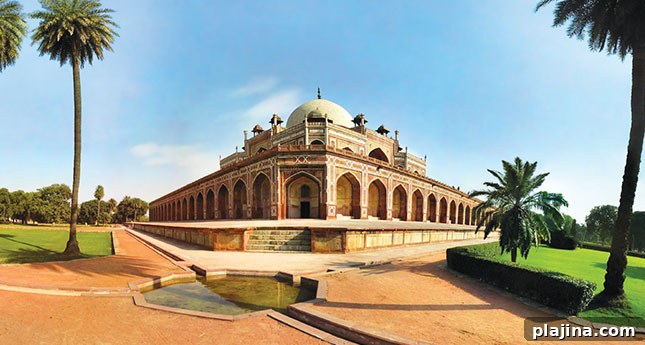
Beyond Old Delhi, don’t miss Humayun’s Tomb in Nizamuddin East, another UNESCO World Heritage site that inspired the Taj Mahal. Recently renovated, this tranquil complex offers peaceful lawns and gardens. Lodi Gardens is another green refuge: a sprawling park with groves, bamboo stands, rolling lawns and an English rose garden, plus historic tombs amid abundant birdlife.
For modern retail and luxury shopping, visit the DLF Emporio Mall in Vasant Kunj, where high-end boutiques and international labels have opened in an elegant, multi-level setting.
Checking In with Sidharth Bodwal
Chief Information Officer of India Tourism
WHAT ARE NEW DELHI’S BIGGEST SELLING POINTS FOR BUSINESS TRAVELERS?
New Delhi combines historical architecture and modern commercial centers, evolving into a forward-looking city while preserving its distinctive character. As the seat of government, it attracts multinational companies, technology firms and a large media presence. International airlines operate from the city, providing strong domestic and global connectivity. This mix of infrastructure, talent and media makes Delhi an increasingly important business destination.
HOW IS THE CITY PREPARING FOR THE 2010 COMMONWEALTH GAMES?
The capital underwent major upgrades to host the event, aiming to become a “world-class city.” New stadiums and expanded transportation—Metro and airport projects—were underway, alongside enhanced security measures. Initiatives included training college students as guides and launching a Bed & Breakfast program to increase visitor accommodations.
TELL US ABOUT THE NEW MALL OF INDIA.
The Mall of India, planned on the NH-8 corridor between Delhi and Gurgaon, was set to be one of the largest malls in the country. Covering millions of square feet with extensive parking, it aimed to be a major retail landmark and to spur further development in the surrounding area.
INFO TO GO
International flights arrive at Indira Gandhi International Airport (DEL). The roughly 13-mile taxi ride to the city center costs about $6 with major taxi operators. For up-to-date travel information, consult official tourism resources.