
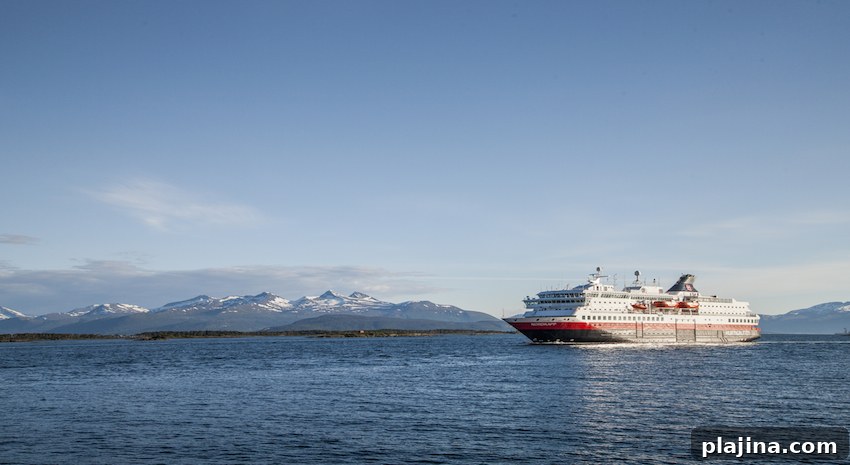
Hurtigruten, the world’s largest expedition cruise operator and one of the industry’s leaders in environmental initiatives, has announced plans to use fishery remains and other organic waste to produce fuel. The company will convert this material into liquefied biogas (LBG), a renewable, fossil-free gas made from dead fish and organic residues. Renewable biogas is among the cleanest fuels currently available for shipping.
“While many competitors still rely on heavy fuel oil, our ships will run on a fuel produced from nature,” said Daniel Skjeldam, CEO of Hurtigruten. “Biogas is the greenest fuel in shipping and gives us a clear environmental advantage. We hope other cruise companies will adopt similar solutions.”
Hurtigruten plans to operate at least six ships on a combination of biogas and battery power by 2021. The company already has three hybrid-electric expedition vessels under construction in Norway, scheduled for delivery in 2019, 2020 and 2021. These ships are being designed to combine battery systems with low-emission fuels to significantly reduce overall emissions during operation.
The move is part of a broader sustainability strategy. Hurtigruten emphasizes that as the largest expedition cruise operator, it has a responsibility to lead by example. “Sustainability will be a defining force for the future of shipping and travel,” Skjeldam added. “Our substantial investments in green technology and innovation are intended to set a new industry standard. Ultimately, we aim to operate our ships with zero emissions.”
Adopting liquefied biogas made from fishery and organic waste offers multiple environmental benefits. It repurposes material that would otherwise decompose or be discarded, cutting methane emissions from waste and reducing reliance on fossil fuels. When combined with energy storage systems and efficient propulsion, biogas enables a cleaner operational profile for vessels, particularly on coastal and short-sea routes where refueling and waste-sourcing logistics are more practical.
Hurtigruten’s approach highlights a shift in maritime thinking: integrating renewable fuels, hybrid propulsion and energy-saving measures to reduce the industry’s carbon footprint. By investing in research, ship design and fuel logistics, the company aims to demonstrate that large-scale cruise operations can become markedly more sustainable without compromising service or safety.
While challenges remain—such as scaling production of renewable biogas, establishing reliable supply chains, and aligning port infrastructure—Hurtigruten’s commitment illustrates how targeted investments and technological adoption can drive meaningful change. If other operators follow this path, the combined effect could substantially lower emissions across marine tourism and short-sea freight sectors.
Hurtigruten’s initiative underscores a practical pathway toward cleaner shipping: use available organic byproducts to create renewable fuel, pair that fuel with battery-electric systems for improved efficiency, and continue to innovate in ship design and operations. The company continues to pilot and expand these solutions as part of a long-term goal to reach emission-free operations whenever feasible.