
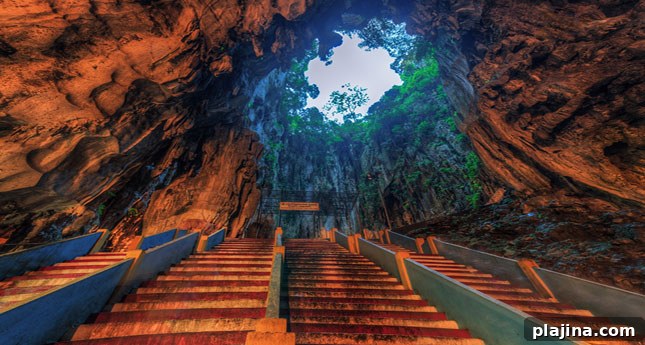
Eight miles north of Kuala Lumpur, tucked among limestone cliffs where monkeys chatter and sun filters through rocky openings, lies one of the most important Hindu shrines outside India. The Batu Caves are a dramatic series of caverns devoted to Lord Murugan and are a major pilgrimage site for Tamil Hindus.
The caves were brought to broader attention in 1878 by American naturalist William Hornaday, and Indian traders soon adopted the site for worship. The steep, spear-like entrance resonated with devotees—Murugan, the Hindu god of victory, is traditionally depicted with a spear. Over the years, devotees and artisans have placed numerous statues, paintings and shrines throughout the cave network. Visitors climb a prominent flight of 272 steps to reach the main cave complex, where a towering 140-foot gold statue of Murugan, installed in 2006, dominates the approach.
While the Batu Caves attract visitors throughout the year, the Thaipusam festival, held in late January or early February, is the highlight of the ritual calendar. During Thaipusam, hundreds of thousands of worshippers travel from across Malaysia and other countries, including India, Australia and Singapore, to participate in the pilgrimage. Devotees often carry elaborate kavadi—ornamental frameworks decorated with feathers and flowers—which can be affixed to the body with skewers as acts of devotion and penance. The procession typically begins at Sri Mahamariamman Temple in Kuala Lumpur’s Chinatown and proceeds to the caves, with priests, chanting crowds and a silver chariot bearing the image of Lord Murugan.
The scene during Thaipusam is intensely colorful and deeply spiritual: devotees in ritual dress, the steady beat of drums, and the sight of pilgrims making the ascent create a powerful, memorable experience for worshippers and observers alike. Photographers and cultural travelers often plan visits around the festival to witness the scale and devotion firsthand, but the caves themselves remain a compelling destination any time of year.
Reaching the Batu Caves is straightforward. From Kuala Lumpur Sentral, take the KTM Komuter train to the Batu Caves station for a direct and economical journey. Alternatively, visitors can hire a round-trip taxi or private transfer; a typical shared taxi tour is often priced around $45 depending on the operator and group size. There is no admission fee to enter the cave complex, though donations and modest offerings are common at shrines.
Practical tips: wear comfortable shoes for the climb, dress modestly out of respect for the religious site, and be mindful of the resident monkeys, which are accustomed to people and may approach in search of food. Whether you come for spiritual reasons, cultural interest or natural beauty, the Batu Caves offer a striking combination of limestone geology, sacred art and living tradition.