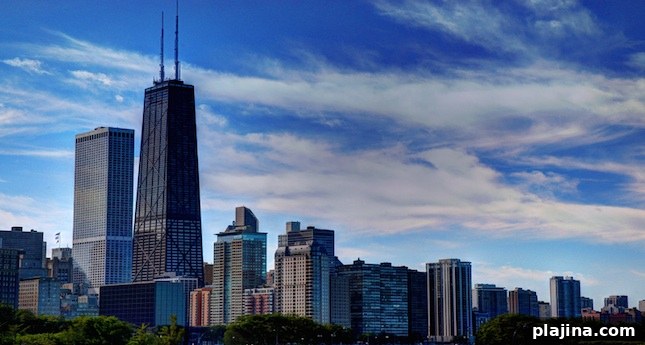
A group of Chicago business leaders has proposed building a glass-enclosed aerial gondola system to give visitors panoramic views of the city from above. The concept was unveiled last month during a presentation to the City Club of Chicago as part of a broader tourism plan aiming to grow annual visitors to 76 million—a roughly 50 percent increase over current levels.
Called the Skyline, the proposed gondola line would connect two of Chicago’s most popular destinations, Navy Pier and Millennium Park, traveling along Michigan Avenue and highlighting the city’s renowned architecture. Designed to operate in all weather conditions, the system would carry up to 3,000 passengers per hour in both directions at speeds around 9 mph. The ride would take approximately 30 minutes and reach heights equivalent to 17 stories above the south bank of the Chicago River. Ticket prices are expected to be about $20 per person.
The gondola is one of several ideas included in the tourism proposal. Other recommendations focus on enhancing the urban experience through improved nighttime lighting to showcase landmarks, upgraded streetscapes, better airport transit connections, floating performance stages on the river, and a new entertainment district along the Cermak corridor. These measures are intended to create memorable, easily accessible attractions that encourage longer stays and more repeat visits.
Lou Raizin, one of the presenters, estimates the Skyline gondola could draw as many as 1.4 million additional visitors to the city. “We kept coming back to the same question: What’s our unique feature? Where’s our Eiffel Tower? Where’s our Big Ben? These ideas are our attempt to answer this question,” he explained, emphasizing the need for iconic attractions that define a city’s identity and appeal to global travelers.
The proposal aims to balance practicality with spectacle: a reliable transport link that doubles as a sightseeing experience, integrated into Chicago’s existing urban fabric. Proponents say the gondola could relieve pressure on ground transportation while offering a distinctive perspective on the city’s skyline, riverfront, and cultural destinations.
While the plan remains a concept, supporters argue it would complement other investments in public space and infrastructure, creating a cohesive strategy to boost tourism and local economic activity. By combining aesthetic improvements, transit upgrades, and new entertainment options, the proposal seeks to make Chicago more inviting for both visitors and residents.
The presentation to the City Club generated discussion about feasibility, cost, and environmental impact, with stakeholders noting that careful planning and community engagement would be essential if the project moves forward. Questions remain about siting, construction timelines, and how the gondola would integrate with existing transportation networks and riverfront uses.
Ultimately, the Skyline gondola and related proposals reflect a broader effort to identify bold, signature projects that can elevate Chicago’s profile as a global destination while improving everyday experiences for people who live and work in the city.