
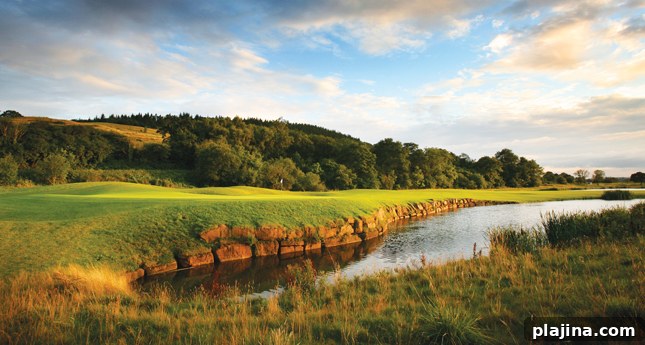
Celtic Manor’s Twenty Ten Course, a 7,493-yard, par-71 parkland layout, was built specifically for the tournament. Nine newly designed holes by European Golf Design were merged with nine holes from the existing Wentwood Hills championship course by Robert Trent Jones, Jr. The combination creates a fusion of British and American influences: thick rough, deep bunkers and abundant water — in the words of its designers, “a bit of Augusta, a bit of Florida, and a lot of Wales.”
While the Twenty Ten is the most celebrated, it is one of three championship courses at Celtic Manor. The par-70 Roman Road course has long hosted the Wales Open on the European Tour, and the par-69 Montgomerie — designed by last year’s Ryder Cup captain, Colin Montgomerie — is the most links-like of the trio, with steep contours, deep pot bunkers and dramatic valley views.
Although under two hours from London, Celtic Manor feels far removed from the capital. Set in the green Usk Valley, the 1,400-acre estate rolls across hills, broad meadows, reed swamps and salt marshes. The property sits within an area the U.K. government classifies as an “Area of Outstanding Natural Beauty,” and its landscape remains largely pristine and well preserved.
The resort includes a 330-room, five-star hotel, a smaller historic four-star hotel, a luxurious health club and spa, a shopping complex and six restaurants. One standout is Newbridge on Usk, a 200-year-old country inn with fireplaces, wooden floors, local ales on tap and six stylish suites.
The surrounding area offers plenty of activities. The Penderyn Distillery, located in the Brecon Beacons National Park, produces a highly regarded single malt and welcomes visitors to tours and tastings in its modern visitor center. Nearby, Treetops Sporting Ground provides clay pigeon shooting on a leafy 38-acre estate for those seeking outdoor sporting pursuits.
When architect Ross McMurray set out to create the Twenty Ten, he aimed to produce more than a golf course — he wanted a stage for a tournament of rare significance. The Ryder Cup’s 40,000 spectators have since dispersed, but the memory of that dramatic final day — when the Americans surged back and Graeme McDowell sealed the victory for Europe on the last match — still hangs over the fairways.
Hole 1 (465 yards, par 4)
The opening hole immediately challenges a player’s shot selection. The fairway doglegs from right to left, and a cluster of bunkers at the turn discourages the most direct line. Playing conservatively to the right leaves a 200-yard approach over traps protecting the green. There’s no water, but the fescue rough is unforgiving and can easily swallow errant shots.
Hole 3 (189 yards, par 3)
Precision is essential on the first of five par 3s and one of six signature holes. From the back tee it’s a straight carry of 160-plus yards over a teardrop-shaped pond. A large bunker guards the front right of the green: short means the water, long risks rolling off into dense vegetation. Accuracy is rewarded, while misjudgment is costly.
Hole 5 (433 yards, par 4)
The second signature hole offers classic risk and reward. Big hitters can reach the green in two, but errant drives will likely find bunkers that flank the fairway’s left-to-right dogleg. The safer play is up the right side, leaving a 100-yard wedge over a stream in a narrow gully — a precise approach is required to avoid trouble.
Hole 9 (666 yards, par 5)
This extraordinary par 5 ranks among the longest holes found on championship courses. While professionals may attempt to reach in two, most golfers will need to keep the momentum going across three strong shots. The River Usk runs along the left, with substantial bunkering to the right; the generous fairway between them is relatively forgiving, offering a pathway through the length of the hole.
Hole 12 (458 yards, par 4)
Famous for dramatic moments during the Ryder Cup, this hole tempts bold shots. The fairway sits like a peninsula with the green positioned across a pond. Players must decide whether to carry the water or play around it. The aggressive line rewards the brave but often leaves tricky recovery options if the approach doesn’t find the putting surface.
Hole 14 (485 yards, par 4)
Water features prominently again as the fairway winds between twin lakes toward a narrow, elevated green. Long hitters can try to clear water with a powerful drive, while a shorter tee shot left of the lake provides a longer but safer approach with water still guarding one side.
Hole 15 (377 yards, par 4)
One of the course’s most memorable holes, this par 4 presents a drivable but well-protected green. The hole tempts players from a high vantage beyond a ridge of trees. While a well-struck tee shot can reach close to the pin, the green is guarded by bunkers that can swallow a slightly misjudged run.
Hole 18 (575 yards, par 5)
The finishing hole provides a dramatic conclusion: a long, downhill fairway that climbs steeply to a demanding green overlooked by the clubhouse. Though reachable in two for the longest hitters, success depends on avoiding bunkers left and steep run-off right. The elevated green sits above water and between two large traps — a conservative line left and long typically yields the safest route to a closing par or birdie opportunity.
The Celtic Manor Resort
Coldra Woods
Newport, South Wales NP18 1HQ
United Kingdom
tel 44 1633 413 000