Casablanca is more than a location; it is a cultural icon. The name evokes classic cinema, memorable lines, romance and the on-screen chemistry of Bogart and Bergman. Immortalized in black and white, the film “Casablanca” fixed an image in the popular imagination that still resonates worldwide.
For many people, the cinematic Casablanca has long overshadowed the real North African port city. Yet beyond the film’s glamour lies Morocco’s largest metropolis, where some 3.5 million residents live in vivid, modern color. The streets are busy, honking with traffic. Container ships move cargo through the region’s busiest harbor. Ambitious commercial projects, including one of the continent’s largest shopping centers, underline the city’s economic aspirations.
Casablanca traffic © Dario Bajurin I Dreamstime.com
Visitors expecting an untouched ancient city may be surprised. Contemporary Casablanca is a working urban center shaped by modern growth and everyday challenges. The Moroccan writer Tahar Ben Jalloun once compared the city to a wooden trunk by the sea, marked by time and the elements.
On arrival the impression can be of faded grandeur. Many colonial-era buildings show wear from Atlantic winds and humidity. Urban sprawl moves inland from the coast, with neighborhoods ranging from affluent enclaves to poorer districts punctuated by congested roads and frequent traffic jams.
Casablanca’s fortunes have fluctuated across centuries, often under the influence of larger regional powers. Phoenician traders first established a port near the Anfa Hills more than 2,600 years ago. That early settlement later became Anfa, the capital of a Berber state, before Portuguese occupiers in the 16th century gave it the name Casa Branca—“White House”—for the whitewashed fortifications they built.
After the Portuguese left, the town declined into a small fishing village by the early 19th century. European demand for trade centers returned in the 19th and early 20th centuries, and French influence eventually shaped the city’s modern layout. Under the French protectorate, General Hubert Lyautey prioritized Casablanca as Morocco’s principal commercial hub and commissioned a major new port.
Development preserved the old medina but replaced much of the surrounding terrain with wide, tree-lined boulevards and civic squares in a French urban style. Architecture in Casablanca became an eclectic fusion: Art Nouveau, Parisian Art Deco and Neo-Classical elements blended with traditional Moorish motifs into a style often called Mauresque. That mix helped inspire the evocative sets associated with the famous film.
By the 1930s Casablanca was viewed as a cosmopolitan model by many Western observers. Yet that era reflected a colonial society in which Europeans made up a large share of the population. The city’s social balance shifted dramatically after Moroccan independence in 1956, as rural migrants arrived in large numbers. Rapid population growth strained infrastructure and led to the expansion of informal settlements.
Over recent decades Casablanca has remained Morocco’s economic engine, even as social inequalities, corruption and infrastructure shortfalls have posed persistent challenges. In 2003 the city endured a tragic wave of coordinated bombings that killed dozens. The attacks highlighted both security concerns and the socioeconomic conditions driving radicalization—many perpetrators came from impoverished neighborhoods.
In response, the government initiated programs to replace shanty towns with affordable housing and to invest in urban regeneration. Simultaneously, Casablanca’s economy has diversified. The city hosts regional offices for multinational firms and has developed industrial zones with an emphasis on aerospace and advanced manufacturing. Local companies collaborate with global partners, and international investors have announced significant projects, including aircraft-parts facilities.
Public transit and urban planning remain priorities. While a full metro system has not yet materialized, progress on a 49-stop tram line aims to ease chronic congestion. Large-scale waterfront developments, such as the Casablanca Marina between the port and the Hassan II Mosque, reflect the city’s push to modernize its coastal areas.
Hassan II Mosque © Richard Sharrocks I Dreamstime.com
In 2011 Casablanca welcomed the Morocco Mall, North Africa’s first major destination shopping center, which opened with a high-profile event. The oceanfront complex includes an indoor aquarium and has positioned itself as one of Africa’s largest retail destinations, aiming to attract millions of visitors annually.
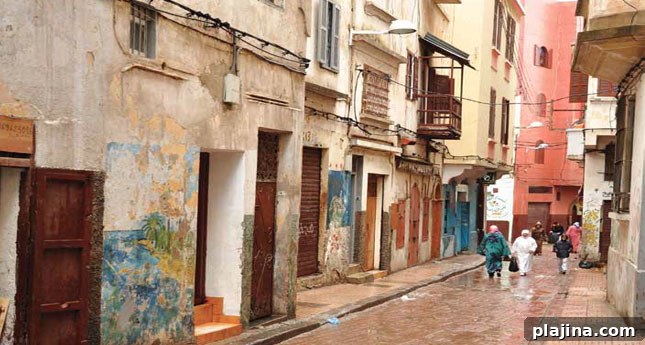
Despite ongoing change, the old medina retains the city’s historical character. Wandering its shaded alleys offers a direct encounter with local life, an opportunity to negotiate in the souks and a way to experience Casablanca beyond its cinematic reputation.
Casablanca’s social atmosphere can feel more open than other Moroccan cities: men and women interact freely, and public debate is more visible. The city was a focal point for demonstrations during the Arab Spring and played a role in the political changes that followed, including recent national elections that brought a moderate Islamist party to power.
For decades the filmic Casablanca shaped global perceptions, often obscuring the realities of a complex, modern African metropolis. Today the city is evolving—sometimes chaotically, sometimes ambitiously—toward a distinct identity that blends history, commerce and contemporary urban life.
Here’s looking at you, Casablanca.
CHECKING IN WITH KATHY KRIGER
Owner, Rick’s Café
TELL US ABOUT YOURSELF.
I am a former U.S. diplomat who opened Rick’s Café in 2004. My experience and the café’s story are detailed in the forthcoming book Rick’s Café: Bringing the Screen Legend to Life in Casablanca.
WHAT ARE KEY OPPORTUNITIES IN CASABLANCA FOR AMERICAN INVESTORS?
Casablanca is Morocco’s economic capital and a regional hub for international companies. Stability, institutional reforms including a new constitution, and recent elections have strengthened investor confidence. Opportunities exist across trade, services, manufacturing and new technology sectors.
HOW IS MOROCCO COPING IN THE CURRENT GLOBAL ECONOMIC CLIMATE?
Morocco maintained positive growth during global downturns, though tourism suffered amid regional unrest. Local banks are conservative with new foreign entrants and often favor established domestic partners, so newcomers should be prepared for cautious financing environments.
WHAT CULTURAL DIFFERENCES SHOULD BUSINESS VISITORS NOTE?
French is commonly used in business, so visitors should not rely solely on local partners for translation. Building relationships on the ground is essential. While corruption exists, being transparent from the start can help avoid ethical pitfalls. The recently empowered Party of Justice and Development has prioritized anti-corruption measures.
HOW HAS CASABLANCA CHANGED SINCE YOU’VE KNOWN IT?
Working on Rick’s Café exposed me to Casablanca’s administrative and bureaucratic challenges. Since 1998 the city’s architectural heritage has suffered neglect; some Art Deco buildings have been lost. Launching major projects has required navigating financial and regulatory hurdles.
WHAT ARE YOUR HOPES FOR THE FUTURE?
I would like to see incentives shift from broad real estate tax breaks to support for preservation and restoration. Low-cost, long-term financing for rehabilitation projects could help protect architectural heritage. I hope Old Casablanca receives attention equal to new developments and that improved public transit eases the city’s traffic issues.
LOCAL ATTRACTIONS YOU’D RECOMMEND?
Visit the Hassan II Mosque for its remarkable interior. The Art Deco district and Marche Central are central to the city’s character. Explore the Ancienne Medina and its historical sites, and stop by Rick’s Café. Rehabilitation projects for the old medina are underway with renewed support.
Things to Do in Casablanca
The Hassan II Mosque is Casablanca’s defining landmark. Completed in 1993 after years of craftsmanship, the mosque features the world’s tallest minaret at 689 feet. Its prayer hall accommodates thousands, and parts of the structure extend over the Atlantic with a glass floor revealing the sea below. At night green lights point toward Mecca. As one of the few Moroccan mosques open to non-Muslims, it requires respectful dress, with shoulders and legs covered.
Nearby, Boulevard Moulay Youssef leads to the Cathédrale Sacré-Coeur, a 1930 Neo-Gothic former church now used as a cultural center. Its soaring whitewashed interior and stained-glass windows make it a striking visit.
Casablanca also preserves Jewish heritage, showcased at the Jewish Museum in the Oasis suburb. The museum presents artifacts and exhibits that document centuries of Jewish life in Morocco, including replicas of synagogues and traditional workshops.
Place Mohamed V forms the city’s administrative and social core, with gardens, fountains and impressive colonial-era buildings like the Palais de Justice. The square is a lively spot to observe daily life and mingle with locals.
The Ancienne Medina offers an authentic look at traditional street life. The New Medina, a 1930s French-era redevelopment, provides a more organized experience near the Royal Palace. For seaside leisure, the Corniche in Ain Diab hosts beach clubs and a vibrant waterfront scene at sunset.
Casablanca Info to Go
Most international travelers arrive at Mohammed V International Airport (CMN), about 18 miles southeast of downtown. Regular train services connect the airport to the city center and shuttle buses provide additional options. Local visitor information resources can help with transport, attractions and events.
Casablanca: Just the Facts
Time Zone: GMT +0
Phone Code: +212 (Morocco), local Casablanca prefix 522
Entry/Exit Requirements: U.S. passport holders need a passport valid for at least three months beyond their intended stay; no visa is required for stays up to three months.
Currency: Moroccan dirham
Official Language: Arabic; French is widely used in business and daily life.
Key Industries: Trade and logistics, phosphate, fisheries, manufacturing, aerospace, banking
Where to Stay in Casablanca
Hotel & Spa Le Doge A restored Art Deco boutique hotel that channels Casablanca’s 1930s elegance. 9 Rue de Doctor Veyre, tel 212 5 22 46 7800
Hyatt Regency Casablanca A centrally located hotel overlooking the old city maze, offering convenience and comfort. Place des Nations Unies, tel 212 5 22 43 1234
Moroccan House Hotel A courtyard-centered hotel inspired by traditional Moroccan houses, blending local decor with modern amenities. 3 Rue Mohamed Smiha, Côte Av. des FAR, Centre Ville, tel 212 5 22 54 3566
Restaurants in Casablanca
La Bavaroise Near Place des Nations Unies, this restaurant serves international cuisine with a French influence; seafood is a highlight. 133 Rue Allal Ben Abdallah, tel 212 5 22 31 1760
Rick’s Café A thoughtfully recreated venue inspired by the film, offering an atmospheric dining experience. 248 Blvd. Sour Jdid, Place du Jardin Public, Ancienne Medina, tel 212 5 22 27 4207
La Sqala A popular café within the old medina, known for Moroccan specialties served in a charming setting. Blvd. des Almohades, tel 212 5 22 26 0960