
In 1832 a wooden ship dropped anchor off a striking group of volcanic islands, carrying a young English naturalist eager to explore a place that had long captured his imagination. The ship was HMS Beagle and the naturalist was Charles Darwin—but these islands were the Canary Islands, not the Galápagos.
Today’s Canaries can feel at odds with Darwin’s description of them as “one of the most interesting places in the world.” Mass-market tourism has transformed parts of Tenerife into busy resort zones filled with high-rise hotels, bustling promenades and neon nightlife geared to millions of visitors each year.
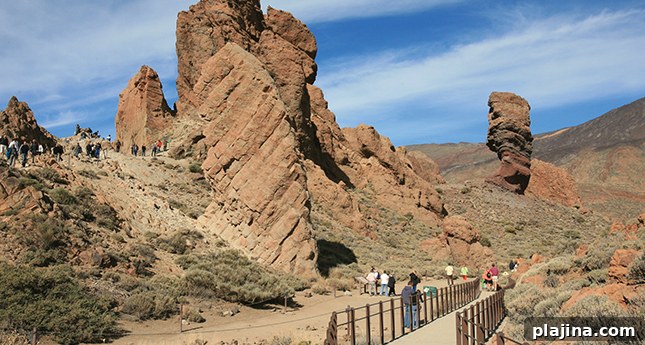
Yet beyond the popular resorts such as Playa de las Américas and Los Cristianos, the island quickly reveals quieter landscapes: country lanes that pass through scenery that alternately evokes mainland Spain, Hawaii, North Africa and, at higher elevations, a lunar plain. Escape the crowds and you’ll find dramatic volcanic terrain, hidden coves and deceptively varied ecosystems.
Mount Teide, Tenerife’s 12,000-foot summit, is Spain’s highest peak and one of the world’s largest volcanoes. On clear days the summit offers sweeping views across Tenerife and the neighboring islands—La Gomera, El Hierro and La Palma to the west, Gran Canaria to the east, and Lanzarote and Fuerteventura farther beyond. On very clear days the Moroccan coast can be glimpsed some sixty miles away.
Teide is home to the Teide Astronomical Observatory, established in 1964. The high-altitude skies and minimal light pollution make it one of Europe’s premier locations for astronomical research and an excellent place to view the night sky.
Human settlement in the Canaries dates back centuries. The original inhabitants, the Guanches—often called the Men of the White Mountain—are believed to have arrived from North Africa around 200 B.C. Their cultural traces remain visible across the islands.
At Güímar on Tenerife’s eastern slopes, Thor Heyerdahl uncovered a complex of stepped stone structures he interpreted as pyramids that might suggest transatlantic contact. More recent studies propose alternative explanations—possibly agricultural terraces from later periods—so visitors are encouraged to see the site and form their own opinions.
Perhaps the most evocative Guanche legacy is displayed in the Museum of Nature and Man in Santa Cruz de Tenerife, where preserved Guanche mummies and a broad collection of archaeological artifacts illustrate burial practices and daily life before the Spanish conquest.
Santa Cruz itself reflects centuries of Spanish influence. Conquered during the 15th century, the islands have retained many Spanish customs: long evenings, siestas and exuberant fiestas. The Carnival of Santa Cruz de Tenerife, held the week before Lent, is a riotous celebration of music, color and parade that rivals major carnivals worldwide.
The city combines historic architecture—Baroque churches and colonial townhouses dating from the 17th century—with striking modern interventions. One contemporary landmark is the Tenerife Auditorium, an expressive building by Santiago Calatrava that now forms a dramatic point on the waterfront near the ferries linking Tenerife with Gran Canaria.
These ferries cross more than sea; they also traverse a long-standing rivalry between the islands. Since 1927 the Canaries have been administratively divided into two provinces. Santa Cruz de Tenerife names the western province, which includes Tenerife, La Gomera, La Palma and El Hierro—three islands that have largely avoided mass tourism due to their rugged, cliff-fringed coastlines and inaccessible interiors.
La Gomera is a short jetfoil ride from Tenerife, arriving at the attractive port of San Sebastián. Its sheltered harbors and largely unchanged interior recall the era when Columbus stopped here, and visitors can still hear Silbo, the island’s traditional whistled language, which was historically used to communicate across steep valleys.
La Palma—known as “The Pretty Island”—lives up to its name. It is one of the steepest islands in relation to its area, soaring to nearly 8,000 feet. Its interior is cut by deep ravines filled with pine forests and banana groves; black-sand beaches such as Puerto Naos provide restful spots to recuperate after mountain hikes.
El Hierro, the smallest of the main islands, is a UNESCO Biosphere Reserve and a haven for travelers seeking solitude and unspoiled nature. Its volcanic landscapes and coastal waters offer excellent hiking and scuba diving opportunities.
By contrast, Gran Canaria—home to nearly half the archipelago’s population—pairs extensive sandy beaches and large resorts with surprisingly varied interior landscapes. Locals pride the island on being a “continent in miniature”: dunes at Maspalomas evoke the Sahara, misty highlands suggest mountain climates, and arid valleys recall the American Southwest. The island’s capital, Las Palmas, is a cosmopolitan port with a diverse population and cultural mix.
Fuerteventura and Lanzarote, to the east of Gran Canaria, are characterized by arid, desert-like interiors dotted with resilient vegetation. Fuerteventura’s southern beaches feature turquoise water and long sand stretches reminiscent of the Caribbean, while its inland villages and Moroccan-like scenery invite exploration.
Lanzarote’s volcanic terrain is stark and otherworldly: rust-red slopes, hundreds of volcanic cones and black lava fields dominate the landscape. Despite its appearance, the island supports fertile pockets, including the main wine region, where vines are carefully sheltered from wind by distinctive semicircular stone walls.
Spend time island-hopping across the Canaries and Darwin’s praise becomes easy to understand: together the islands form a unique, richly diverse archipelago with volcanic geology, varied ecosystems and deep cultural history. It’s easy to imagine Darwin’s frustration when quarantine prevented him from disembarking during the Beagle’s brief visit.
Info To Go
There are no direct flights from the United States to the Canary Islands. Tenerife (TFN and TFS), Gran Canaria (LPA), La Palma (SPC), Fuerteventura (FUE) and Lanzarote (ACE) airports receive frequent flights from many European cities, with London Gatwick, Madrid and Amsterdam among the most convenient hubs for trans-Atlantic connections. La Gomera and El Hierro are reached by flights or ferries from neighboring islands.
Diversions
Mount Teide dominates western Tenerife and offers about 50 marked trails for hiking. A cable car reaches close to the summit in eight minutes, though queues are common. Visitors should dress warmly for the summit, which can be bitterly cold. A daily limit applies to the number of people allowed to climb from the upper station to the very top; reserve permits in advance from the Servicio de Uso Público in Santa Cruz. While in Santa Cruz, the Museum of Nature and Man presents excellent displays on the Guanche people, and the Military Museum includes historic artifacts linked to naval engagements in the region.
La Gomera’s Garajonay National Park offers dense laurel forests and excellent walking routes. The island’s whistled language, Silbo, is still taught locally—check for community classes if you want to learn more.
La Palma features dramatic volcanic scenery. Caldera de Taburiente National Park contains a vast volcanic depression to explore, and the Roque de los Muchachos observatory houses powerful telescopes; summer visits are sometimes available by prior arrangement.
El Hierro, the geologically youngest island, markets itself as a low-impact eco-destination with rewarding inland hikes and some of the best diving in the Canaries. The Guinea Eco Museum showcases rural architecture and a captive breeding program for the endemic El Hierro giant lizard.
Gran Canaria combines mainstream holiday facilities with surprising natural variety. Theme parks and watersports are concentrated around the resort zones, while cultural attractions include recreations of Guanche heritage. Fuerteventura’s Betancuria provides a shaded, palm-ringed village experience inland, and Isla de Lobos offshore makes a pleasant half-day excursion for birdwatching and diving.
Lanzarote’s dramatic scenery has inspired filmmakers and artists for decades. Local artist César Manrique left a strong imprint on the island through distinctive buildings and cultural projects; his former home is now the César Manrique Foundation, exhibiting his work and influence.
Lodging
Gran Hotel Bahía del Duque, Tenerife
A 5-star hotel in the quieter Costa Adeje area, inspired by 19th-century Canarian architecture and opening onto an attractive public beach. Av. Bruselas, Costa Adeje, Tenerife, tel 34 922 746900.
Hotel Casa del Embajador, Lanzarote
A small family-run hotel housed in an early-1900s diplomatic residence near Playa Blanca. No pool, but close to the beach. Playa Blanca, Lanzarote, tel 34 928 519191.
Hotel Jardín Tecina, La Gomera
Comfortable rooms set in extensive gardens, with a pool overlooking Mount Teide—an excellent base for exploring the island’s interior. Playa Santiago, La Gomera, tel 34 922 145850.
Dining
La Bocaina
A long-standing local favorite in Playa Blanca, Lanzarote, offering a modern European menu prepared by British chef Paul Ecob and his wife. Tel 34 928 518388.
Marqués de Oristano
A popular spot on La Gomera known for regional specialties given a modern twist—try rabbit with marmalade if you’re feeling adventurous. 24 Calle Real, San Sebastián, La Gomera, tel 34 922 141541.
La Vieja
Seafood-focused dining on Tenerife’s coast, run by a Galician chef who favors straightforward, high-quality preparations. Av. Las Gaviotas, La Caleta, Tenerife, tel 34 922 711548.