
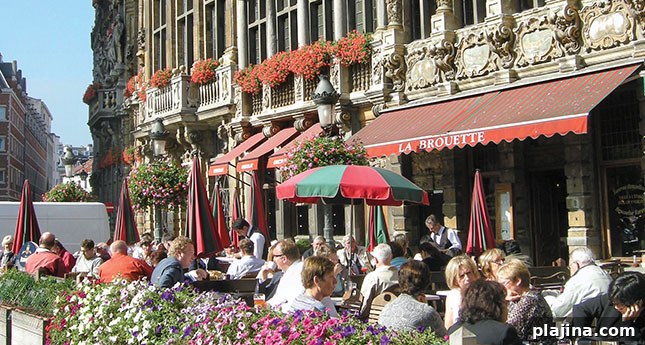
With so many capital cities close together across continental Europe, Brussels can easily be overlooked when planning a family trip. Don’t skip it. Belgium’s royal metropolis — home to more than a million people in the wider urban area — offers a compact, lively mix of history, culture, food and family-friendly attractions that reward both first-time and returning visitors.
A great place to begin is the Municipal Instruments Museum, located in the striking Old England building, an 1898 Art Nouveau landmark on Rue Montagne de la Cour. The museum displays more than 1,500 instruments — keyboards, strings, brass, classical and folk pieces, vintage and modern — and uses interactive stations and headphones to enhance the audio-visual experience. The museum’s sixth-floor restaurant and tea room opens onto a roof terrace with sweeping views of Brussels’ rooftops and cityscape.
Nearby, on the Kunstberg hill, the Palace of Charles Alexander of Lorraine has recently been restored and is open for tours. The palace’s 18th-century Baroque apartments and salons feature elegant details — a Grecian statue of Hercules beside a grand staircase and a rotunda crowned with a rosette made from 28 varieties of Belgian marble.
A short walk leads to the fashionable Sablon district, where sidewalk cafés, antiques dealers, art galleries and boutiques cluster around Place du Grand Sablon. This is where you’ll find high-end chocolate makers like Pierre Marcolini, the celebrated pastry shop Wittamer and the family-friendly bakery-restaurant Le Pain Quotidien. Place du Petit Sablon is a small Renaissance-style garden enclosed by decorative iron railings and dotted with statues of 16th-century guild masters, each bearing the tools of his trade. On weekends, the area around the late-Gothic Notre-Dame church hosts Les Marché des Antiquaires, one of Europe’s finest antiques markets — open Saturdays (9 a.m.–5 p.m.) and Sundays (9 a.m.–1 p.m.).
Many travelers consider the Grand’Place the most picturesque market square in Europe. Paved with cobblestones and similar in size to a soccer field, the square is a pedestrian-only “urban living room” dominated by the 15th-century Hôtel de Ville town hall. The town hall’s 315-foot spire is topped by a gilded statue of Archangel Michael, patron saint of Catholic Brussels. Guided tours of the town hall are available for a modest fee, and they provide useful historical context.
Surrounding the square are 39 harmonious 17th-century Flemish guild halls with pinnacles, parapets, turrets and ornate gables. In summer evenings, floodlights illuminate the façades and classical music often accompanies the atmospheric scene. From early morning into the afternoon, flower vendors fill stalls with colorful blooms. Every two years, during the second weekend of August, a vast flower carpet made of begonia blossoms covers part of the Grand’Place, forming intricate patterns across thousands of square feet.
For shopping, head to Rue Neuve, Boulevard de Waterloo and the busy Boulevard Anspach a few blocks from the Grand’Place and the historic Bourse building, a 19th-century domed colonnaded structure. If your trip coincides with Ommegang — a historical pageant usually held in early July — book accommodations early. The Ommegang reenacts a 1549 procession ordered by Holy Roman Emperor Charles V, with costumed riders, musicians, stilt-walkers and theatrical scenes that transform the Grand’Place into a lively medieval village.
From the eastern edge of the square, narrow streets lead into L’Ilot Sacré, a densely packed quarter where pedestrian-only Rue des Bouchers is lined with seafood restaurants and souvenir shops. That street connects with the glazed Galeries Saint-Hubert, completed in 1847 as one of the first enclosed shopping arcades. With cafés, a theater and boutiques, the galleries are a pleasant, weatherproof spot for people-watching and sampling Belgian chocolates such as Neuhaus, Leonidas, Guylian and Godiva. While visiting the Grand’Place, families may also enjoy the Museum of Cocoa and Chocolate for an introduction to Belgium’s famous confectionery heritage.
Belgian comfort food is abundant: cream cakes, crêpes and waffles (gaufres) are national favorites. Equally iconic is Belgian beer — nearly 400 varieties from more than a hundred breweries — ranging from well-known brands like Stella Artois and Leffe to regional specialties such as Hoegaarden, Rodenbach and lambic styles.
The Royal Museum of Fine Arts of Belgium combines Ancient Art and Modern Art collections and offers works by Old Masters such as Bosch, Cranach, Rubens, Rembrandt, Van Dyck, Memling and Bruegel alongside 20th-century Belgian Surrealists like René Magritte, Paul Delvaux and James Ensor. A dedicated space highlights Pieter Bruegel the Elder’s famous scenes of village life and his dramatic depictions of moral and religious subjects.
On Rue des Sables, the Belgian Comic Strip Center occupies a 1906 textile warehouse redesigned by Victor Horta. The museum celebrates Belgium’s rich comics tradition with displays, original publications and figurines featuring characters such as Tintin, Lucky Luke, Spirou and the Smurfs — a hit with children and adults alike.
About a mile east of the historic center is the European Union district, where international workers populate cafés and pubs that reflect a range of national styles. Nearby Cinquantenaire Park features a monumental triumphal arch and several museums. Autoworld, housed in a pavilion from the 1958 World’s Fair, traces a century of automobiles and includes notable historic vehicles. The National Botanical Garden, near Gare du Nord, displays thousands of flowering plants in season.
Info To Go
The taxi ride from Brussels Airport (BRU) to the city center takes about half an hour and typically costs between $42 and $55. To save money, take the No. 3 STIB bus. For official visitor information, consult the local tourist office resources for Flanders.
Lodging
Adagio Brussels Centre Monnaie
This well-maintained apartment hotel on a main shopping street offers 140 stylish units with full kitchens and modern communications amenities. Blvd. Anspach 20, tel 32 2 212 93 00, $–$$
Hotel Metropole
Steeped in late-19th-century charm, this renowned 5-star hotel sits amid business, government and shopping districts within walking distance of the Grand’Place. Place du Brouckére 31, tel 32 2 217 23 00, $$$
Sheraton Brussels Hotel
A large modern high-rise with 511 rooms, multiple restaurants, a spa and conference facilities, this hotel suits travelers seeking familiar international standards. Place Rogier 3, tel 32 2 224 31 11, $$$–$$$$
Dining
Le Cap Sablon
Set near Place du Grand Sablon, this intimate Belgian-French bistro seats about 20 and features period décor and attentive service. Rue Lebeau 75, tel 32 2 512 01 70 $–$$
Falstaff
An Art Nouveau brasserie near the stock exchange, Falstaff serves Flemish beef and beer stew and offers an extensive selection of Belgian beers. Rue Henri Maus 17, tel 32 2 511 87 40 $
La Maison du Cygne
This well-regarded restaurant boasts a comprehensive wine list and window tables overlooking the Grand’Place. Note that it is closed on Saturday lunchtimes and all day Sunday. Rue Charles Buls 2, tel 32 2 511 82 44, $$$$