
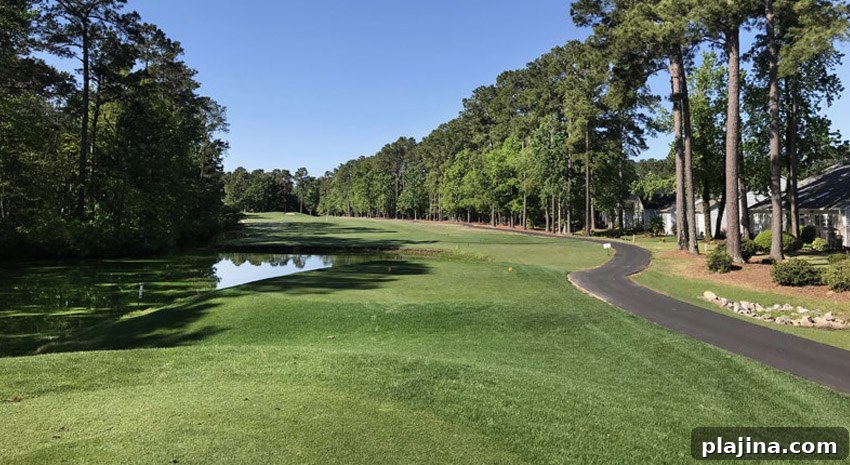
I searched high and low, and surprisingly my annual, more-than-20-year Myrtle Beach tradition had never included a review of the Grand Strand’s only Gary Player signature course — Blackmoor. The South African legend, known for his distinctive walking-through swing, has also built a reputation as a top course designer. Blackmoor sits on Longwood Plantation along the Waccamaw River, on land that was once a rice plantation. While playing, you’ll notice remnants of the area’s history, including old graves near some holes.
Player’s design here respects the site’s natural undulating terrain, likely drawing on the kinds of landscapes he knows from home. He used the property’s contours to create a course that is both playable and challenging. As a prolific designer with projects around the world, Player’s work at Blackmoor holds its own among courses that reward strategic, thoughtful golf.
My round at Blackmoor came in the afternoon, the back nine after an earlier 18 — making it an end to a 36-hole day. I played with Mike Donahue (chairman, GT Advisory Board), Jimmy Spratt (an internationally known security expert focused on canine surveillance) and John Ecklund (an IBM executive).
We appreciated the newly installed cart paths, primarily on the front nine, and hope the improvements continue throughout the property. The course was in very good condition and presents several clever, sometimes tricky holes that invite a second look and a little more “Player” savvy.
HOLE 3 | 514 yards, par 5
Hole 3 is deceptively playable on paper, and it’s easy to underestimate it. Many are fooled by the manageable yardage; it can take the best of you if you’re not careful.
Jim played it textbook and managed a spectacular — but sneaky — par while the rest of us struggled to convert. The key is favoring the left side of the fairway off the tee so your second shot can clear the marsh that swallows wayward approaches. Some players intentionally avoid the driver and opt for a 3- or 5-wood off the tee to prevent reaching the marsh on the first shot. Once you clear the wetland, the approach to the green is straightforward.
HOLE 9 | 372 yards, par 4
Nine is a well-crafted finishing hole for the front nine and gave me one of the few pars of the round while the rest of the group carded bogeys.
A well-placed tee shot is essential: water and bunkers line the left, and the entire right side is out of bounds. I barely mishit my drive but fortunately it found the center of the fairway. The green is sculpted with many subtle contours, so hitting the appropriate spot on your approach is important. Mike found a large pot bunker near the green but played a superb recovery to reach the putting surface to our applause.
HOLE 10 | 411 yards, par 4
John and I were determined not to let this dogleg left — the course’s No. 1 handicap hole — get the better of us. Regulars know the two mounds at the dogleg’s turn are useful markers from the tee, and we executed clean drives to the ideal landing area.
The oblong, well-bunkered green is best attacked from the right side, and both John and I managed to reach the green in regulation for well-earned pars. On a hole with that rating, hitting the proper angles counts for a lot.
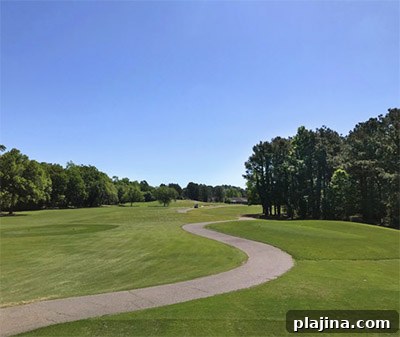
Hole 14 © FRANCIS X. GALLAGHER
HOLE 14 | 390 yards, par 4
Hole 14 left me still thinking about strategy long after we finished. The starter, Sammy, stopped by and offered helpful advice about options from the tee. This dogleg right provides multiple lines: hitters capable of driving more than about 240 yards can try to cut the corner over the trees. But push the carry too far and you risk blasting through the fairway and into water. Sammy thought I had pulled off the corner cut, though I know better — it was a close call.
In classic Player fashion you might spot alligators basking on the banks around this hole. John and Jimmy made the layout look easy with pars, but Mike and I struggled to match them.
HOLE 16 | 413 yards, par 4
Hole 16 presents a blind tee shot with water lurking to the left and trouble to the right. Pulled drives can find the water; missed right and you may be out of play or perched on a steep slope with no view of the green. Mike and I teed off to similar spots on a deep slope, while Jimmy and John took the more conservative line, leaving straightforward approaches.
The course has addressed the directional challenge by placing an arrow in a large tree behind the hole pointing to the green — a simple, effective aid to speed play and help with navigation. Using that cue, I managed to estimate distance and direction well enough to hit the green in regulation, turning an otherwise poor drive into a par while the others recorded higher scores. Considering the hole’s quirks, a par felt like a fine result.
Blackmoor Golf Club
6100 Longwood Drive
Murrells Inlet, SC 29576
tel 843 650 5555
blackmoor.com