
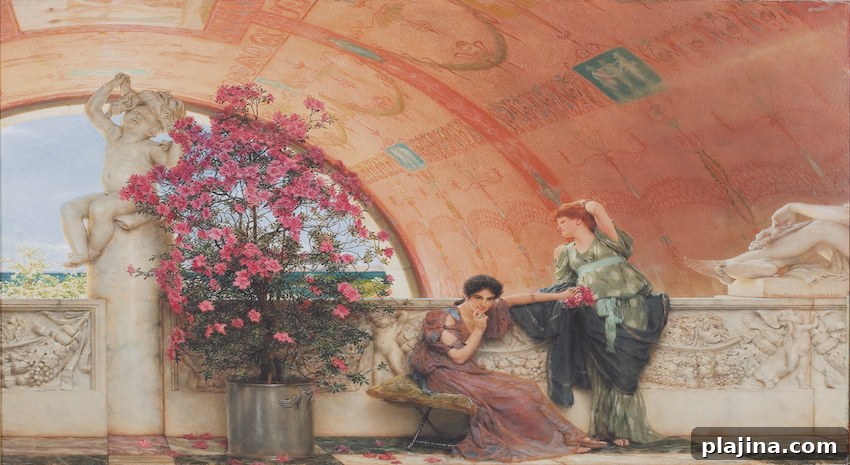
Until June 18, visitors to the Belvedere in Vienna can explore the exhibition “Lawrence Alma-Tadema: Decadence & Antiquity.” Born in the Netherlands and educated in Belgium, Alma-Tadema established his career in London with his wife, painter Laura Theresa Epps. Together they amassed an extensive collection of objects, textiles and furnishings from a wide range of cultures, many of which appear in his finished paintings.
Alma-Tadema developed a deep fascination with material remains from antiquity. He frequently depicted scenes inspired by life in ancient Rome, Pompeii and Egypt, using archaeological details, costumes and props to lend his compositions a convincing sense of authenticity. That meticulous approach gave his work an authoritative, cinematic quality that later influenced early historical filmmakers and modern directors alike.
The present solo exhibition, organized by the Fries Museum in the Netherlands, is on display in the Lower Belvedere at Rennweg 6 in Vienna. It brings together paintings, drawings and selected objects that illustrate how Alma-Tadema combined scholarly interest with imaginative reconstruction. Visitors can see how his carefully staged interiors and archaeological settings transform fragments from the past into dramatic narratives.
Beyond their visual appeal, Alma-Tadema’s paintings reflect nineteenth-century tastes for antiquity and the period’s broader interest in history, archaeology and the material culture of classical civilizations. His works often emphasize texture, light and surface—marble floors, mosaics, fabrics and architectural ornamentation—creating scenes that invite close inspection. The exhibition highlights these qualities, showing how specific objects and props were reused across compositions to achieve particular effects.
Organized displays of the artist’s studio possessions help visitors understand his creative process. By seeing the actual items that inspired or appeared in his paintings, viewers gain insight into how Alma-Tadema negotiated between historical research and artistic invention. The show also situates his work within a larger cultural context, demonstrating its influence on visual storytelling and design.
Whether you are interested in nineteenth-century art, classical antiquity or the history of exhibition practice, the Belvedere’s presentation offers a thoughtful look at Alma-Tadema’s career and legacy. The selection emphasizes both his technical skill and his role in shaping how later audiences imagined the ancient world.
Tickets and opening hours can be confirmed directly with the Belvedere. The exhibition remains on view through June 18 in the Lower Belvedere at Rennweg 6, Vienna.