
If you’ve never been to Beijing, know this: the city is enormous. On my first visit I asked the hotel concierge how far Tiananmen Square was. “Oh, just a couple of blocks,” he said. I set off on foot and didn’t arrive until three hours later. Beijing’s scale reflects China’s immense power and history—walking its streets often makes you feel very small. Palaces, parks, temples and tombs spread across vast areas. Blocks seem to go on forever, and the metropolitan area is home to more than 21 million people.
That size means you should allow plenty of time to get around. As China’s cultural, educational and political center, Beijing offers a wealth of attractions. Plan at least three days to explore the essentials and get a real feel for the city.
Despite smog and pollution, there’s rarely a bad time to visit. Winters can be quite romantic, with snow drifting around temple pagodas, the scent of roasting sweet potatoes in the air and frozen lakes perfect for skating. Summers bring warmth and a lively atmosphere—palace and temple gardens bloom, and streets fill with vendors selling spicy skewers and cold beer.
Lao She Teahouse © Peng Li | Dreamstime.com
Beijing blends the old and the new. Traditional neighborhood life—residents playing mah-jongg, sipping tea and tending cricket cages—can still be found in the hutongs, narrow alleys best explored on foot or by rickshaw. South Gong and Drum Lane and Skewed Tobacco Pouch Street are good areas to wander for that atmosphere.
Start your sightseeing at Tiananmen Square, the vast plaza at the heart of the city. Once used by Chairman Mao for public gatherings and parades, the square has been the site of major public events, including the massive public mourning in 1976 and the pro-democracy demonstrations of 1989. Today it’s a place for locals and tourists to meet, fly kites and visit nearby monuments like the Mao Zedong Mausoleum. Seeing Mao’s preserved body is a solemn, strangely arresting experience as you pass the sarcophagus.
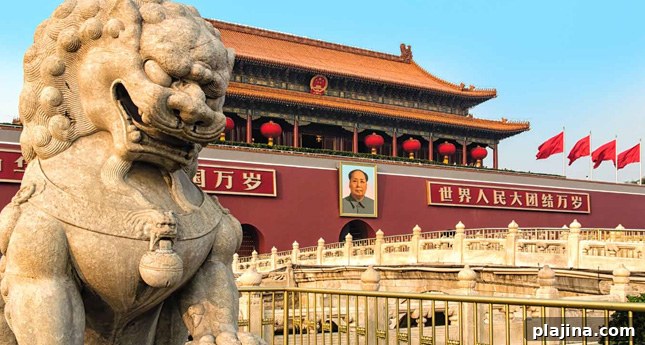
On the Tiananmen Gate—also called the Gate of Heavenly Peace—you’ll find a giant portrait of Mao. Built into its current form in the 17th century, the gate is a popular photo spot for visitors standing beneath Mao’s watchful image.
Beyond the gate lies the Forbidden City, China’s largest and best-preserved imperial complex and the setting for Bernardo Bertolucci’s film The Last Emperor. Spanning nearly 200 acres, it was the residence of 24 emperors from 1420 until the end of the dynasty in 1911. Commissioned by the Yongle emperor Zhu Di, the complex contains 980 buildings and was off-limits to anyone outside the imperial household for centuries. Today it’s a UNESCO World Heritage site. Nearby, the brightly colored Lama Temple—with its gardens, tapestries and frescoes—is also worth visiting.
The Great Wall of China © Scrabble2 | Dreamstime.com
Other World Heritage sites include the Summer Palace in western Beijing, the Temple of Heaven with its exquisite Ming architecture, and the Great Wall plus the Imperial Tombs of the Ming and Qing Dynasties. The Summer Palace, originally built in 1750 and restored later in the 19th century, features an Imperial Garden of hills and water dotted with pavilions, temples and bridges. Kunming Lake is a popular spot for picnics or boat rentals in warm months and for skating when it freezes.
To visit the Great Wall and the imperial tombs you’ll need a car or a tour. Sections such as Badaling and Mutianyu attract many visitors and vendors, but standing on the wall and watching it stretch across the landscape is an unforgettable reminder of the structure’s long history and engineering might.
For a modern contrast, visit the 2008 Olympic sites: the Beijing National Stadium—the “Bird’s Nest”—with its lattice exterior that glows at night, and the National Aquatics Center—the “Water Cube”—whose illuminated blue facade creates a striking sight. The interplay of circular and square forms at these venues reflects traditional symbolism of heaven and earth.
Families and animal lovers should include the Beijing Zoo, home to about 600 species, including Chinese natives like the giant panda and the red-crowned crane. For contemporary art and culture, explore the 798 Art District in Dashanzi, a former factory area transformed into galleries, design studios, boutiques, restaurants and bars—a lively hub for the city’s creative scene.
Dining in Beijing offers rich flavors and traditions. The city’s signature dish is Peking duck—crispy, lacquered and served with thin pancakes and hoisin sauce. Siji Minfu is a highly regarded spot for expertly carved duck, and the kitchen traditionally makes a savory broth from the carcass to round out the meal. For a broader taste of local snacks, Baodu Feng Jiumen Xiaochi food court hosts many covered stalls offering dozens of small dishes: tripe with a secret sauce, braised beef, bean curd with braised mushrooms, mashed pea cakes and fried flour tea flavored with fragrant osmanthus are among the options.
Beijing’s nightlife is lively. After dinner you can enjoy a cocktail or live music at popular spots, or experience traditional entertainment like Peking opera. The city offers an array of venues, from fashionable bars to clubs and performance spaces catering to diverse tastes.
Beijing Info to Go
International flights arrive at Beijing Capital International Airport, about 20 miles from downtown. The Airport Express line links terminals 2 and 3 with Dongzhimen and Sanyuanqiao stations in the city. For convenience and comfort, many visitors arrange car or taxi transfers to and from their hotels.
Where to Stay in Beijing
Four Seasons Hotel Beijing Luxurious rooms and suites, six restaurants and lounges, a gym and spa, plus family-friendly amenities and activities. 48 Liang Ma Qiao Road, Chaoyang District $$$$
The Opposite House A stylish hotel in the business district with sleek rooms, multiple dining options, a gym and an attractive pool. 11 Taikoo Li Sanlitun N., Sanlitun Road, Chaoyang District $$$$$
Rosewood Beijing A residential-style luxury hotel with elegant rooms, several restaurants and lounges, a spa and an executive club. Jing Guang Centre, Hujialou, Chaoyang District $$$$
Restaurants in Beijing
Black Sesame Kitchen An intimate spot offering a communal 10-course dinner with wine pairings on select evenings and hands-on cooking classes at lunchtime. 28 Zhong Lao Hutong, Dongcheng District $$$$
China Grill Located in the Park Hyatt Beijing with panoramic city views, this upscale restaurant serves refined Chinese dishes alongside sushi and Western-style steaks and seafood. Park Hyatt Beijing, 2 Jianguomenwai St., Chaoyang District $$$$$
Siji Minfu Famous for authentic Peking duck prepared and carved at the table. 32 Dengshikou W. St., Dongcheng $$$$