
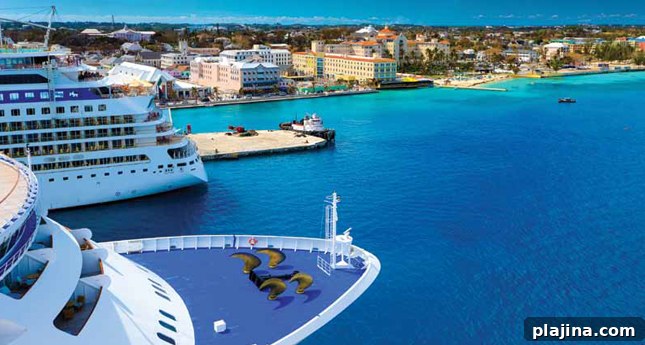
Christopher Columbus arrived first, making The Bahamas the initial landfall on his 1492 voyage to the New World. Five centuries later, about four million cruise passengers a year visit The Bahamas, many seeking the same simple goal as Columbus’s crews: rest and relaxation. With roughly 300 sunny days annually and shallow, warm seas, The Bahamas is an ideal tropical destination. The islands offer white-sand beaches, abundant water sports, lively nightlife and steady daytime temperatures typically near the 80-degree mark year-round.
For North Americans, The Bahamas is both appealing and convenient: short flights, no jet lag and no visas required for U.S. citizens. The low-lying archipelago begins about 50 miles off Florida and includes more than 700 islands, islets and cays. Its proximity makes it easily reachable from gateways such as Miami and Fort Lauderdale and even from ports farther afield, including Galveston, New Orleans, Baltimore and New York.
Although often grouped with the Caribbean, The Bahamas lies closer to the West Indies, and Bahamians tend to identify separately from Caribbean or West Indian labels. The islands became a British Crown Colony in 1718 and later served as a refuge for American Loyalists. Slavery was abolished in 1834, and today descendants of those enslaved people make up roughly 85 percent of the population; descendants of white American Southerners and British settlers make up much of the remainder. The Bahamas achieved full independence in 1973 but maintained ties to the British monarchy, English as the official language and left-side driving as reminders of its heritage. Today tourism drives the economy, providing about half of all jobs, and cruise passengers represent roughly 70 percent of visitors.
The primary decision for visitors is which cruise to book. Cruises vary widely—some are brief, others last a week or more; some cater to families, others to partygoers. Many itineraries focus on shopping, gambling or golf, while others attract adventurers, divers and divers. A distinguishing feature of many Bahamas sailings is the inclusion of private islands and cays owned or leased by cruise lines.
Private islands function like boutique resorts, offering cabanas, beach activities, shore excursions, shops, barbecues, bars and buffets. Examples include Castaway Cay, Disney Cruise Line’s thousand-acre private retreat with dedicated family, teen and adult beaches; CocoCay, Royal Caribbean and Celebrity Cruises’ 140-acre playground between Nassau and Freeport; Great Stirrup Cay, Norwegian Cruise Line’s 250-acre hideaway; Princess Cays, Princess Cruises’ mile-and-a-half of beachfront on Eleuthera; and Half Moon Cay, Holland America Line’s reserved 2,400-acre island.
Tourists riding horses along the beach at Half Moon Cay © Ramunas Bruzas | Dreamstime.com
Longer weeklong voyages typically include a cruise line’s private island alongside the Bahamas’ best beaches and ports. For example, Princess Cruises runs roundtrips from Houston on the Caribbean Princess that call at Freeport and Princess Cays. Many Holland America Caribbean cruises also visit Half Moon Cay. Norwegian sails regular seven-day voyages from New York to Great Stirrup Cay and to Nassau during peak seasons.
Nassau, on New Providence Island, is the most frequented port in the islands. Home to about 250,000 of the country’s roughly 380,000 residents and connected to Paradise Island by bridge, Nassau offers beaches, markets, casinos and historic sites. Major attractions include the Atlantis Resort with its striking architecture, casino and nightlife; Ardastra Gardens, Zoo and Conservation Centre, known for marching flamingos and diverse species; the Straw Market on Bay Street with hundreds of vendors; Blue Lagoon Island (Salt Cay), offering beach activities and dolphin encounters; Fort Charlotte, an 18th-century fortress with tunnels and lookout points; and the interactive Pirates of Nassau museum. Beyond its dining and nightlife, Nassau features more than 50 beaches for visitors to enjoy.
Freeport, Grand Bahama Island’s main port and the second-largest city, is smaller than Nassau but offers a lively casino-and-entertainment scene, shopping and beaches. Freeport is also the access point for Lucayan National Park, home to extensive underwater limestone cave systems and notable ecological features.
Bahamas reef life © Conchasolver | Dreamstime.com
Short cruises—two to five nights—often focus on Nassau and Freeport. These brief itineraries make for weekend getaways or short vacations and are popular because they are affordable and efficient. For travelers seeking a more upscale, short escape, Celebrity Cruises operates year-round four-night sailings from Fort Lauderdale that include a day in Nassau aboard the Celebrity Constellation.
For travelers with limited time who want to party, Bahamas Paradise Cruise Line runs frequent year-round sailings from West Palm Beach to Grand Bahama Island. These quick trips typically include a full day on the island for snorkeling, shopping, gambling, dolphin interactions, Jeep tours or beach time. The Grand Celebration, configured as a cruise-for-fun with pools, lounges, a casino and live entertainment, departs in the evening and returns two nights later, ideal for midweek or weekend breaks.
Five centuries after Columbus first anchored there, The Bahamas remains a close-to-home tropical escape that combines clear, shallow waters, warm weather and a wide range of activities—relaxing and accessible yet still feeling adventurous and exotic.