
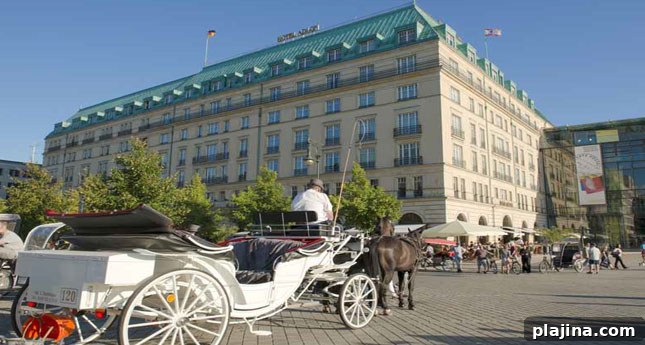
Consider Unter den Linden a symbol of the city. Named for the linden trees that once lined its broad, elegant avenues, this grand, centuries-old boulevard in Mitte—the heart of historic Berlin—lost its trees and much of its former splendor by the end of World War II. In 1961 it was cut off behind the Berlin Wall for 28 years, and when the wall fell the street showed little of the elegance it had once held.
On my first visit to Berlin, I stood on a corner at Unter den Linden and counted cranes in every direction: 13 to one side and 10 to the other. At street level a new subway entrance was under construction, and cafés bustled along the wide sidewalks. Businesspeople passed by, speaking a patchwork of German and English. With many of Berlin’s companies based near or radiating out from the boulevard, Unter den Linden felt newly prominent in the 21st century.
The rest of reunified Berlin has experienced a similar revival. Nov. 9 will mark the 25th anniversary of the fall of the wall, and over the past decades the city has emerged from a difficult chapter in its 20th-century history to become vibrant and energetic. Cranes continue to push new buildings skyward, tourism is booming, and Berlin has become a magnet for artists, musicians, innovative restaurants and lively nightlife.
Berlin is also a center of commercial opportunity. Its economy benefits from the interaction of business, science and research, supported by three major universities, dozens of other higher-education institutions and strong medical research at local hospitals. The city encourages startups—especially in software, media and communications—and has attracted tech companies such as Google and Etsy. Today, about one-third of the world’s 50 largest corporations maintain offices in Berlin.
Where to stay in Berlin? The five-star Hotel Adlon Kempinski, long regarded as one of the city’s finest, caters to business travelers with conference facilities, reception spaces, executive lounges, a business center, express check-out and complimentary WiFi. An early-bird breakfast starting at 6:30 a.m. suits those who begin their workday before most people wake.
The five-star Ritz-Carlton also serves business guests with amenities such as a club lounge on the 10th floor. A short walk from Unter den Linden, the well-priced four-star Maritim proArte Hotel Berlin offers meeting rooms and a business center on its conference floor.
For breakfast meetings, Café Einstein is a popular old-world choice and opens at 8 a.m. The newer Grosz Coffee House, which describes itself as “more than a café,” serves breakfast from 9 a.m. to noon and is another comfortable spot for informal business conversations.
Business luncheons are an important part of the workday in Berlin. The Grand, located in a handsome 1842 building, features a two-story dining room and a menu grounded in German cuisine. Private spaces on an upper floor accommodate business meetings, and the restaurant transitions into an evening scene with music, dancing and drinks for continued entertaining.
For contemporary fine dining, Restaurant Tim Raue offers inventive lunch and dinner menus inspired by the bold flavors of China, Thailand and Vietnam. Chef Tim Raue’s cooking is widely praised for its creativity and lively, relaxed atmosphere.
To host clients in truly formal style, reserve a table at Lorenz Adlon Esszimmer. Located within the Hotel Adlon Kempinski, this elegant restaurant is known for refined décor, attentive service and top-quality cuisine—an ideal choice for special business dinners.
Brunnenstrasse in Kreuzberg © Eddygaleotti | Dreamstime.com
After work, Berlin offers many places to unwind. Bars around Hackescher Markt near Alexanderplatz are lively choices, Potsdamer Platz hosts musical theater and broader entertainment, and Kreuzberg presents a more alternative, countercultural scene.
Transport from the airport is straightforward. A taxi from Tegel to central hotels, with tip, runs about $33; airport buses offer a cheaper option for under $5 each way. Hotels such as the Adlon Kempinski and The Ritz-Carlton can also arrange private limousine service for arrivals and departures.
Much of Mitte is easy to explore on foot. When you need transit, hotels will call taxis, or you can use the BVG network of buses, subways and trams. Consider the Berlin Welcome Card for public-transport access and additional discounts around the city.
If you have free time, Berlin’s cultural offerings are vast: roughly 400 art galleries, 180 museums, three opera houses and about 50 theaters. Museum Island alone houses five museums with some of the city’s greatest treasures. The Neues Museum, for example, is home to the famous limestone bust of the Egyptian queen Nefertiti, a remarkably well-preserved work from the 14th century B.C. that continues to captivate visitors—much as Berlin itself has recovered and reclaimed its place on the world stage.
Read about Nefertiti at Berlin’s Neues Museum.