
Northern Ireland’s Antrim Coast can capture the heart. It drew me with promises of giant-sized steps, towering headlands, Neolithic sites and ruined castles, then won me over with forested glens, craggy cliffs, walled gardens and constant birdsong. I set out from Belfast with a tidy list of must-sees and must-dos — Irish craic, pints of local ale — but once I turned north onto the A2 I abandoned strict plans and let the road and chance lead the way.
My first unscheduled stop was Carrickfergus Castle, a 12th-century Norman stronghold in County Antrim’s oldest town. I lingered by the waterfront, admiring the castle and enjoying excellent fish and chips from a humble takeaway facing the harbor. Recharged, I continued along the Antrim Coast Road, a 19th-century engineering feat that threads between sea and cliffs, slices through the Black Arch tunnel and delivers you into the first of the nine Glens of Antrim.
The Glens are places of legend and landscape: valleys formed by ancient volcanoes and shaped by glaciers, filled with woodlands and grasslands, peat bogs and sandy coves, cliff-edged mountains and rocky headlands. Historic ruins and prehistoric sites sit amid grazing sheep and grazing cattle. Local lore insists that giants and tiny fairy folk hide in misty caves and coastal crags.
Signage promising a tearoom and a walled garden led me into Glenarm. Its castle, one of the oldest estates in Northern Ireland, has been home to the McDonnell family, Earls of Antrim, since the 17th century. After tea and scones, I wandered the 18th-century walled garden, where beds of vivid red, pink, orange and yellow blooms contrasted with the surrounding greenery and felt like a touch of fairy mischief made real.
I diverted to Glenariff, known as the Queen of the Glens, a U-shaped valley that begins in dense woodland and opens into farmland and a long sandy beach. The Glenariff and Inver rivers tumble through century-old oak, ash, willow and hazel in Glenariff Forest Park. Trails follow the streams, cross small bridges over stepped falls and wind through moss-lined gorges where plunging cascades mist the air with the heady, restorative scents of decay and new growth. It felt quietly transformative — not an epiphany, but a deep, settling calm.
Returning to the coast via Glenballyeamon, I passed through the Red Arch and the village of Cushendall. Rather than follow the A2 inland, I looped through Glennann to see Ossian’s tomb, a megalithic court cairn said to be the resting place of the Celtic warrior poet, then returned via Glendun. There, glimpses of the impressive 19th-century Glendun Viaduct span the river Dun before the road brings you to Cushendun. This Cornish-style coastal village, now cared for by the National Trust, was designed by Clough Williams-Ellis, the architect behind Portmeirion in Wales.
Where the glens keep their whispers, the coast makes a grand statement. Torr Road offers a white-knuckle, scenic drive northwest from Cushendun, clinging to the shoreline as it climbs and drops, snakes around farm meadows and skirts windswept headlands above crashing surf. A rugged path leads to the ruins of a lookout on Torr Head; the view toward Rathlin Island, Northern Ireland’s northernmost point, is worth the climb and the imagination it stirs.
I did reserve time for Antrim’s headline attractions: Carrick-a-Rede and the Giant’s Causeway. The Carrick-a-Rede Rope Bridge, once used by salmon fishermen, spans a 66-foot chasm and sits 75 feet above the water. The trail to the bridge is short and pleasant; the crossing tests the nerves and the head for heights. Afterward I treated myself to lunch at the nearby teahouse.
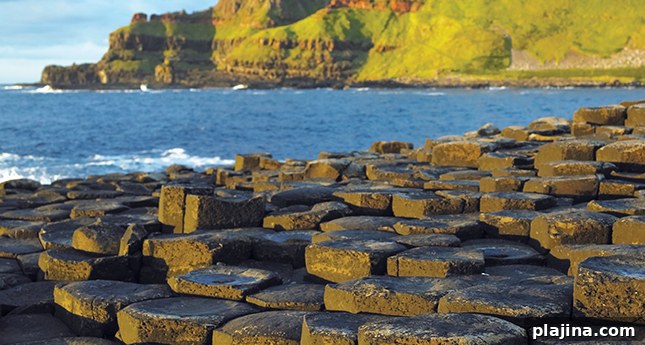
The Giant’s Causeway, according to legend, was built by the giant Finn McCool to reach Scottish rival Benandonner. The interlocking polygonal basalt columns do look as though they were laid out for a giant’s stride across the foam. Today this UNESCO World Heritage site draws many visitors; at peak times it can feel crowded. Visiting early or taking quieter trails such as the two-mile Runkerry Head path can make the experience more peaceful.
Over a dram in nearby Bushmills, my thoughts returned to Rathlin Island. I backtracked to Ballycastle and caught the ferry across the Sea of Moyle to the L-shaped island six miles offshore. Rathlin has long been a place of shelter and legend — Robert the Bruce is said to have watched a persistent spider on Rathlin that inspired him to persevere — and today it is best known for its seabird colonies.
Rathlin’s western cliffs and sea stacks host Northern Ireland’s largest seabird colonies in early summer. The RSPB maintains a reserve and a visitor center in the West Lighthouse, perched midway up a 300-foot cliff. With limited time I took the Puffin Bus from the ferry, which saves the four-mile walk to the reserve. The single-track road climbs to a high headland, then a marked path descends toward the lighthouse and 89 steep steps lead to the viewing platform.
From the deck I watched fulmars, guillemots, kittiwakes, puffins and razorbills swirl and wheel around the cliffs in astonishing numbers. Their cries and the sight of so many birds packed onto rock and air were unforgettable, a raucous counterpoint to the pounding sea below. When I finally left, it felt fitting: if any monarchs rule the realm of Northern Ireland’s fairies and wee people, they surely preside over this wild, spectacular island.