
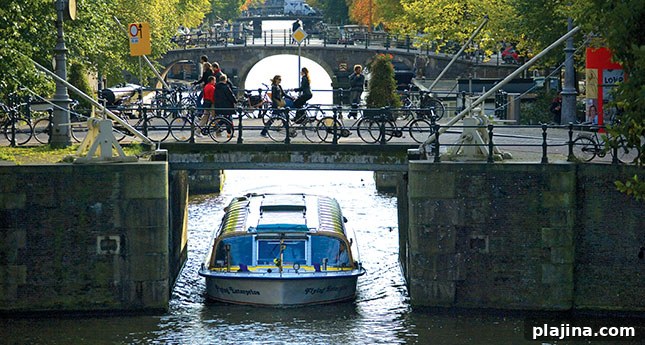
There will be clichés — they are unavoidable, so let’s get them out of the way: canals, 17th-century gabled townhouses, bicycles, the Red Light District, coffee shops selling cannabis, Van Gogh, Rembrandt, Anne Frank, Heineken beer, tulips, Edam cheese, wooden clogs. Yes — we are in Amsterdam.
Given the weight of these preconceptions, you might wonder whether the city is worth visiting. Those doubts fade the moment you arrive at Amsterdam Airport Schiphol. As one of the world’s busiest international hubs, Schiphol reflects centuries of global connections. Despite some parochial trappings, Amsterdam is surprisingly cosmopolitan, shaped by trade and travel from across the globe.
Before leaving the airport, take a moment to appreciate the engineering that made it possible to build here, southwest of the city center. Nearly a third of the Netherlands lies below sea level, and Schiphol itself stands on land reclaimed from the sea — the site of a 1574 naval battle. The Dutch mastery of water management is everywhere.
Amsterdam’s relationship with water is complex. The city continuously protects reclaimed land with an extensive system of dikes while also embracing water as a defining feature: 165 canals weave through the urban fabric, bringing waterways to the doorstep of many residents.
Construction of the Grachtengordel, the “girdle of canals,” began about 400 years ago and helped transform Amsterdam into a major trading center. Today, strolling along the leafy, cobblestone banks, it’s easy to forget the industrious bustle of barges and schooners that once delivered goods straight to merchants’ doors.
One reminder of that mercantile past hides behind a modest gabled entrance on Oude Hoogstraat in the city center. Step through a dim passage into a quiet 17th-century courtyard, and you’ll find the letters “VOC” above a doorway — Vereenigde Oostindische Compagnie, the Dutch East India Company. Founded in 1602, the VOC was the world’s first multinational corporation. It issued shares to the public and paid annual dividends, laying groundwork for modern capitalism.
Two centuries of VOC success helped make Amsterdam one of the wealthiest cities in the world. Merchant ships arrived with cargo and people from far-flung lands. Rather than closing ranks against newcomers, Amsterdam absorbed them; the city developed a reputation for pragmatic tolerance. Today around a third of residents have non-European origins, and while the city doesn’t feel as kaleidoscopically multicultural as London or New York, it remains a distinctively Dutch melting pot.
In recent years the financial heart has shifted south to Zuidas, where modern offices and skyscrapers house global firms — successors, in a sense, to the VOC’s commercial legacy. With business activity relocated, some of the old city’s industrial dynamism has faded, but the historic center still rewards visitors richly.
Part of that appeal is the clichés themselves. Rent a bicycle and follow shaded streets, or hire a pedal boat to explore the canals. Amsterdam’s compact size makes it easy to immerse yourself in the city without getting hopelessly lost.
Refinement and a slightly seedy underbelly coexist here. Dam Square’s Baroque grandeur sits adjacent to the flamboyance of the Red Light District. The scent from a local deli can mingle with the haze from a nearby coffee shop. Posters advertising major exhibitions at the Van Gogh Museum and the Rijksmuseum appear on walls scrawled with graffiti. It’s a city that presents contrasts matter-of-factly — liberal, practical and unmistakably Amsterdam.
Info To Go
International flights arrive at Amsterdam Airport Schiphol (AMS), about five miles southwest of the city. Taxi or bus transfers to the center take roughly 20 minutes. Schiphol Station, beneath the airport, offers regular trains to downtown Amsterdam in about 15 minutes and onward connections to other Dutch cities as well as Belgium and Germany.
Diversions
For extensive sightseeing, consider the I amsterdam Card, which provides free or discounted entry to many museums and attractions plus unlimited public transport. Cards are sold online and at tourist offices with options for 24, 48 or 72 hours.
Major museums are clustered a short ride southwest of the center. The Rijksmuseum houses a world-class collection with masterpieces by Rembrandt and Vermeer. The Van Gogh Museum holds the largest collection of Vincent van Gogh’s work, including hundreds of paintings, drawings and letters, alongside works by artists such as Gauguin and Monet. Nearby, the Stedelijk Museum focuses on modern and contemporary art and has undergone significant renovation in recent years.
Closer to the city center, on the Amstel River, the Hermitage Amsterdam presents rotating exhibitions alongside works from the State Hermitage’s collections. The Rembrandt House Museum preserves the artist’s former home and displays nearly all of his etchings, offering insight into his life and technique.
The Anne Frank House remains a poignant, essential visit, preserving the hiding place and diary of the young Jewish girl whose wartime account has moved readers around the world. The city’s oldest church, Oude Kerk, has occupied its site since the 11th century and now sits amid the Red Light District, illustrating the city’s pragmatic and open cultural character.
Lodging
HEM Hotel Maas
Within walking distance of many attractions, this family-run hotel is small and quiet; several rooms feature whirlpools or waterbeds. Leidsekade 91, tel 31 20 6233868, $$
Hotel Pulitzer, Amsterdam
Set across 25 restored 17th- and 18th-century townhouses, most of the 230 individually styled rooms offer canal views. Prinsengracht 315-331, tel 31 20 5235235, $$$$
NH Grand Hotel Krasnapolsky
Commanding Dam Square since 1865, the Krasnapolsky pairs modern guestrooms with public spaces that retain Belle Époque character. Dam 9, tel 31 20 5549111, $$$$
Dining
Brasserie de Poort
Operating since 1870, each steak here comes with a numbered certificate; if the number is a round hundred, you receive a free bottle of wine. Die Port van Cleve Hotel, Nieuwezijds Voorburgwal, tel 31 20 714 2000, $$$
Brasserie Harkema
Housed in a former tobacco factory, this Dutch take on the Parisian brasserie serves a predominantly European menu with contemporary touches. Nes 67, tel 31 20 4282222, $$$
Kantjil & de Tijger
Amsterdam has a long tradition of excellent Indonesian cuisine. Kantjil & de Tijger focuses on the food itself rather than exotic decor and is widely regarded as one of the city’s best. Spuistraat 291-293, tel 31 20 6200994, $$$