
Heidi keeps appearing in my mind. Outside the train window, traditional wooden chalets with red shutters and slate roofs scatter across a snow-covered landscape. Mountain goats and sheep pick their way along icy hillsides, and snow sparkles on distant summits. Around every bend I expect to spot the storybook girl herself.
Snow drew me to Switzerland, Heidi’s home. I came to ski, snowshoe and toboggan; to experience the sophistication of St. Moritz; to savor lunch and scenery aboard the Glacier Express on the way to expansive Zermatt; and to cross over to Cervinia, Italy, from Zermatt’s glaciers just because it’s possible. Between outings I indulged in as much cheese, chocolate and strudel as my itinerary — and my appetite — would allow.
A 1968 Rolls-Royce Phantom, once owned by the British royal family, ushered me from St. Moritz station to the aptly named five-star Badrutt’s Palace Hotel. In 1864, owner Johannes Badrutt famously promised four English guests that if they didn’t enjoy winter at his hotel he would refund their travel expenses. They returned bronzed and refreshed, and St. Moritz has remained a fashionable winter destination ever since, hosting the Winter Olympics in 1928 and 1948. I eased any travel stiffness in the hotel’s spa, an experience in itself with rooms named Ice, Mist, Aroma Therapy, Salt-steam, Massage Shower and Rain Shower.
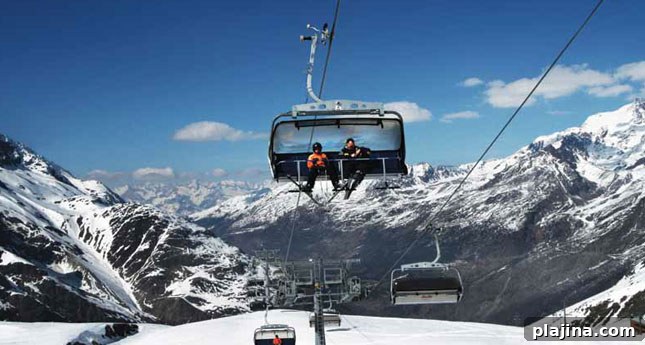
The next morning, Rudolf Bachman, an instructor and guide from Badrutt’s Ski School, and I took the funicular to Corviglia, one of the four alpine areas that rim Lake St. Moritz. We stepped out into a white expanse of wide-open slopes stitched with chairlifts beneath a brilliant blue sky — not surprising in a village that enjoys about 322 days of sunshine a year. We launched into run after run on 31 named trails that lace the bowls and slopes. Most terrain leans intermediate, and the service felt every bit as five-star as the hotel. Rudolf stopped at a children’s snow park and pointed to a rustic shelter. “That’s the original hut from the movie Heidi,” he said.
After skirting the back side of Piz Nair we made our way to lunch at El Paradiso, a tucked-away restaurant overlooking St. Moritz and the Engadine Valley. We soaked up the sunshine on a sheepskin-lined bench and began with a platter of local air-dried meats, cheeses, salami and Parma ham, followed by pizzocheri, a hearty local casserole of potatoes, cheese, pancetta and chard. Rudolf pointed across Lake St. Moritz to the Diavolezza area and mentioned that you can ski by moonlight on full-moon nights. I immediately regretted not being there for that experience. He interrupted my wistfulness: “We must have dessert — the vanilla cream pastry is famous.” What arrived was a slice of pure indulgence: light, airy and decadently creamy.
The next afternoon, after sampling Engadiner nutcakes and Swiss chocolates, I left Badrutt’s by horse-drawn sleigh and headed to Lej da Staz, a secluded 10-room lodge and restaurant set in a nature reserve. The moment I arrived I was charmed. Dozens of the region’s maintained Nordic and winter walking trails pass right by the door. I grabbed a map and set off for an afternoon hike.
Lej da Staz offered more culinary delights. I started with a spinach salad topped with local bleu cheese, followed by hay soup, a regional specialty reminiscent of a light mushroom bisque, and then a saltimbocca with basil risotto, another house favorite. A couple at the next table struck up a conversation; when they learned I was American they implored me not to tell too many others about their hideaway.
Light snow fell as I boarded the Glacier Express for the scenic journey from St. Moritz to Zermatt, a seven-hour ride that never bored. The train crosses 291 bridges, including the imposing Landwasser viaduct, passes through 91 tunnels and climbs the Oberalp Pass where snow piles up to 40 feet. We passed ski areas, toboggan runs, cross-country skiers and snowshoers; houses decorated with sgraffito; ancient churches; frozen ice veils and ruined castles. Rolling through the town where Heidi was filmed, I half expected her cantankerous grandfather to step out of a mountain hut.
Zermatt | Photo: © Serban Enache | Dreamstime.comsw
Where St. Moritz feels modern, chic and intimate, Zermatt is traditional, bustling and grand. St. Moritz boasts a lake; Zermatt has the Matterhorn. Private cars and combustion engines are banned in Zermatt, so the air is clean and electric vehicles hum softly along the streets. Getting around is easy thanks to a free bus system and a network of funiculars, gondolas, trams and mountain railways. I met my guide, Urs, at the train station, arranged a dinner plan, and checked in at the four-star Hotel National. From my balcony the Matterhorn dominated the deepening twilight sky, begging to be photographed.
Urs had a double treat planned. We took the late Tuesday tram to the mountain village of Furi for fondue at Restaurant Gitz-Gadi and then sledded nearly two miles back to town. The moon lit the snow-packed trail as we slid through the woods; steering and braking were controlled by foot. I struggled at first to read the twists and turns, but once I found my line my confidence and speed grew and all that remained was the soft whoosh of runners through the night.
Zermatt’s peaks are crisscrossed by 73 lifts and more than 153 miles of marked trails, plus generous off-piste terrain. The next day we explored Matterhorn Glacier Paradise, an area of open slopes linked by gondolas, high-speed six-packs and a summit tram. Clouds hid the peak that day, so we focused on Zermatt’s vast terrain and stopped for lunch at Restaurant Alphitta in Riffenalp — one of more than 50 on-mountain restaurants. Over rösti and grilled meats we planned the afternoon’s runs.
High-speed lifts helped us rack up miles, though the terrain remained larger than we could conquer. When my legs protested we retreated to Cervo, a lively après-ski venue above town. After a warming Glühwein I considered the spa, but the prospect of joining a group of well-intentioned but unclothed German men was more adventure than I wanted to handle.
On day two the sky cleared and we returned to Matterhorn Glacier Paradise, taking the tram to the 12,740-foot summit station. The thin air made me sluggish and breathless. “It’s the altitude,” Urs said kindly, and then guided me to the summit panorama.
From that vantage point the view encompasses 28 peaks higher than 13,000 feet. I scanned Switzerland, Italy and even France, eyes lingering on the Matterhorn and Mont Blanc. The engineering behind the tram and summit station was staggering, and Urs mentioned plans for additional summit trams from both Zermatt and Italy.
We descended the glacier-skiing area and dropped down the south-facing side into Italy. There was no border check, but I carried my passport just in case. The run to Cervinia is about seven miles with wide, sweeping turns on groomed slopes. From there we rode a series of trams and gondolas back to Zermatt. After refueling with a traditional macaroni-and-cheese dish served with applesauce, we eased back to town on one of Europe’s longest ski runs — an 11-mile thigh burner that left me pleading for mercy.
On my third day I set out alone with an overly ambitious plan to ski the entire resort and cross into Italy and back, starting with the first Gornergrat Express train. The train climbs through forested slopes and emerges above the tree line, passing through tunnels in avalanche zones. I rode to the summit and found the Gornergrat slopes largely to myself. I lingered too long before moving on, and when my stomach finally reminded me it was time to eat I realized I was at Rothorn, as far from Italy as possible.
After a massive bowl of pasta and a generous slice of strudel, I tried to weave my way across sectors but misread the map twice and ended up on a mountain train instead of in the gondola line. By the time I skied down and took the gondola to Furi, I was spent. My return to Italy would have to wait for another trip — and besides, Heidi doesn’t live there.
INFO TO GO
International flights from the United States arrive at Zürich International Airport (ZRH). Regular trains run 12 to 15 minutes from the airport’s Flughafen station to Zürich Hauptbahnhof for connections to St. Moritz, a 3.5- to 4-hour journey that requires one change. The Glacier Express operates as a full-day connection between St. Moritz and Zermatt. The rail trip from Zermatt back to Zürich Airport takes about three hours and typically requires one change.