
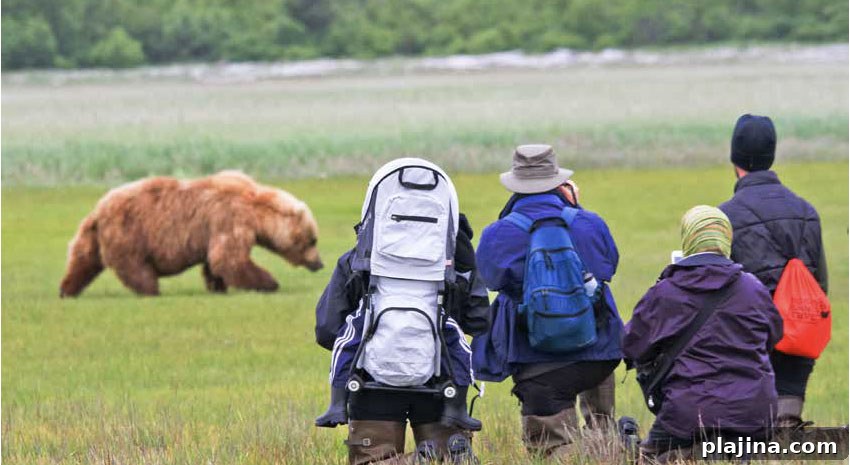
TO SEE BEARS IN ALASKA you might assume you need to trek far into the wilderness. I thought the same, packed my outdoor gear and headed north.
It was mid-September, one of the prime times to watch bears. They fatten up before winter by catching salmon in rivers and feeding on late-season berries.
My trip began in Juneau, the capital in Southeast Alaska’s panhandle — a fractured coastline of spruce-clad islands and sheltered channels very different from the state’s interior. I kayaked across the frigid lake at the foot of Mendenhall Glacier, a bucket-list experience in itself, before moving on to national parks in search of bears.
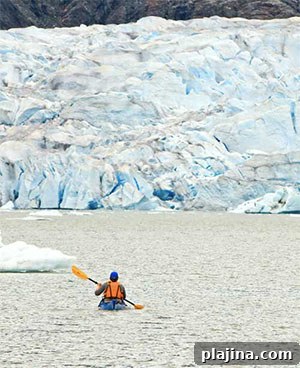
Kayak paddling on Mendenhall Glacier Lake © LAWRENCE WESLOWSKI JR | DREAMSTIME
Even tourists need to eat. After an exhilarating day on the water, I left the downtown Driftwood Hotel in search of dinner. Relaxed and off-guard, I turned onto South Franklin Street — the main strip of bars and souvenir shops — when someone shouted, “Turn around, friend. There’s bears that way.”
A block away, a female black bear and two cubs were rummaging through an overturned dumpster. People peered from doorways and windows; camera flashes lit the scene. This wasn’t the wilderness encounter I’d imagined.
Locals told me such sightings are common in Juneau. The city backs onto forested mountains that provide prime black bear habitat. Bears living closest to town have grown accustomed to humans and often appear on streets or in backyards, scavenging through trash.
Black bears are the smallest of Alaska’s three bear species and are the ones most often seen near towns. The largest and most elusive is the polar bear, found only in the far north, well inside the Arctic Circle.
The Northern Alaska Tour Co. runs guided expeditions from Fairbanks to Kaktovik on Barter Island, within the Arctic National Wildlife Refuge, where polar bears can be observed from boats under the supervision of certified guides. Polar bears are dangerous and should never be approached on foot.
Polar bears do not hibernate. They gather along the Beaufort Sea shore in August and September before the sea freezes, then disperse across the ice for the long winter months to hunt seals. Viewing tours from Kaktovik are exceptional opportunities to see these apex predators, though they are costly — expect to pay upward of $1,800 for a day tour from Fairbanks.
The third species, the brown or grizzly bear, approaches the polar bear in size but differs in diet and behavior. Grizzlies are omnivores, eating both plants and meat, and unless food is extremely scarce they are unlikely to hunt humans.
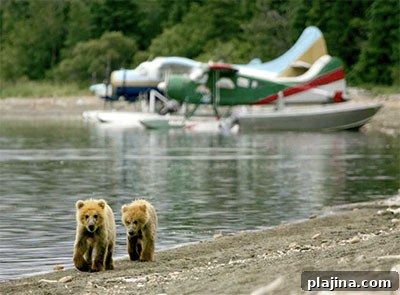
Grizzly bear fishing for salmon at Brooks Falls in Katmai National Park © OKSANAPHOTO | DREAMSTIME
A few days after Juneau, I stood beside a lake in Katmai National Park while a large male grizzly walked directly toward me. To get there I flew to Kodiak Island, then by floatplane to Katmai on the mainland. Fly-in bear-watching services operate from several providers, including local floatplane companies.
From the air we spotted bears below — a mother and cub crossing the mudflats of Hallo Bay. We landed on the lake and drifted to the sandy shore. I stepped from the float to dry land, preparing for a short hike to a nearby salmon run where bears congregate, and almost immediately I saw the approaching male. The pilot and my companion were still on the plane.
I repeated one rule in my head: stand your ground. It’s fundamental to safe grizzly viewing. Never run; remain firm. At about 30 feet the bear slowed, sniffed the air and detoured around me.
Like many bucket-list moments, the experience was intense rather than purely enjoyable — I was terrified. Still, I managed a few photos. As the bear ambled off into the brush, relief and exhilaration washed over me. That memory — equal parts fear and wonder — is exactly what bucket-list travel yields.
INFO TO GO
Flights from the Lower 48 arrive at Juneau (JNU), Anchorage (ANC) or Fairbanks (FAI). Much of Alaska is reached by chartered bush plane or floatplane. Several local operators offer dedicated fly-in bear-watching tours in and around the state’s national parks; book in advance during peak season and follow all guidance from certified guides to ensure safe, responsible wildlife viewing.