The highest margins in air travel are at the front of the cabin. Although first- and business-class passengers make up roughly 12 percent of travelers on international flights, they can account for as much as 75 percent of an airline’s profits. Competition for those seats has been intense, and prior to the COVID-19 pandemic carriers raced to unveil ever-more luxurious products.
COVID-19 abruptly halted international travel and altered demand patterns. Business travel — once a dependable revenue stream — declined as companies embraced virtual meetings. At the same time, demand for premium seats rebounded and even grew, driven by vacationers upgrading their travel experience and by the rise of “bleisure” trips, where people combine business with leisure and often travel with family.
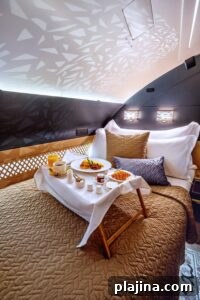
PHOTO: © ETIHAD AIRWAYS
Airlines have taken time to adapt to this shift. Etihad Airways’ flagship double-deck Airbus A380s spent months in long-term storage in Spain; four of the ten returned to service in June 2023, initially on the London–Abu Dhabi route. Their comeback restored The Residence suite, featuring a living room with a leather sofa, a double bedroom and an en suite shower. Etihad’s A380 first-class cabin also includes nine self-contained apartments that can convert into bedrooms.
In 2022 Etihad launched the Business Studio on its Airbus A350-1000 fleet, offering fully reclining seats, large 4K screens and extensive connectivity and storage. The airline extended this product to its 39 Boeing 787 Dreamliners in 2023.
One challenge for premium travelers is the wide variation in products between aircraft types operated by the same carrier. Emirates highlights this: its A380 first-class seats are older, somewhat cramped and offer limited privacy compared with the new first-class suites on its Boeing 777s, which provide floor-to-ceiling walls and sliding doors. That heightened privacy, however, can isolate travelers from companions.
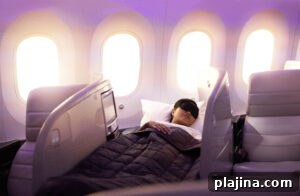
© AIR NEW ZEALAND
Air New Zealand addressed that trade-off with its Business Premier seats introduced on Boeing 787-9 Dreamliners in 2024. Middle-row partitions can open so passengers can share space, and some suites include a “buddy” seat for dining together. As carriers enhance business class, many are phasing out first class: Air New Zealand, American Airlines, Qatar Airways, Delta and Turkish Airlines are among those replacing traditional first-class cabins with elevated business-class suites that offer similar levels of privacy and comfort once exclusive to first class.
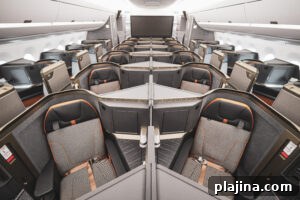
© STARLUX AIRLINES,
New entrants are also raising the bar. STARLUX AIRLINES launched trans-Pacific service between Taipei and Los Angeles with A350 interiors by BMW Designworks, featuring ambient lighting tailored to seasons and different flight stages. First-class “personal suites” offer 60-inch-tall partitions, sliding doors and 32-inch screens; business-class suites have 48.5-inch partitions and 24-inch screens. Both classes have lie-flat seats that can be set to a “Zero G” position, inspired by NASA technology to reduce fatigue and pressure.
American Airlines planned to introduce Flagship Suites on A321XLRs and 787-9 Dreamliners beginning in 2024, replacing first class in order to add more premium seats across its fleet. Each Dreamliner will offer up to 51 self-contained Flagship Suites with lie-flat seats, and middle-row seats with openable partitions to facilitate shared space.
Air France began rolling out a similar business-class design across its A350 fleet in July 2023 after introducing it on 777s. Marketed as “Travel in your own cocoon,” the design follows a “3F” concept: full flat beds (up to 6.5 feet), full access (direct aisle access for every passenger) and full privacy (sliding doors close the suites). Middle-row suites adjoin but include partitions that can be raised or lowered for privacy or shared space.
Fitting numerous suites into a cabin creates design puzzles. To maximize capacity, some carriers position seats facing backward, or in interior rows use virtual windows with live video to offset the lack of real windows. The result is a variety of seat configurations and features within the same cabin on many airlines.
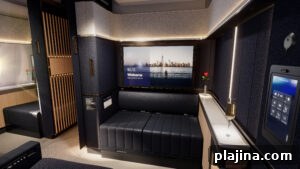
PHOTO: © LUFTHANSA
Lufthansa’s Allegris business class, released at the end of 2023, illustrates this diversity: seven design variations offer different levels of privacy and space, with some suites featuring sliding doors, double suites for couples, throne seats with extra storage and workspace, and seats that convert to extra-long beds. Pricing reflects these differences. Swiss International Air Lines, a Lufthansa partner, plans to adopt a higher-spec version of the Allegris product starting in 2025.
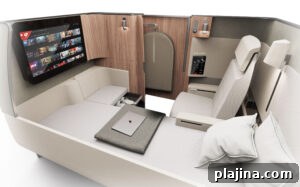
PHOTO: ©QANTAS
Qantas’ Project Sunrise, anticipated in 2025, will operate ultra-long nonstop flights between Sydney and Melbourne and cities such as New York, London and Paris on the A350-1000. These 20-hour services include onboard features aimed at passenger comfort: a Wellbeing Zone for stretching and light snacks, noise-dampening and tactile finishes in premium suites, and dedicated sleeping configurations. The fleet will include 52 business suites and six first-class suites that separate seat and bed areas and include 32-inch entertainment screens.
Safran has been a key partner in cabin redesigns, and the company’s work also appears in Air India’s transformation since Tata Group acquired the carrier in 2022. As part of a multi-billion-dollar modernization, Air India unveiled a new livery and plans to introduce a Safran-derived business-class product with Indian design accents. The rebranding, dubbed Vihaan — a Sanskrit word meaning “dawn” — aims to refashion the airline’s image and upgrade a significant portion of its widebody fleet.
Premium cabins are about more than seats; service remains a vital element. Singapore Airlines’ cabin crew have long been regarded as exemplary, though other carriers now match that level of service. In Skytrax’s 2023 cabin crew awards, Garuda Indonesia ranked first, with Asian airlines dominating the top 20 and a few non-Asian carriers like Qantas, Austrian Airlines and British Airways also appearing.
Still, the premium experience is fleeting: even the longest flights end in hours, and passengers return to everyday life without cabin service. One lasting takeaway, however, is the amenity kit. These small offerings often become cherished souvenirs: All Nippon Airways’ charming miniature Victorian-style leather suitcase kits, Qantas’ artist-designed cases with Australian-brand products, and KLM’s iconic miniature Delft Blue houses filled with Dutch gin. Since the 1950s, KLM has released a new house each year to mark its anniversary; collectors can track their sets with an app, turning premium travel into a collectible hobby.