
Ever since Odysseus set sail on the “wine-dark sea,” the Greek islands have beckoned travelers with stories, scenery and irresistible charm. Today the allure remains: whitewashed villages, blue-domed churches, dramatic coastlines and layered history invite exploration. For a first trip to the Aegean where convenience and discovery matter equally, we chose a seven-day Athens-to-Athens voyage aboard Variety Cruises’ intimate 25-cabin yacht, Harmony V. Small-ship cruising proved ideal: relaxed luxury, fewer crowds onshore and a route that touches many highlights of the Cyclades, Crete and the Peloponnese.
The itinerary sails southeast from Piraeus into the Cyclades, calling at Kéa, Míkonos, Delos and Santoríni, then heads south to Crete before returning north along the Peloponnese with stops at Kýthira, Monemvasía and Ídra. Shore excursions connect passengers with major Minoan, Mycenaean, Homeric and Hellenic sites, along with villages famed for narrow lanes, Byzantine churches and classic island architecture.
We boarded Harmony V in Piraeus, the port at the end of Athens’ metro line, and rounded Cape Sounion, where the ancient Temple of Poseidon stands sentinel above the sea. Our first island stop was Kéa, close to Attica. Ioulis, Kéa’s mountain town, offers a charming square, a medieval castle, old churches and a small archaeological museum with pre-Archaic finds, though our visit was limited to a leisurely stroll along the harbor.
That evening we sailed on to Míkonos, the island known for glamorous nightlife, iconic windmills and the Venetian-influenced “Little Venice.” Míkonos served as a gateway to Delos, a nearby islet that is one of Europe’s finest open-air archaeological parks. Guided by a national expert, we explored Delos’ extraordinary ruins—temples, private homes, public squares and monumental statuary dating back more than 3,000 years. Once the religious and commercial heart of the Cyclades, Delos also houses the world’s oldest known synagogue site and evokes a clear sense of the Aegean’s ancient civic and spiritual life.
One of many windmills on Míkonos © Freesurf69 | Dreamstime.com
Back in Míkonos we wandered the car-free lanes lined with art galleries, boutiques, boutique hotels and cafés. The white cubic houses and rows of cylindrical windmills reflect the island’s Venetian past; today Míkonos draws international visitors seeking style, beaches and nightlife, making it one of Greece’s pricier getaways.
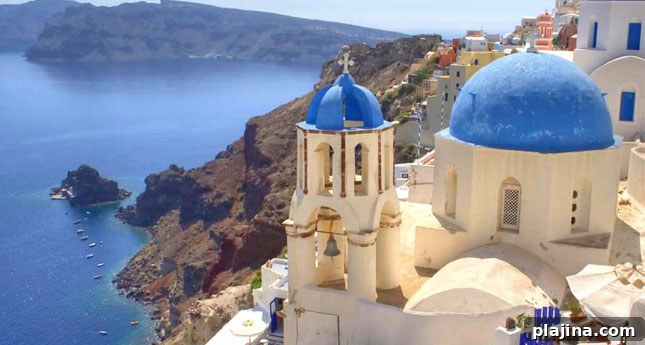
Next came Santoríni, anchored within a vast caldera formed by a volcanic eruption. The steep cliffs rising from the sea frame the photogenic village of Fira and the cliffside terraces of Oia. We rode the cable car to Fira and then visited Akrotiri, the Minoan settlement preserved under volcanic ash long before Pompeii. Carefully re-excavated and reopened after conservation work, Akrotiri reveals multi-story houses, frescoes and urban planning from the Bronze Age; many artifacts are now displayed in the Museum of Prehistoric Thíra in Fira.
Oia sits at Santoríni’s northern tip and epitomizes postcard-perfect island architecture: whitewashed terraces, blue-domed churches and narrow streets lined with shops and cafés. Its sunsets and views draw visitors year-round, and even off-season the lanes can be crowded.
The same eruption that shaped Santoríni may have triggered tsunamis that impacted Crete and influenced ancient myths. We sailed to Crete and docked at Réthimno, a town shaped by Venetian and Ottoman rule and known today for long sandy beaches. Our main reason for visiting Crete was Knossos, the palatial center of Minoan civilization. Excavated largely by Sir Arthur Evans, Knossos reveals grand courtyards, painted frescoes, complex corridors and the Throne Room—elements that inspired the legend of the labyrinth and the Minotaur.
From Crete the cruise doubled back toward the Peloponnese with a stop at Kýthira, an Ionian island traditionally associated with the birth of Aphrodite. Smaller ships can call here where modern island life blends with quiet traditions: narrow streets, a medieval castle and local specialties such as thyme honey and Faturada, a spiced local liqueur.
Monemvasía was next—a fortified island-town linked to the mainland by a causeway and crowned by a medieval fortress. Wandering its car-free lanes reveals Byzantine churches, stone arches, art galleries and cafés overlooking the sea. The compact scale and historic fabric create an evocative sense of place.
A short sail brought us to Nafplion, often called Greece’s most beautiful town and the convenient gateway to Mycenae. Excavated by Heinrich Schliemann, Mycenae was a Bronze Age citadel associated with Homeric kings and early Greek civilization. The Lion Gate, beehive tombs and extensive ruins convey the site’s former power and long history.
On the final leg back to Athens we called at Ídra in the Saronic Gulf, a crescent-shaped island with a long maritime tradition. Ídra’s harbor, captain’s mansions and cobbled lanes are largely car-free; supplies still move by donkey in places. The island retains an artistic, slightly bohemian atmosphere—once home to Leonard Cohen—and preserves customs such as the afternoon siesta. Evenings here fill with visitors arriving from Piraeus and local cafés and bars come alive.
Greece counts around 5,000 islands and islets, with roughly 500 inhabited, yet a small selection of eight islands can already convey the diversity of Aegean culture: archaeology, architecture, culinary traditions and seafaring life. A week on a small cruise ship offers an efficient, relaxed way to sample these contrasts while avoiding the crowds that can overwhelm larger vessels.
Nafplion © Sborisov | Dreamstime.com
INFO TO GO
Variety Cruises operates small-ship voyages in the Mediterranean with attentive cruise directors and national guides for shore excursions. Greek isle itineraries typically run from Piraeus April through October. Piraeus is connected to Athens by public transport: Metro Line 1 links downtown to the port in about 30 minutes, and buses or taxis provide airport access. Travelers should check current schedules and fares when planning.
LODGING
BELVEDERE HOTEL A luxury option in downtown Míkonos within walking distance of windmills and Little Venice, featuring upscale restaurants and refined accommodations. Agiou Ioannou, Míkonos
HILTON ATHENS HOTEL A long-established landmark with updated rooms, executive services and rooftop views of the Acropolis. Vassilissis Sofias Ave. 46, Athens
TSITOURAS COLLECTION HOTEL A cluster of villas on Santoríni with kitchenettes, caldera views and personalized service from an owner-artist. Firostefani, Santoríni
DINING
BYZANTINO An elegant buffet-style restaurant popular with locals and visitors, offering a wide selection of Greek dishes and desserts. Hilton Athens Hotel, Vassilissis Sofias Ave. 46, Athens
TO MAEREIO A small, family-run bistro on Míkonos where simple, home-style cooking is prepared in an open kitchen. Kalogera 16, Míkonos
XERI ELIA DOUSKOS A traditional taverna on Ídra with seafood displays, live music and a welcoming village square. Ídra Square, Ídra