
Abu Dhabi, once a quiet community of pearl divers, fishermen and small traders, transformed rapidly after the discovery of vast oil reserves beneath the desert in 1958. By 1962 the emirate was exporting petroleum and soon became one of the Middle East’s wealthiest and most stable international business centers.
Oil remains the main economic driver in this globalized emirate of roughly 1.5 million people, about 80 percent of whom are expatriates. Abu Dhabi supplies nearly all the oil for the United Arab Emirates, the federation that borders Saudi Arabia and Oman. Often cast as the cautious elder to Dubai’s daring younger sibling, Abu Dhabi has at times supported its neighbor financially: when Dubai delayed payments by a state-owned entity in 2009, Abu Dhabi injected billions to stabilize the situation.
As the capital and largest member of the UAE, Abu Dhabi has invested petrodollars into a striking skyline along the Persian Gulf and into diversification across banking, aviation, real estate, construction and cultural tourism. Major projects aim to attract international visitors and to broaden the economy beyond hydrocarbons.
The city remains a construction hotspot even during downturns, with cranes and development sites visible across the landscape. Cultural initiatives include a Frank Gehry–designed Guggenheim branch and a Louvre outpost on Saadiyat Island, part of a multi-billion dollar cultural district scheduled to open in phases. Abu Dhabi International Airport expanded with a modern terminal in 2009 and planned capacity increases to accommodate growing passenger numbers. Etihad Airways, the national carrier founded in the mid-2000s, has expanded quickly, linking the emirate to dozens of destinations and acquiring large numbers of aircraft. In total, Abu Dhabi has initiated or announced developments valued at hundreds of billions of dollars.
Rapid modernization has come at a cost. Much of the city’s older fabric has been altered or removed, and efforts to preserve heritage were initially slow and limited. Today, reconstructed and preserved sites offer visitors a taste of traditional culture. At the Heritage Village, artisans demonstrate pottery and weaving and visitors can view a camel-hair tent representing Bedouin life. Continuous construction adds dust and noise to a climate already prone to sandstorms, and fast-paced development has created traffic congestion and a sense of constant transition in the city center.
Despite modern façades, Abu Dhabi is a conservative Arabian Muslim society. Many local women dress modestly and wear headscarves; full veils are less common outside religious settings. Alcohol is regulated: there are no standalone liquor stores or public bars, but licensed restaurants and hotel bars serve alcohol to guests, and some members-only venues provide drinks to patrons with membership.
Abu Dhabi purposely avoids Dubai’s ostentatious flair at times, but it remains an engaging destination: efficient, generally safe and increasingly cosmopolitan. A large expatriate community—outnumbering Emirati citizens—contributes to a diverse urban culture, especially visible in shopping and dining. Major malls such as Marina Mall and Abu Dhabi Mall host international fashion and retail brands. Culinary options range from traditional Arabian and Lebanese cuisine to Italian, French, American, Mexican and a wide variety of Indian restaurants favored by residents and visitors alike.
Internationally renowned architects like Frank Gehry, Sir Norman Foster and Tadao Ando have projects in the emirate, while some newer buildings echo classic Islamic forms. Notable attractions include the opulent Emirates Palace Hotel, a showpiece with art exhibitions and lavish public spaces, and the Sheikh Zayed Grand Mosque, a vast white-and-gold complex completed in the 2000s that can accommodate tens of thousands of worshippers and offers daily English-language tours except on Fridays. The Souk Qaryat Al Beri recreates a traditional marketplace experience along canals, and the bustling Fish Market at Mina Zayed remains a vivid reminder of Abu Dhabi’s maritime past.
Walking around the city can be challenging: construction zones and the harsh climate limit pedestrian access in many areas. The Corniche promenade along the Gulf provides a pleasant waterfront walkway, public beaches and scenic views, while traditional souks and markets offer compact, shaded streets for browsing handicrafts like rugs and gold jewelry. Signs are commonly bilingual in Arabic and English. High humidity and summer temperatures that can exceed 120°F encourage travelers to plan outdoor activities for cooler months; winter temperatures are milder and more comfortable for sightseeing.
Public transport does not yet include a subway system. Local buses operate across the city but can be difficult for newcomers to navigate. Taxis are the most convenient option for many visitors—modern, metered cabs are widely available. For trips into the emirate’s interior, renting a car at the airport is recommended; well-maintained highways lead to destinations such as Al Ain, an oasis town about 90 minutes from the city, known for its forts, palm groves and mountain backdrop.
Info to Go
The most practical transfer between Abu Dhabi city and Abu Dhabi International Airport (AUH) is by taxi. There is no metro. The roughly 22-mile journey takes about 30–40 minutes and typically costs around $18. Check whether your hotel offers a free shuttle service.
Diversions
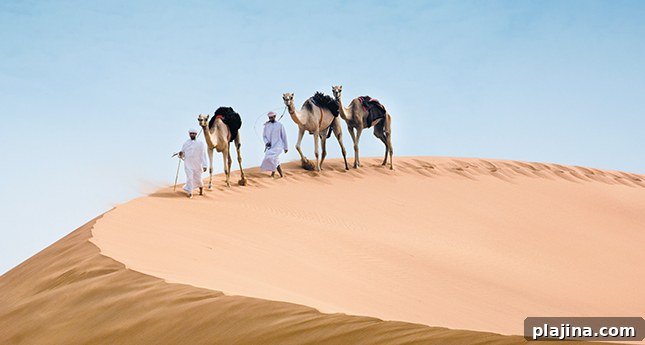
Dune-bashing is a popular desert activity offered by tour operators. Experienced guides drive four-wheel-drive vehicles over steep dunes, creating an exhilarating ride across ever-shifting sand. Tours often include a stop at a camel farm—camels are now raised mainly for racing—a short camel ride, sunset views, and a traditional barbecue followed by shisha in a desert camp.
Lodging
Emirates Palace
A national landmark known for its opulence and extensive guest amenities. Corniche Road W., tel 971 2 690 9000, $$$$
Shangri-La Hotel, Qaryat Al Beri
A waterside retreat with resort-style facilities, attractive rooms and business services. Between the Bridges, tel 971 2 509 8888, $$$$
Sheraton Khalidiya Hotel
A centrally located international-brand hotel favored by business travelers. Sheikh Zayed the First St., tel 971 2 666 6220, $$$
Dining
Al Dhafra
A dinner-cruise option on a comfortable, air-conditioned boat offering views of the skyline. Near Al Mina Fish Market, tel 971 2 673 2266, $$–$$$
Indigo
Stylish fusion cuisine blending contemporary design with modern takes on Indian and other Asian dishes. Beach Rotana Hotel and Towers, Tourist Club Area, tel 971 2 697 9334, $$$–$$$$
Shang Palace
An elegant Cantonese restaurant featuring dim sum and banquet-style Cantonese fare. Shangri-La Hotel, Between the Bridges, tel 971 2 509 8888, $$$$