
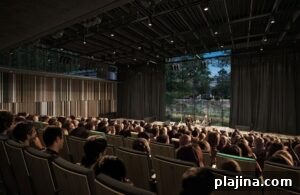
Earlier this year, COOKFOX Architects announced the opening of the Bruce Springsteen Center for American Music at Monmouth University in Long Branch, New Jersey. This new cultural institution is dedicated to telling the story of American music while celebrating Bruce Springsteen’s contributions within that tradition. The 30,000-square-foot facility brings together exhibits about Springsteen and other strands of American music, an extensive Springsteen archive, a 240-seat auditorium for concerts, lectures and screenings, and adaptable gallery space for rotating exhibitions.
© Alex Ferrec / COOKFOX Architects
The center’s founding director, Bob Santelli, is widely recognized for his museum work interpreting the history of rock and roll and other popular music forms. Under his leadership, the center aims to serve as both a research resource and a public destination, making archival materials and curated narratives accessible to scholars, students, and fans alike.
Rick Cook, founding partner of COOKFOX Architects, explains that the project began with a personal connection to Bruce Springsteen as a storyteller, and that connection guided the design process. The team sought to reflect Springsteen’s artistic virtues—honesty, courage, and authenticity—in the visitor experience, the building’s proportions and materials, and in the careful integration of performance and exhibition spaces.
In designing the facility, the architects prioritized how the building would support and enhance the content it houses. The auditorium, described as a high-performing space, is intended for a range of uses: musical performances, academic lectures, film and video presentations, and community gatherings. Gallery zones are arranged to accommodate both permanent displays and changing exhibitions, allowing the center to evolve over time and present fresh perspectives on American music.
Conceived as a multipurpose destination for exhibitions, education, performance and research, the center also acknowledges its local roots. It is sited in a neighborhood that figures prominently in Springsteen’s early career; nearby venues and the university itself were important settings during his formative years. The center’s design and programmatic focus intentionally engage with that local history while placing it within the broader story of American musical traditions.
© Alex Ferrec / COOKFOX Architects
Located across from the historic Guggenheim Memorial Library on the Monmouth University campus and in the vicinity of the Great Hall at Shadow Lawn, the center occupies a prominent and contextually meaningful site. Monmouth University not only hosted Springsteen during his early performances but also houses a portion of his archives, making the campus a natural home for an institution focused on his legacy and the American music story more broadly.
Architecturally, the building is clad in weathering steel panels and employs an unstained mass-timber structure, choices that provide a warm, tactile character while aging gracefully in the coastal environment. These material decisions and the building’s form were informed by the team’s desire to create an architecture that resonates with the music it celebrates—direct, robust, and grounded in place.
© Alex Ferrec / COOKFOX Architects
Visitors approach the music hall via a boardwalk, a deliberate and evocative gesture that references local shoreline paths and invites a contemplative arrival. This sequence connects the center to its coastal setting and creates an approachable, human-scale experience before entering the exhibition and performance spaces.
Beyond its galleries and auditorium, the center is designed to support research and education. Archival holdings and interpretive resources will be organized to facilitate study and scholarly work, while public programs, workshops and talks are expected to engage students, researchers and the wider community. By balancing exhibition, performance and archival functions, the facility aims to be both a lively public venue and a serious center for preservation and scholarship.
COOKFOX’s team emphasizes that the building’s role is to serve the stories it contains rather than to overshadow them. The architectural intent is to create a setting in which the music, the artifacts and the narratives take center stage, supported by carefully considered acoustics, circulation and display conditions. In this way, the Bruce Springsteen Center for American Music seeks to honor a regional musical legacy while contributing to the cultural life of Monmouth University and the surrounding community.