
I was surprised to learn Denmark consistently ranks among the world’s happiest countries. At first glance, the cool Nordic climate and long winters might seem at odds with a perpetually sunny disposition, but after a visit to Copenhagen the reasoning becomes clear. The city balances efficient modern living with cozy, human-scaled neighborhoods, thoughtful design and a strong food scene. Whether you’re a fashion-forward traveler, a Michelin-star seeker, a history enthusiast or simply curious, Copenhagen delivers experiences that linger long after you leave.
Copenhagen is well served by public transportation, but the best way to experience the city is like the locals: by bike. Cycling infrastructure is excellent, with dedicated lanes and bike-friendly intersections, making it easy and enjoyable to traverse the city quickly. For first-time visitors who want to pack as much into a short stay as possible, choose accommodation in a central district. The Carlsberg District is an especially compelling option for those who appreciate history, architecture and easy access to top dining and cultural attractions.
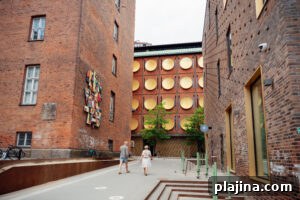
Hotel Ottilia © Visit Copenhagen / Abdellah Ihadian
The Carlsberg District’s history begins in the mid-19th century when J.C. Jacobsen founded the Carlsberg Brewery. Over generations the brewery complex grew into a distinct enclave, enclosed by striking brick walls and punctuated by ornate gates and historic industrial buildings. After brewing operations moved elsewhere in the 21st century, the area underwent thoughtful transformation. Old warehouses and workers’ homes were adapted into boutique hotels, lively restaurants, creative offices and museums, preserving the character of the place while making it relevant to contemporary urban life.
At the heart of the neighborhood is Hotel Ottilia, a boutique property that occupies two former brewery buildings. Named for Ottilia Jacobsen, the hotel blends the scale and materiality of industrial architecture with clean Danish design principles. The lobby embraces industrial heritage with concrete and exposed steel accents, while interior touches and furnishings reflect modern Scandinavian comfort. It’s a pleasant place to relax, meet other travelers and begin exploring the neighborhood on foot or by bike.
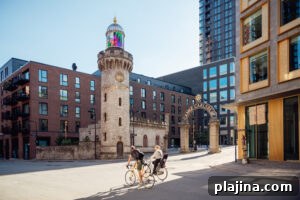
Carlsberg’s Chalk Tower © Visit Copenhagen / Abdellah Ihadian
Copenhagen sits among the world’s most respected food destinations, on par with capitals known for culinary innovation. Options span simple market stalls and casual street-food markets to elegant tasting menus in refined dining rooms. Near Hotel Ottilia you’ll find restaurants that celebrate regional produce alongside international influences. For a memorable evening, consider a trattoria that serves generous, ingredient-driven Italian dishes paired with thoughtful wine selections; elsewhere, inventive kitchens combine seasonal Nordic produce with global techniques.
The convergence of Danish and Japanese culinary sensibilities is apparent in several of Copenhagen’s kitchens: both traditions prize fresh seafood, clean presentation and seasonality. Restaurants that blend these traditions create a distinct dining experience where precision and subtlety meet bold, memorable flavors. A short ride from the Carlsberg District brings you to several notable dining rooms where chefs curate compact, focused menus that highlight local fish, vegetables and artisanal products.
Beyond dining, the Carlsberg District is an appealing case study in urban regeneration. It demonstrates how historic industrial sites can be repurposed into mixed-use neighborhoods that support culture, hospitality and creative industries while maintaining a strong sense of place. The brick facades, narrow courtyards and preserved details provide texture and continuity, while new additions — thoughtfully scaled and designed — bring contemporary life into the district.
Practical tips: rent a bike for short-term travel to maximize mobility and feel like a local; reserve popular restaurants in advance, especially for weekend dinners; and plan time to wander—Copenhagen rewards slow exploration, from canals and parks to small galleries and design shops. With an efficient transport network and compact layout, you can experience the Carlsberg District and much of central Copenhagen in just a few days, leaving you eager to return for deeper discovery.