
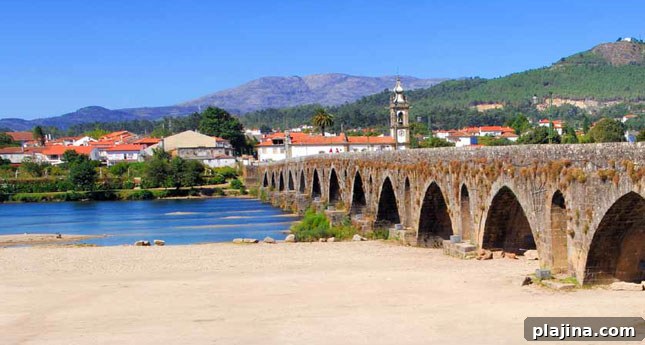
Beneath the worn soles of my favorite hiking boots, an ancient stone road, jumbled and ragged with age, climbs unevenly toward the mountaintop. Earlier today, far below in the paved plaza of Ponte de Lima, a feathery post-dawn mist hugged the ground. Walkers with tall staffs and small groups laden with backpacks gathered in the plaza, each preparing to continue their route. Many were pilgrims setting off on the Portuguese Way of the Caminho de Santiago, a steep section that leads from here toward the Cathedral of Santiago de Compostela in Spain. José Augusto, co-owner of Portugal Green Walks, met me there and we set off with the quiet pleasure that fills every explorer’s heart.
My reason for walking this mountain was not religious but personal: to step away from growing anxiety that had been disturbing my sleep. I’ve discovered that walking not only clears my stress but also lets me absorb a landscape at a natural pace. There was plenty to absorb. Our twelve-mile upward route left the plaza, crossed a medieval Romanesque-Gothic bridge of 22 arches spanning the Lima River, and entered a flowering countryside. The path sometimes briefly joined narrow paved roads through small villages and vineyards, where stout granite trellises supported thick, trained vines.
Several hours into the trek we paused at a tiny roadside café for fruit and chilled water. Augusto warned that the real challenge began beyond this point — and he was right. For hours we negotiated narrow, rocky gaps that passed as paths, climbing nearly straight up trails worn by Roman soldiers long ago.
As the trail grew tougher, my thoughts wandered to wine and castles, and to the rewards I had planned for the next four days. Each evening would end in one of Portugal’s magnificent pousadas — historic castles, palaces, abbeys and monasteries converted into elegant hotels. After the final climb we crossed a low rock bridge built by those same soldiers and walked a few more miles on mostly level ground. I paused to take in the resplendent landscape, feeling a pleasant ache in my legs and the lightness that comes with completing a demanding day.
That night I rested at the celebrated Pousada de Santa Marinha in Guimarães. Originally the Monastery dos Agostinhos, the twelfth-century complex was adapted in 1975 by architect Fernando Távora. Passing through an upper gallery tiled with scenes from nature and the arts, I paused before a panel depicting heavenly figures pouring clouds into the sky. My room overlooked part of an extensive formal garden; I rose early to walk among its paths. Hidden in a wooded copse I found a wide terraced stone staircase that led to a walled reflecting pool. The moss-covered, crumbling wall gave the place a secretive, contemplative air.
Lindoso granaries © Vítor Ribeiro | Dreamstime.com
After breakfast, Paulo Lopes and guide Isabel Sousa joined me and we headed for Parque Nacional Peneda-Gerês, Portugal’s largest protected area. We stopped in Lindoso, a tiny granite village where small stone granaries stand on pillars to keep rodents from the harvest. Two horsemen rode by with a goat trotting beside them, and the scene felt like a moment from a film set.
Deeper in the park, where wolves still roam, the landscape felt wild and untamed. A group of garrano ponies crossed our path as we followed a winding shepherd’s trail bordered by towering conifers. Our destination was a Neolithic dolmen nestled in a rocky hollow, its massive capstone remarkably intact. Sousa explained that this dolmen and other standing stones date from eras when Celtic tribes occupied the region; older carvings and symbols, predating the Celts, can still be found in places such as the coastline north of Viana do Castelo.
The next day I left the northern provinces of Minho, Douro and Trás-os-Montes and took the train from Porto to the central Alentejo. There the landscape opens into rolling fields of olive groves, vineyards, citrus orchards and the gnarled cork trees that define the region. At the Pousada do Alvito, a small 15th-century castle blending Moorish, Gothic and Manueline details, I woke to a courtyard where peacocks wandered in the sunlight.
After breakfast featuring oranges from the garden, Jorge Pereira Sintra, a noted cyclist and partner at Passeios e Companhia, guided me along a five-mile route from Vila Nova da Baronia into the countryside. The trail threaded past belled sheep and through thickets of olive and cork trees. The heat made a cool pause irresistible, and we visited a small seventeenth-century church whose interior is richly tiled and frescoed. Sintra obtained the key from an elderly woman tending a nearby garden; her cautious watch turned to a warm smile when I praised the church’s beauty.
We crossed another ancient Roman bridge and arrived at Pousada de Vila Viçosa, where I was nearly revived by the building’s striking beauty. Nuno Guégués led me through a cloistered walkway where joined flat stones mark the resting places of nuns who lived here over five centuries ago, when the complex served as the Convento Real das Chagas de Cristo. The painted walls and ceilings, attributed to the artist-poet Cecilia of the Holy Spirit, left me breathless. Local legends speak of lingering spirits, but my night there was peaceful.
The final long hike began in Serra de São Mamede with Guégués and Jorge Velez of the local outfitter Tempo Sem Fim. Guégués, both botanist and manager of the Pousada de Marvão, identified plants along the way and explained their traditional medicinal uses. On reaching a broad plateau, my guides surprised me: Velez had carried a young potted cork tree to the summit the day before. He named it the Debra Tree and together we planted it in the rocky soil, watering it from our bottles. We celebrated at the trailhead with local meats, cheeses, breads and regional treats from Almojanda.
I spent the night at Pousada do Crato, the former Santa Maria de Flor da Rosa Monastery. Its layered construction—Gothic courtyard, Manueline church and Renaissance and Mudejar rooms—was complemented by contemporary interventions from architect Carrilho da Graça, which harmonized surprisingly well with the historic fabric.
As Rebecca Solnit wrote in Wanderlust: A History of Walking, “Walking is how the body measures itself against the earth.” I would add that walking allows the heart to loosen its worries and to open to something larger and brighter. In Portugal, where soft language and countless paths lead to palaces and castles, time and distance often blurred. I left with a new connection planted on a mountaintop, a living reminder to return to when the world feels overwhelming.
INFO TO GO
Lisbon International Airport (LIS) connects to the city center via the metro Red Line, with a station outside the arrivals/departures area; tickets must be validated before boarding. The city lies less than five miles from the airport and is reachable by taxi or bus; note taxis apply a surcharge on weekends, holidays and between 9 p.m. and 6 a.m. Carris city buses and Aerobus run regular services to central Lisbon, with buses every half hour after 9 p.m.; fares can be paid on board. Porto Airport (OPO) is about seven miles from the city center and links to the metro Purple Line. Taxis, buses and rental cars are readily available at Porto Airport.