
In the early 1960s, oil transformed the federal capital of the United Arab Emirates from a fishing village into a modern city with one of the strongest economies in the Middle East. Today Abu Dhabi sits atop roughly 107 billion barrels of oil reserves. However, volatile oil and gas prices and the global shift toward electric vehicles driven by climate concerns threaten to reshape the emirate’s economic landscape.
To secure a prosperous future, Abu Dhabi has been deliberately diversifying away from oil dependence by prioritizing technology and other knowledge-based industries and opening its markets to foreign investment. Central to that effort is the Abu Dhabi Economic Vision 2030, which provides a long-term framework for economic diversification and development across the emirate.
Introduced in 2007, the strategy applies to both the city and the wider Abu Dhabi emirate. It aims to attract new sectors to reduce reliance on hydrocarbons, with priorities that include technology, renewable energy, advanced manufacturing, financial services, tourism, healthcare and aviation.
© BRIGHT | DREAMSTIME
Progress has been steady. Since 2006, when Masdar City was launched as a sustainability-focused development, Abu Dhabi has created several free zones—special economic areas that offer incentives to attract foreign companies. Each free zone has a particular focus; for example, Masdar City Free Zone targets businesses working in renewable energy and clean technologies.
The United Arab Emirates has also revised its investment and residency rules to make the country more attractive to foreign entrepreneurs and companies. The 2018 Foreign Direct Investment Law allows up to 100 percent foreign ownership for qualifying businesses that support national economic objectives. The Golden Visa program, introduced in 2019, grants renewable long-term residency—up to 10 years—to eligible investors, professionals and specialized talents.
Local initiatives have complemented these policy changes. Hub71, launched in 2019, is a tech incubator that connects startups with capital, corporates, accelerators, universities and government entities. The success of startup support and small- and medium-business development helped inspire the creation of the Abu Dhabi IPO Fund in 2021, which supports private firms, including foreign businesses, aiming to list on the Abu Dhabi Securities Exchange.
Abu Dhabi marked additional milestones in 2021. Mohamed bin Zayed University of Artificial Intelligence opened in January, drawing graduate students globally and strengthening the emirate’s talent base for AI and tech industries. The UAE-hosted Expo 2020 (held in Dubai from October 2021 to March 2022) also produced economic spillovers and renewed international interest in doing business across the country, including Abu Dhabi.
The emirate’s economy expanded robustly in the first half of 2022, growing by 11.2 percent. While hydrocarbon revenues contributed, non-oil sectors played a significant role in that growth. More recently, global economic headwinds have tempered the pace of expansion, but the long-term diversification strategy remains in place.
Accounting for about 60 percent of the UAE’s economy, Abu Dhabi continues to court foreign investment and build new industries. The goal is that technology, manufacturing and renewable energy will eventually stand alongside oil and gas as pillars of the emirate’s economy.
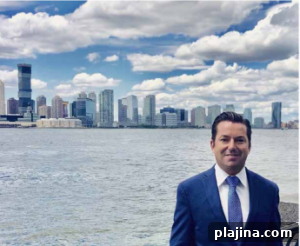
PHOTO: © THE BOYD COMPANY, INC.
CHECKING IN WITH JOHN BOYD, JR.
Principal, The Boyd Company, Inc.
For more than 50 years, your company has provided corporate site selection services to Fortune 500 companies like Boeing, HP, PepsiCo and Visa International. What makes Abu Dhabi such an attractive option for companies like these?
From our experience in the Gulf, Abu Dhabi ranks among the easiest, most business-friendly places to operate. It offers a safe, diverse environment, strong government support for diversification, and an increasing focus on innovation. The emirate’s stable finances and strategic policies make it attractive to multinational corporations.
How successful has Abu Dhabi been in moving away from its dependency on oil and gas?
Shifting an economy built on hydrocarbons is a long-term strategic endeavor. The UAE holds a significant share of global oil and gas reserves, so change is gradual. Nonetheless, Abu Dhabi has made deliberate progress by investing sovereign assets, developing policy frameworks that support innovation and digitalization, creating free zones, and preparing industrial sites for new investment.
Why are corporations choosing to locate in Abu Dhabi over Dubai?
Abu Dhabi is one of the world’s wealthiest capitals and serves as the nation’s political center. It offers a growing tourism sector, deep financial resources and a strong quality of life—factors that attract major consumer brands and global companies seeking a presence in the emirate.
DIVERSIONS
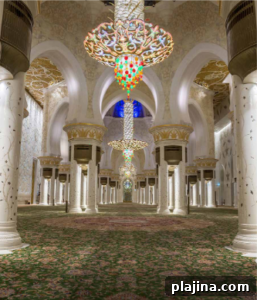
PHOTO: © DMITR86 | DREAMSTIME.COM
When you have downtime in Abu Dhabi, visit the city’s top attractions. Start at the Sheikh Zayed Grand Mosque, an architectural landmark inspired in part by classical designs and renowned for its marble finishes, 24-karat gold accents and one of the world’s largest hand-woven carpets.
Qasr Al Watan, the presidential palace, is open to the public and displays national artifacts and gifts. At Qasr Al Hosn visitors can learn about the nation’s history and take part in cultural experiences such as a traditional Arabic coffee ceremony.
The Louvre Abu Dhabi houses a significant collection of works from international museums and private collections, while Yas Island offers family attractions including Warner Bros. World, Yas Waterworld and Ferrari World.
Opened in 2021, the National Aquarium Abu Dhabi is the largest aquarium in the Middle East and features multiple themed zones. Animal-focused attractions also include the Abu Dhabi Falcon Hospital, which offers tours, and the Arabian Saluki Center, dedicated to the historic Bedouin hunting dog.
Outdoor and desert experiences are easily accessible from the city. Popular activities include 4×4 dune drives, camel treks, sandboarding, Bedouin-style camp dinners and wildlife tours that showcase the region’s natural environments.
LODGING
Emirates Palace
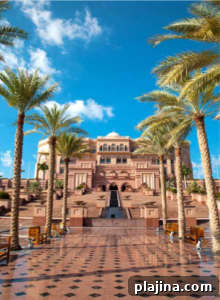
This opulent hotel features mother-of-pearl inlays, 22-karat gold leaf and Swarovski chandeliers across its iconic domes. The grounds include extensive gardens and a private beach.
West Corniche Road
$$$$$
Rixos Marina Abu Dhabi
Opened in 2022, this large hotel is noted for its striking architecture and panoramic sea views, with interiors influenced by Arabic and Turkish design traditions.
Marina City Ring Road
$$$
Shangri-La Residences
Serviced by the Shangri-La Hotel, these sea-facing residences range from studios to four-bedroom apartments and include kitchens plus access to the hotel’s fitness and pool facilities.
Khor Al Maqta, Qaryat al Beri
$$$$
DINING
COYA
COYA offers Peruvian-inspired cuisine with global influences, including ceviche prepared using techniques from Japanese, Chinese and Spanish traditions. A lively atmosphere often includes a resident DJ and creative cocktails.
Four Seasons Hotel, The Galleria, Abu Dhabi Global Market Street – Second
$$$$
Hakkasan Abu Dhabi
Located within Emirates Palace, Hakkasan serves elevated Chinese dishes such as dim sum and Peking duck, complemented by an international wine selection.
Emirates Palace, West Corniche Road
$$$$
Meylas
Meylas serves traditional Emirati cuisine prepared according to family recipes. The café is popular for breakfast, lunch and dinner.
Al Raha Beach – Al Muneera
$$
INFO TO GO
International flights arrive at Abu Dhabi International Airport, located about 19 miles east of the city center. Air-conditioned city buses connect terminals to select destinations for a small fare, and taxis are available with a modest base rate.
Etihad Airways, the UAE’s national carrier, provides complimentary chauffeur service for first- and business-class passengers and paid coach transfers for other travelers; these services should be booked at least 24 hours in advance.
JUST THE FACTS
Time zone: GMT +4
Phone code: Country code: 971
City code: 02
Currency: United Arab Emirates dirham
Key industries: Oil and gas, renewable energy, technology, financial services, manufacturing and tourism
OFFICIAL LANGUAGE
Arabic
COMING AND GOING
U.S. citizens need a passport valid for at least six months beyond the date of entry. A visa is not required for tourist stays of less than 30 days.