
Who doesn’t love a dinosaur? At select hotels across the United States, guests can experience life-size prehistoric displays and curated fossil exhibits that bring ancient history to life. These installations pair especially well with the renewed public interest in dinosaur-themed entertainment. For example, The Dino Hotel in Lakeland, near Denver, decorates its spaces with faux dinosaur bones and a range of Jurassic memorabilia. Miami Beach’s Faena Hotel features the Mammoth Garden, home to Damien Hirst’s monumental gold-plated woolly mammoth, “Gone But Not Forgotten.” At Montage Big Sky, visitors can participate in an interactive fossil dig as part of the resort experience.
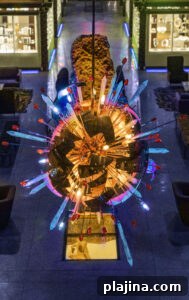
One of the most ambitious collections is at JW Marriott Plant Riverside District in Savannah, which functions as a museum-like showcase for artifacts collected by Richard Kessler, Chairman and CEO of Kessler. The lobby features striking specimens, including two massive citrine and amethyst slabs and a dramatic replica of a gigantic fossil that greets guests on arrival. To better understand the story behind the exhibit, we spoke with Kessler about the dinosaur and the broader vision for the property.
Global Traveler: Tell us about the dinosaur at Plant Riverside District in Savannah. What kind is it, and how old?
© Kessler
Richard Kessler: In 2016 we reached out to Dave Trexler, a paleontologist at the Two Medicine Dinosaur Center in Bynum, Montana, and commissioned what would become the world’s largest dinosaur replica. Trexler and his team had prior experience building skeletal models, but this project required extensive comparative research to be accurate at such a scale. The replica is based on fossilized bones discovered in Colorado in the 1870s and identified as Amphicoelias fragillimus. The chrome-finished sculpture represents this immense herbivore, known for its extremely long, slender body. The finished piece stands roughly 22 feet tall and measures about 135 feet in length. More than 230 bones were carved from foam, then coated in plaster, primed and finished with chrome paint—a process that took over two years to complete.
GT: Why showcase a dinosaur, along with other fossils and artifacts, in the lobby space?
Kessler: My fascination with nature, minerals and fossils began in childhood. I collected minerals and fossils for years, and when I first walked into the space that became Plant Riverside District, I envisioned a museum-like environment where those collections could be shared. The goal was to curate a setting that would both educate and captivate—something memorable that elevates the guest experience. A dinosaur was the natural centerpiece to achieve that sense of wonder and discovery.
GT: Has the dinosaur and the collection influenced guest traffic and engagement?
Kessler: Absolutely. The dinosaur has become the hallmark of Plant Riverside District—many people refer to us as the Dinosaur Hotel and visit specifically to see it. Staying at JW Marriott Plant Riverside District has a cinematic quality, reminiscent of films where history seems to come alive around you. Since opening in 2020, the presence of the exhibit has had a meaningful impact on bookings and overall revenue. We’ve also developed programming around the collection, including a fossil scavenger hunt for children and guided history tours for guests who want a deeper look into the specimens and the stories behind them. These activities enhance the guest experience and invite families and travelers to interact with natural history in an accessible, engaging way.
The Plant Riverside District demonstrates how a hospitality venue can blend luxury accommodations with educational, museum-quality displays. By presenting fossils, minerals and large-scale replicas in public spaces, the hotel creates a unique destination that appeals to families, history enthusiasts and travelers seeking something beyond the typical hotel stay. The collection not only enriches the property’s atmosphere but also sparks curiosity—encouraging guests to learn, explore and return.