
Half-timbered houses cluster around old churches with needle-thin spires. Grassy paths lead into dense pine forests, and jagged, sheer-sided mountains frame peaceful Alpine meadows. Welcome to the Dolomites — a UNESCO World Heritage region of 18 peaks rising above 10,000 feet in the northern Italian Alps.
In summer, high meadows are carpeted with wildflowers while cows with gentle faces and tinkling bells add a pastoral soundtrack. Warm weather draws hikers, climbers, cyclists (including electric bikes), hang gliders and abseilers from across the globe.
Alongside luxury chalet-style hotels and fine dining, the Dolomites offer many family-friendly and budget-conscious options compared with the glamorous ski resorts of the French, Swiss and Austrian Alps. Rifugi or hütte—charming mountain huts set in stunning locations—provide authentic, economical experiences. Many are accessible only on foot or by ski; some open seasonally while others welcome guests year-round for meals and overnight stays.
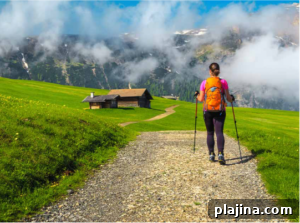
© JANOS GASPAR | DREAMSTIME
Hikers and mountain bikers should consider downloading the free maps.me app, which displays trails and footpaths and can be used offline once maps are downloaded. Tre Cime di Lavaredo (Three Peaks) offers one of the Dolomites’ most iconic hikes, with easy-to-moderate paths winding past massive sandstone monoliths and through lush valleys. The trek to Lago di Sorapis is more demanding: plan on about four hours roundtrip through meadows and pine woods, culminating in a technical section with metal stairs, ladders and cables along a narrow rock ledge before you reach the lake’s milky-blue glacial waters. For an easier outing, don’t miss the 20-minute circuit around Lago di Carezza, an emerald lake embraced by misty spruce forests and dramatic mountains—especially lovely at sunset.
Merano, a historic spa town and a favorite retreat of European royalty in the 19th century, has found new life through contemporary wellness culture. Terme Merano provides detox programs, thermal pools, a snow room and treatments that use local ingredients such as organic whey or fine marble sand. In Val Gardena, Adler Spa Resort Dolomiti features unique rituals like an organic hay sauna, blossom steam bath and even an underground salt lake. Modern spas blend cutting-edge therapies with time-honored remedies—hot soaks, vigorous massages and the restorative mountain air. Note that many saunas are mixed-gender and patrons may be nude or wrapped in towels.
History enthusiasts can explore World War I battlefields—trenches, tunnels, forts, bunkers, parapet walks and via ferratas—where Italian and Austro-Hungarian troops fought fierce battles in these steep cliffs. Figures such as Erwin Rommel served here as young officers. Small hillside military cemeteries, framed by low stone walls and overrun with grass and wildflowers, mark the resting places of fallen soldiers. Battlefield maps and guided tours are available for those who want to learn more about the region’s wartime past.
In winter the Dolomites transform into a skier’s paradise, with some of Europe’s longest continuous runs. The Dolomite Super Ski Pass grants access to the entire network—more than 740 miles of pistes and 450 lifts. Beginners can learn at the historic Cortina Ski School and book a Smart Ski Course to gain confidence, since almost half of Cortina d’Ampezzo’s slopes are suitable for novices. Mid-level skiers will enjoy Alta Badia with its winter hiking trails, cross-country tracks and over 80 miles of downhill runs. Val Gardena attracts powder hounds and heli-skiers. Advanced skiers can try carving, telemark, freestyle or off-piste adventures with an experienced mountain guide.
Snowshoeing opens fantastic winter hiking options—Cinque Torri in the Eastern Dolomites offers a moderate 4.5-mile circular route taking three to four hours. Other winter activities include sledding, tobogganing, fat-bike touring, snowmobiling and dogsledding.
For a combined skiing and culinary experience, try the Santa Croce Gourmet Ski Tour out of Alta Badia, where you can enjoy hut-to-hut dining without taking off your skis. Non-skiers can reach many mountaintop restaurants by cable car to savor local dishes and panoramic views. Sample regional specialties such as speckknödel (bacon-speckled dumplings in beef broth), kaspressknödel (cheese dumplings) and game dishes when available. For dessert, try strauben or the indulgent Kaiserschmarrn—shredded sweet pancakes with stewed berries, powdered sugar and whipped cream.
Après-ski scenes vary: Selva and Cortina attract lively crowds, while Livigno offers more than 150 bars. Don’t miss a bombardino, a warm winter drink of creamy egg liqueur mixed with brandy, topped with whipped cream and cinnamon—a rich, boozy comfort on cold evenings.
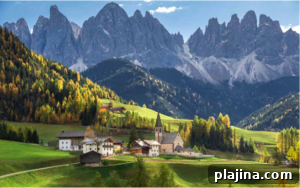
PHOTO: ©
TARAS DZOBA | DREAMSTIME.COM
Don’t miss picture-postcard spots such as the fairy-tale village of Santa Maddalena in Val di Funes, the rolling high meadows of Alpe di Siusi dotted with wooden farmhouses, the tiny whitewashed St. Johann in Ranui church set beneath towering peaks, and the dramatic Gardena Pass with its hairpin turns—stunning vistas that reward careful drivers and hikers alike.
LODGING
Forestis Dolomites
Nestled among dense forest and snow-dusted peaks, this retreat features minimalist interiors with floor-to-ceiling windows, indoor and outdoor fireplaces, nature-based wellness programs, farm-fresh dinners and beverages infused with local herbs and berries.
Palmschoss 22, Bressanone
$$$$$
Hotel & Spa Rosa Alpina
A family-owned, longstanding resort known for gracious hospitality, antique accents, frescoed walls, a family pool and roaring winter fires. Luxurious yet welcoming, it blends tradition with comfort.
Strada Micurà de Rü 20, San Cassiano
$$$$$
Hotel Miramonti
An elegant but unpretentious mountain hideaway ideal for couples and families. Warm woods, contemporary furnishings, a glass-enclosed restaurant with sweeping views, a Finnish sauna and onsen, plus a Land Rover shuttle to the slopes.
Via San Caterina 14, Avelengo, Merano, South Tyrol
$$$$
DINING
AlpiNN
A dramatic glass cantilever overlooking the landscape, attached to the Lumen Museum of Mountain Photography. Reserve a window table and enjoy a hyper-seasonal, locally focused multi-course menu. Reachable by cable car.
Plan de Corones 11, Brunico
$$$$$
The Restaurant St. Hubertus
A 10-table, three-Michelin-star restaurant led by chef Norbert Niederkofler, following a no-waste, mountain-focused philosophy with seasonal local ingredients and an excellent South Tyrolean wine list.
Hotel Rosa Alpina, Strada Micurà de Rü 20, San Cassiano
$$$$$
Rifugio Ütia de Bioch
A family-run slope-side restaurant at the top of the Bioch chairlift with a cozy wood interior and Tyrolean decor. Traditional offerings include polenta with wild mushrooms and warm apple strudel, paired with local wines.
Piz Sorega – Loc. Bioch, Badi
$$
INFO TO GO
Driving from Austria, Germany or Switzerland typically takes four to six hours depending on traffic and weather. Venice Marco Polo Airport is a major international gateway; from there, it’s roughly a 2.5-hour drive to Bolzano or two hours to Cortina d’Ampezzo. Road signage is in Italian and German; English is commonly spoken in tourist areas. Major credit cards are widely accepted, but carry euros for smaller restaurants and some rifugi. Several specialist tour operators offer guided itineraries, private guides and tailored experiences for hiking, history, cooking and spa-focused stays.