
As our pontoon boat bobbed on the icy waters of Alaska’s Inside Passage, a dozen of us sat bundled in cold-water suits and lifejackets. Our patience paid off when the underwater microphone suspended beneath the boat picked up the soft swish of bubbles and the excited chattering of humpback whales. At first they sounded like children at play, but we knew the whales below were focused on one thing: feeding.
Suddenly the hydrophone went quiet, then a single whale began an ululating solo that swelled to a stirring crescendo. When his song faded, we watched the water intently. Without warning, a pod of eight massive whales surged upward in a thunderous display, mouths agape as they scooped thousands of herring into their expanding throats before disappearing beneath the surface.
The boat rocked as camera shutters fell silent and our own voices rose in excited chatter. We settled into quiet observation, scanning for shiny backs breaking the surface and the flash of white flukes as whales dove. The behavior we witnessed—sounding followed by bubble-net feeding—is a signature humpback tactic. Lead whales sing and dive to corral schools of herring with walls of bubbles, forcing the fish skyward so the group can gulp down enormous quantities of prey. An individual humpback can consume as much as a ton of herring in a day.
Time and again, the lead whale’s entrancing solo—our group jokingly nicknamed him Pavarotti—preceded explosive feeding events. We watched pleated throats expand as whales engulfed thousands of gallons of water and fish. The animals came so close we could smell the briny breath from their blowholes. Spellbound, we lingered until the cold and our growling stomachs led us back to the comforts of the Safari Explorer.
Seeing whales breach and bubble-net within yards of our skiffs was only one highlight of the eight-day cruise through Alaska’s coastal wilderness. Most vessels receive less than a day in Glacier Bay National Park, part of a 25-million-acre World Heritage site and one of the world’s largest protected wildlife areas. The Explorer holds a two-day permit, allowing overnight stays inside the park and visits to quieter reaches of the bay. From there we explored Frederick Sound, Windham Bay and Endicott Arm. The 145-foot yacht anchored in secluded coves at night and cruised during the day to maximize wildlife viewing and scenery.
A harbor seal and pup © Donelle Oxley
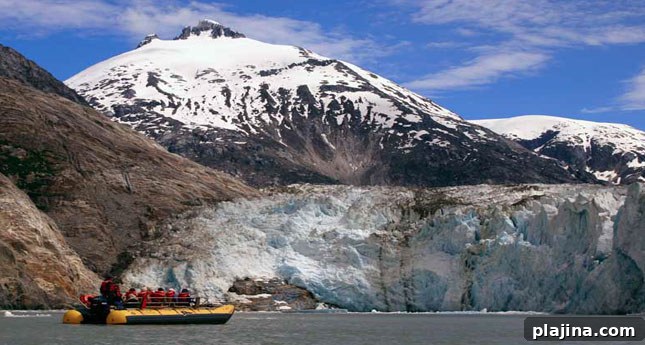
After departing Juneau, the steel-hulled Explorer pushed through fields of icebergs. Ice floes hosted mother seals and their pups, their pale faces and wide eyes watching us drift by. In the upper reaches of Glacier Bay, immense glaciers—blue-tinged walls of ice hundreds of feet high—loomed over the ship, stretching to the horizon.
We often launched kayaks to explore closer, navigating among floating ice and watching house-sized blocks calve from glacier faces. One unforgettable moment came at Dawes Glacier. Drifting in respectful silence, we listened to trapped air popping free from melting ice around us. Then a thunderous roar announced a massive icefall as a sheet of glacier plunged 200 feet to the water, sending ripples across the bay. I scooped a few pieces of glacial ice to the kayak—occasionally my drink contained ice older than the country itself.
Wildlife encounters were daily and varied. Curious sea lions surfaced within arm’s reach of our skiffs and kayaks; tufted puffins and other seabirds dashed after a raven; cormorants dove for fish; mountain goats negotiated sheer cliffs with effortless agility; and bald eagles swooped to seize salmon from the surface. Occasionally we glimpsed black and brown bears feeding along the shoreline.
Each day’s scenery rivaled the last: deep-green conifer-clad slopes against snow-capped peaks; sheer cliffs in earthy tones rising straight from the water; waterfalls tracing timeworn grooves down rock faces; and veils of fog around tiny, tree-twisted islets. We went ashore for hikes through pristine woods and temperate rainforests, and climbed vantage points to watch goats and eagles and look down on the ship.
We rarely saw other vessels or signs of human development, enjoying a rare combination of luxury and remote wilderness. That contrast was striking when we walked the streets of Petersburg while the ship took on fresh seafood and water.
That evening we feasted on a king salmon caught that morning, one of many gorgeously prepared meals served aboard the Explorer. The ship’s chef offered daily seafood entrees alongside meat options such as pork loin, leg of lamb and steak. The dining schedule was flexible—wildlife sightings and activities could delay meals, and the crew cheerfully accommodated those adjustments.
All too soon we shared our final dinner—filet mignon and Alaskan king crab legs—and prepared to disembark in Juneau after breakfast the following morning.
If you can, allow extra time to explore Juneau before or after your cruise. The lively former pioneer town features attractions such as the Alaska State Museum with extensive artifacts and natural history exhibits; an underground tour of the AJ Gold Mine; zipline adventures above the rainforest; the Mount Roberts Tramway, which rises 1,800 feet above the city; and the Macaulay Salmon Hatchery. One memorable excursion is a Bike and Brew tour that rides to Auke Lake and the Mendenhall Glacier and concludes with tastings of Alaska microbrews in a historic seaplane hangar. Other options include fishing trips, bear-viewing tours to Admiralty Island, helicopter flights to dogsled on glacial ice fields and floatplane sightseeing. As a frequent port for large cruise ships, Juneau also offers a wide range of shops and restaurants.
Our group aboard the Safari Explorer included 34 shipmates ranging in age from 11 to 80, most in their 50s and 60s. Like us, they appreciated the mix of adventure and comfort. The ship’s crew of 18 and two onboard naturalists provided briefings and guided outings in each region we visited.
The 145-foot Safari Explorer features 18 staterooms with large windows or sliding glass doors, DVD players and private baths with heated tile floors. Shared spaces include a window-lined dining room; a library; a lounge with a large-screen TV for films and naturalist presentations; an open bar stocked with premium liquors and wines; and a sun deck with a sauna, hot tub and exercise equipment. The ship’s spacious, glass-fronted bridge was open to passengers throughout the voyage.
Alaska Info to Go
Juneau is the only U.S. state capital reachable only by boat or plane. Alaska Airlines offers daily nonstop flights from Seattle and Anchorage to Juneau International Airport (JNU). Transfers from the airport to the city dock are available by taxi, rental car, public bus or limo; many hotels offer airport shuttles. The Safari Explorer is part of a fleet of yachts and small ships that operate seasonal cruises in Alaska, typically sailing May through September. Itineraries vary in length and price and often include shore excursions, onboard meals and beverages, and a range of guided activities designed to showcase the region’s wildlife and scenery.