
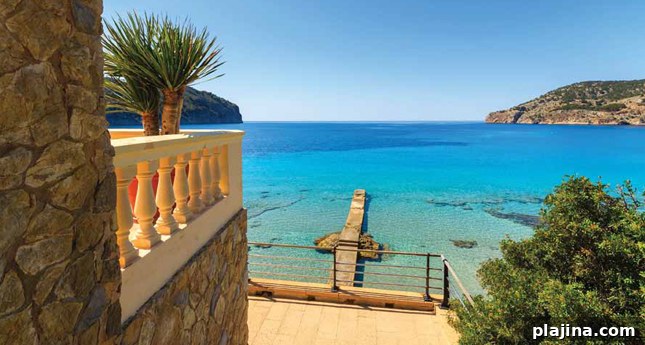
There’s something special about an island — more than just its separation from the mainland by water. It represents a distinct way of life and a mindset that captures the imagination. Even when Mallorca’s beaches resemble those of Spain’s Costa del Sol, they feel like another world.
Mallorca, together with the smaller islands of Menorca, Ibiza and Formentera and numerous islets about 60 miles off Spain’s Mediterranean coast, forms the Balearic archipelago. The islands are famed for their beaches — Mallorca alone has more than 200 — and for an effortless mix of family resorts, luxury retreats and private villas, all underscored by a relaxed holiday atmosphere.
Not every beach is crowded or lined with rows of sunbeds, which distinguishes Mallorca from the busier Costa del Sol. Drive a few miles southeast from Palma and you’ll find Es Trenc, more than a mile of dune-backed golden sand and clear water. Nearby on the southeast coast, Cala Barca faces a bay beside Mondragó Natural Park and is a popular spot for diving and snorkeling.
Under the pine-forested slopes of Llevant Natural Park lies Cala Agulla, a blue-flag beach known for its clean water and protected setting. Blue-flag status also applies to Cala Formentor at the island’s northern tip. On the southern tip of Mallorca, a 30-minute walk from Colònia Sant Jordi leads to Cala Es Carbó, a long white strand tucked into a protected bay and often nearly deserted. Near Manacor, Cala Varques ranks among the island’s most beautiful beaches: white sands and crystalline water backed by cliffs, reached by a scenic path through woods.
Mallorca offers much beyond sandy shores for travelers seeking fresh air and activity. Some trails lead into the island’s rich cultural past — hilltop castles and prehistoric sites — while others climb mountains and explore nature reserves, making Mallorca ideal for active travelers.
Birdwatchers and nature lovers head to Mondragó Natural Park, where rivers run from orchid-draped forests through dunes to the sea. Trails and cycling paths in the park can reveal as many as 70 bird species. In late January and early February, blossoming almond trees paint the landscape in pink and white.
Street in Valldemossa village © Veronika Galkina | Dreamstime.com
At 3,500 feet, El Teix is considered an enchanted mountain. The climb to its summit along one of Mallorca’s most spectacular trails is a memorable experience. The stone path from Valldemossa passes the remains of old charcoal burners and several viewpoints as it winds through oak forests and runs along a cliff with coastal vistas. From the summit you can see across the Tramuntana range, the north coast and the Bay of Palma. Another scenic Tramuntana route climbs Barranc de Biniaraix, a four-hour walk on ancient stone paths through olive groves and along streams in a protected reserve.
A popular cycling route runs from the postcard village of Fornalutx, set in a dramatic valley in the Serra de Tramuntana, through orange groves and terraced mountains to Biniaraix in the Sóller Valley — a village known for its ravines and stony landscapes.
For dramatic coastal views, follow the road west from Palma through the steep terraces of Banyalbufar toward Andratx. A striking drive leads to Cape Formentor on the island’s northeastern tip, where caves are carved into cliffs high above the sea. Port d’Alcúdia, one of more than 40 marinas around the island, offers fishing excursions, yacht charters and ferries to Menorca. Porto Adriano and other upscale marinas attract visitors seeking luxury berths and services.
Cape Formentor © Veronika Galkina | Dreamstime.com
Golfers will find plenty to enjoy on Mallorca. The Real Federación Española de Golf lists 18 affiliated clubs on the island, and top-class courses like Son Gual are ranked among Europe’s best. Near Palma, the championship Puntiró Golf Park, designed by Jack Nicklaus, sits alongside other challenging 18-hole courses such as Son Muntaner and Son Termens. Son Termens is quieter than many island courses but presents a demanding layout with water hazards and natural obstacles. In the northeast, Pula Golf Club hosts European Tour events.
Mallorca’s location along ancient trade routes shaped a complex history: pirates, Romans, Vandals, Moors and later Spanish rulers all left their mark. The island preserves remains from each era — prehistoric settlements, a Roman town, Moorish baths and gardens, and medieval castles and watchtowers. These sites are often set in attractive countryside, linked by walking and climbing trails, and many serve as outstanding viewpoints.
A scenic two-hour walk through pine forest takes you to the Tower of Cala en Basset near Sant Elm, a convenient starting point for coastal walks. This 16th-century tower was part of a coastal defense network built to warn and protect towns from pirate raids. Accessible by car are other towers and castles, including Capdepera Castle from the 14th century, which crowns a hill with views over the channel toward Menorca. The Canyamel Tower also offers sweeping bay views and stands among the island’s most notable defensive structures.
The prehistoric village of Ses Païsses, centered around a circular talayot — a defensive stone tower more than 3,000 years old — preserves walls and other structures. The Son Fornés archaeological site dates back to at least the 6th century B.C. and features the island’s largest preserved talayot, 55 feet across, with a museum displaying artifacts from excavations. The Roman town of Pollentia reveals the islands’ Roman past through sections of wall, mansion ruins, an arcaded street and part of a first-century Roman theater.
Courtyard of Palau March Museum with the Henry Moore sculpture Three-Way Piece and view of the Almudaina Palace towers © Artesiawells | Dreamstime.com
Alaró Castle, reached by a stone footpath, traces its origins to the Moorish period, as does Palma’s Almudaina Royal Palace. After the Spanish reconquest in the 1300s, the palace became a royal residence and later a museum; the king of Spain still uses it during the summer months. On Calle Can Serra you can visit 11th-century Arab baths, one of the island’s few surviving examples of Islamic architecture. Many traces of Mallorca’s Arab past remain in Palma’s medina — fountains, rounded arches and winding streets. In the valley below the Coll de Sóller pass, the gardens of the Alfàbia estate offer a glimpse of Moorish landscape design that dates to the 13th century.
With mountain trails and nature reserves blending seamlessly with prehistoric sites, hilltop castles, beaches, golf courses and luxury resorts, Mallorca offers a wide variety of experiences. It’s easy to add a few extra days to your itinerary and find reasons to stay longer.
Mallorca Info to Go
Major carriers offer frequent connections to Palma de Mallorca (PMI) via Madrid or Barcelona from several international gateways. Palma’s airport links to the city center by bus (Line 1) and to many beach hotels (Line 21). Car hire is available at the airport and many hotels; some companies also deliver vehicles to accommodations. To get an overview of Palma, consider a 24-hour hop-on/hop-off sightseeing bus ticket.