
It doesn’t matter whether you wake on the 87th floor of Shanghai’s Jin Mao Tower or under yak-wool blankets in remote Xinjiang: wherever you start the day in China, you’re on Beijing Time.
From the construction of the Forbidden City centuries ago to the modern decision to maintain a single time zone across all provinces, the capital has long asserted itself as the center of China’s political and cultural life.
In the last decade, Beijing’s profile has risen even further. The 2008 Olympic Games showcased the city’s financial muscle and national pride to a global audience, while sustained GDP growth—often exceeding 10 percent in recent years—has drawn attention amid global economic uncertainty.
Strategically located on the edge of the North China Plain (Beijing means “Northern Capital”), the metropolis of more than 10 million people transitioned into a post-industrial economy in the late 1990s. Today it hosts 26 Fortune Global 500 companies, ranking third worldwide after Tokyo and Paris.
Beijing is no stranger to reinvention. Since becoming the capital in the 13th century under Mongol rule, the city has been reshaped repeatedly—shifting roles from imperial center to republican hub and then to the seat of the People’s Republic.
Few transformations matched the rapid redevelopment that followed the successful Olympic bid. The municipal government invested heavily—more than $40 billion—on infrastructure and urban renewal. Entire neighborhoods gave way to towering new buildings designed by leading international firms, and the real estate, tourism and financial sectors experienced explosive growth.
Nowhere is that change more visible than in the Central Business District (CBD). Conceived to improve conditions for both foreign and domestic companies, the 1.5-square-mile district accelerated rapidly over the past decade. It now hosts the majority of overseas-funded firms, most foreign press offices and many embassies.
Growth continued through landmark projects: Skidmore, Owings & Merrill completed China World Trade Center III in 2009, becoming Beijing’s tallest building, and China Central Television unveiled its striking headquarters—nicknamed “Big Pants”—the same year. The CBD has also become a media hub and regular destination for international conferences and business festivals.
Beijing Financial Street—a larger 35-block area—has emerged as a center for domestic and international finance. It houses institutions such as the People’s Bank of China alongside major foreign banks and asset managers. Containing a large share of the country’s financial assets and surrounded by luxury hotels, upscale residences and retail, Financial Street is positioning itself as a serious rival to Shanghai as China’s financial core.
Economic success has produced mixed results for residents. Policies that kept the renminbi undervalued boosted exports but contributed to inflation and rising living costs. In response to public concern, national leaders have signaled a gradual appreciation of the currency and announced plans to shift priorities from sheer GDP growth toward improving quality of life.
Local officials have promised measures to ease housing pressure, including building substantial numbers of affordable units. Beijing’s mayor pledged to curb runaway housing prices and expand low-income housing supply as part of broader efforts to stabilize urban life.
Household incomes and consumer activity are rising. Beijing’s GDP per capita surpassed $10,000 in 2009, and China as a whole became a major market for luxury goods. To manage vehicle growth, the city dramatically reduced new license plates issued this year, reflecting a population increasingly able to afford cars.
On weekends, thousands of residents flock to stores like IKEA—not just to shop but to imagine a comfortable middle-class lifestyle, trying out beds and sofas as they plan for the future. For now, they live at the center of a changing nation.
Info to Go
Beijing Capital International Airport (PEK), one of the world’s busiest, is roughly 16 miles from central Beijing. The Airport Line subway takes about 20 minutes to reach Dongzhimen Station on the Second Ring Road. Taxis into the city typically take 30 minutes to an hour. The airport shuttle bus serves multiple routes into the city. A high-speed rail line between Beijing and Shanghai is scheduled to open this month.
Just the Facts
Time Zone: GMT +8
Phone Code: 86 China, 10 Beijing
Currency: Renminbi yuan (RMB)
Entry/Exit Requirements: U.S. citizens need a valid passport and a visa to enter China; obtain tourist or business visas before departure.
Official Language: Mandarin (English is commonly spoken in business districts.)
Key Industries: Finance, tourism, real estate, automobiles, chemicals, electronics, machinery, retail, household appliances.
Diversions
The Forbidden City, the largest and best-preserved traditional wooden complex in China, sits north of Tiananmen Square and offers a sweeping introduction to the city’s imperial past. Built in the 15th century, the complex served as home to Ming and Qing dynasties and contains thousands of rooms to explore.
At the southern entrance of the imperial compound, the Gate of Heavenly Peace overlooks Tiananmen Square, where Mao Zedong’s portrait still watches over China’s central plaza. Early risers can watch the flag-raising ceremony performed by the People’s Liberation Army and visit Chairman Mao’s Mausoleum for a solemn, if eerie, experience.
Exploring Beijing by bicycle remains one of the most charming ways to experience the city. Hotels commonly rent bikes by the hour or day, allowing visitors to weave through disappearing hutong alleys and pedal along the scenic Back Lakes. The northern lake area, Qianhai, hosts a lively cluster of cafés, bars and artist stalls, and the nearby Drum Tower offers panoramic views over traditional neighborhoods.
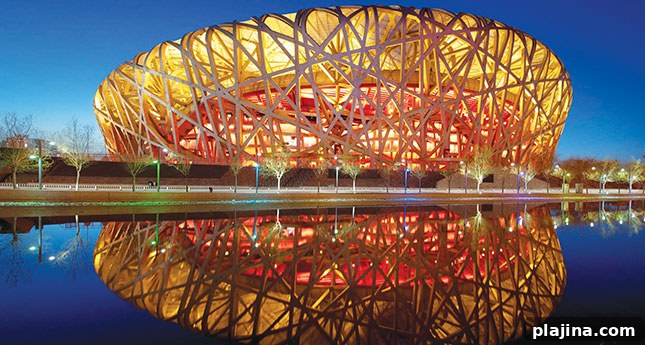
Modern architecture and Olympic landmarks are key attractions: the “Bird’s Nest” stadium and the Water Cube on the Olympic Green contrast strikingly with the Temple of Heaven, a masterpiece of Ming-era design and a serene park in the city’s south.
Further northwest, the Summer Palace rewards an afternoon of wandering through royal gardens, lakes and pavilions. And no trip to Beijing is complete without visiting the Great Wall: sections such as Badaling, Simatai and Jinshanling—each offering different levels of restoration and challenge—are reachable within a couple of hours.
Lodging
Aman Beijing
Set within an imperial garden near the Summer Palace, Aman provides an intimate, luxurious urban retreat. 1 Gongmenqian St., tel 86 10 5987 9999
Grand Hyatt Beijing
A long-standing favorite for business travelers, the Grand Hyatt combines strong service with a prime location near the Forbidden City. 1 E. Chang An Ave., tel 86 10 8518 1234
The Opposite House
Designed by Kengo Kuma, this minimalist boutique hotel features contemporary art and stylish rooms in Sanlitun’s vibrant district. The Village, Building 1, 11 Sanlitun Road, Chaoyang District, tel 86 10 6417 6688
Dining
Beijing Da Dong Kaoya Dian
Chef Dong’s Peking duck is celebrated for its delicate skin and thoughtful accompaniments, blending traditional and inventive flavors. 1-2/F Nanxincang International Plaza, Chaoyang District, tel 86 10 5169 0329
Ding Ding Xiang
A popular hot pot spot where diners enjoy individual boiling pots and a distinctive dipping sauce. Opposite Donghuan Guangchang, Chaoyang District, tel 86 10 6417 2546
Maison Boulud
Chef Daniel Boulud offers refined French cuisine in the former American embassy’s elegant setting. Qianmen Dong Da Jie 23, Beijing City Center, tel 86 10 6559 9200
Checking In with Lee Mack
Managing Editor, Beijing City Weekend
Which Beijing spots are essential for business travelers? Sanlitun’s Mosto remains a top pick for upscale casual dining. Maison Boulud leads the high end, with Capital M close behind. For beer lovers, Great Leap Brewery offers quality craft brews in a restored courtyard, while Contempio—set inside a renovated temple—provides an atmospheric spot for cocktails and wine.
For a less touristy stroll than Nanluoguxiang, try Wudaoying Hutong near the Lama Temple. It blends history with boutiques, restaurants, bars and even a jazz club.
What industries are strongest in Beijing now? The digital sector dominates: online and mobile products—games, apps and e-commerce—are booming. Many Western online game companies operate in Beijing, producing titles for social media and mobile platforms. E-commerce continues to expand rapidly, driven by platforms that make delivery inexpensive and convenient. Traditional businesses, including bakeries and wine retailers, are increasingly integrating online sales and delivery into their models.