
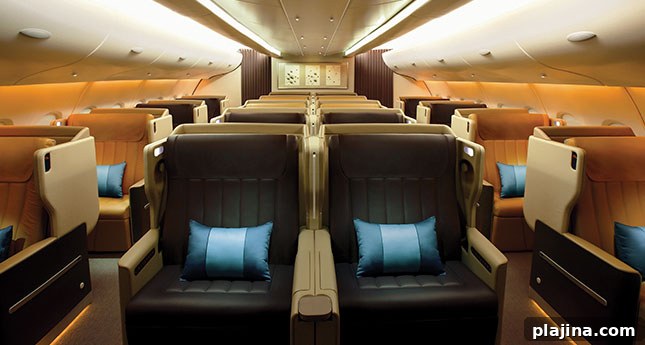
Hurry and reserve a seat in your preferred airline’s first- or business-class cabin. After a turbulent 2009, travelers are quickly returning to the front of the plane. Airlines are seeing premium cabins fill again as passengers expect the high-caliber products and services they once enjoyed.
At Global Traveler, we aim to simplify your first- and business-class choices. Whether you continued flying up front through the downturn or are just returning, we — like our readers — are eager to learn what’s new in premium travel. Browse the following pages to find out.
For the seventh consecutive year, Global Traveler presents our annual first- and business-class survey. After months of compilation, we produced the charts you will find on the next 15 pages. Those charts cover all airlines operating flights between U.S. destinations and other cities, domestic and international. The information includes cabin configuration, entertainment offerings, amenities, and seat width, pitch and recline.
New and Improved
Several carriers responded to the return of business travelers by revamping and upgrading their premium products in 2010.
In Asia, two launches stand out. Asiana introduced the OZ Quadra Smartium, marketed as a “luxury business class.” The name combines the airline’s code (OZ) with “quadrant,” reflecting the seat’s four key features, and the hybrid “Smartium,” implying smart design and place. The product delivers on its promise with a fully flat bed 74.5 inches long; strong privacy and dedicated storage; direct aisle access from every seat; and a staggered layout achieved by removing eight seats from the previous business-class cabin.
All Nippon Airways debuted Inspiration of Japan on the New York (JFK)–Tokyo (NRT) route, a comprehensive redesign of first and business classes that blends innovation with modern Japanese service philosophy, omotenashi — anticipating passengers’ needs. ANA introduced ANA Business Staggered and ANA First Square. Business Staggered ensures aisle access from every seat, a staggered layout with about 50 percent more space, a wide sliding table, ample storage and a class-leading 17-inch LCD screen. ANA First Square creates a suite-like environment with high-panel walls and abundant compartments for clothing, baggage and personal items.
In Europe, Alitalia’s Magnifica offers a fully redesigned business-class cabin in a 1-2-1 layout suitable for solo travelers or pairs. The seat features a 15.4-inch private video screen with a privacy device that restricts viewing to the designated passenger, more than 40 films, 12 audio channels, noise-reduction headphones, and regional Italian cuisine. Cabin lighting adapts to the stage of the journey to promote restful sleep, and a landscape camera provides live external views.
Iberia refreshed Business Plus by removing a row of seats to increase space between rows by nearly 12 inches, enabling the installation of fully flat seats on its A340 fleet serving Spain–U.S., Latin America and South Africa routes. Iberia plans further long-haul cabin upgrades in 2012.
United Airlines rolled out updates to its Boeing 777s on selected transatlantic and domestic routes. Business-class seats now recline to a full 180 degrees and include 15.4-inch personal monitors with over 150 hours of programming. The cabin mixes forward- and rear-facing seats to improve aisle access, privacy and comfort, and offers adjustable armrests and seat widths. United First Suite is a fully flat bed extending 6 feet 6 inches by 23.5 inches, with generous storage and an in-suite coat hook. Menus were developed by Chef Charlie Trotter and wines curated by Doug Frost, who holds both Master Sommelier and Master of Wine titles.
The Great Recline Debate
Survey responses often raise questions, particularly about the relationship between seat pitch and recline. Over the years we have defined these terms consistently and adjust recline entries to match our definitions.
Pitch is the distance from the back of your headrest to the back of the headrest in front of you when seats are fully upright. Pitch determines how much room passengers have both sitting upright and when reclining. Based on the average adult male height of 5 feet 9 inches, a seat pitch of 70 inches or greater is required for a true 180-degree lie-flat bed. For genuine lie-flat business-class service, consider carriers such as OpenSkies (BIZ BED cabin), Virgin Atlantic, Air New Zealand, Korean Air or Qantas.
Some airlines describe seats as “angled lie-flat.” Because we require a numeric degree measurement for recline, we estimated degrees where airlines used that description. “Angled lie-flat” often means the seat does not lie completely horizontal when fully reclined; it tilts, which can cause passengers to slide toward the foot of the seat. SeatGuru defines angled lie-flat seats as slightly angled when fully reclined: comfortable for relaxing and working, but not ideal for sleeping.
Consumers seeking true lie-flat seats should be cautious of angled lie-flat marketing. In our charts, airlines listed as offering 180 degrees of recline provide true lie-flat beds according to our definitions.
There are exceptions. Some innovative cabin layouts deliver true lie-flat beds with less than a 70-inch pitch. Herringbone configurations used by Air Canada, Delta Air Lines and Cathay Pacific angle seats outward, creating suite-like space and allowing full 180-degree recline even when head-to-head pitch measures under 70 inches.
ANA’s Business Staggered is another example. Each seat has a large side table alternately positioned left and right. A passenger’s feet extend under the space in front, beneath the neighboring side table, producing a fully flat bed with a 44-inch pitch. Swiss International Air Lines uses a similar staggered layout.
Singapore Airlines achieves a fully flat 76-inch bed with seat pitches of 51 to 58 inches by using a wide-seat concept that accommodates the body’s shape, compartmentalizing head and feet areas so the bed aligns comfortably when extended.
And All the Rest That’s Fit to Print
Not all details fall neatly into chart categories. To keep our charts concise, accurate and easy to read, we standardize the information provided. That sometimes requires deducing, estimating or translating airline responses to fit our format.
The entertainment section is one area with significant variation. Airlines report entertainment in different ways — hours of programming, number of channels, CDs, MP3 libraries — so we note those differences in the charts where necessary.
“Number of Other Video Programs” in the charts includes games, TV shows, children’s content, and audio books, among other items. We also observed a change in how airlines present news: instead of multiple dedicated news channels, many now offer live satellite updates, scrolling headlines or intermittent bulletins. Examples include British Airways (daily BBC News updates), Emirates (satellite headline updates), EVA Air (24-hour internet news), Jet Airways (live text news updated hourly) and Qantas (an international news bulletin by Channel Nine News).
The “WiFi on Board” column mainly applies to domestic carriers, but international airlines often provide alternative connectivity like SMS, text messaging or seat-based satellite services. An “N” in that column does not mean every connectivity option is absent—it only indicates no WiFi was reported. For example, Finnair allows SMS and email via a satellite phone at each seat, even if full internet access is not available.
Choosing an airline involves many considerations — service reputation, fare, routing and onboard experience. We hope this survey helps make that decision easier. Whichever carrier you choose, enjoy your next first- or business-class journey.
The Method
To compile the most current and comprehensive information on first- and business-class cabins, Global Traveler spent months contacting airlines and gathering data.
When airlines did not respond, we performed independent research using airline websites and reputable resources. Entries completed through our research are clearly marked, and data labeled “EST” in the charts indicates an estimate. In some cases airlines provided information in formats different from our standard, so we interpreted responses to fit the chart layout.